When I got back into gaming a few years ago, the thing that struck me as strangest about contemporary RPGs was the assumption that you play D&D
with miniatures and a grid.
We never did that when I was a kid. Yes, we sometimes had miniatures on the table, but they were used for convenience (marching order, formations in combat and various tactical situations) and were mostly ignored altogether. We almost never used any scenery that wasn't improvised on the spot ("This d4 is the pillar with the prisoner chained to it"), and we certainly didn't use a grid. The occasional book with pictures of Chessex mapping paper pointed to some absurd platonic ideal.
I can think of a single Dragon Warriors one-off that I ran that used entirely painted miniatures with a tower and floorplans (the tower was from the Citadel mighty fortress, with old Citadel dungeon floorplans representing each level and the cellar). But that was a late-stage exception.
And I think I can safely say that none of us every paid the slightest heed to the movement stats in whichever game we were playing (RuneQuest, AD&D, Dragon Warriors, Call of Cthulhu, whatever). We assumed humans could outrun things that were more sluggish, and we assumed that fast things (e.g orcs - I tended to enforce a certain Tolkien purism on this) would catch you sooner or later.
Since resuming RPGs with kids, family and old friends, though, I've used miniatures about half the time. Holiday games are always 'theatre of the mind' - a term that we never used as kids, because it was the default. So too have been the classic Dragon Warriors scenarios and Dungeon World homebrew games we've run through. One-off dungeon-crawls for lots of kids are done with miniatures and commercially produced tiles, however, and our Whitehack campaigns this year and last have used miniatures (15mm last year, 28mm this). The one-offs I've run for my old gaming friends have been a bit of both (miniatures for Tales of Blades and Heroes, which requires them; theatre of the mind for Heroquest Glorantha and Dungeon World; and miniatures again for Whitehack).
I added some thoughts on the use of miniatures on
noism's blog last year, when I was generally veering away from their use:
I increasingly think that they're a constraining factor in all kinds of ways: cramping scales by limiting things to the size of the tabletop; limiting the GM's imagination to the available models (even if subliminally and irrationally); and entailing a huge amount of NPCs and stuff (e.g. for a fight in a crowded marketplace).
Noism's comment that miniatures are a "straightjacket for the imagination" was exactly how I felt.
But since then, I've grown a bit fonder of their use. There are lots of problems, of course.
First, miniatures cramp scales by limiting encounter spaces to the available tabletop. It would be hard to do Tolkien’s Moria, with its vast chambers and 50-foot chasms, on the average dinner table – let alone a city square, a castle courtyard or a section of steppe. To do such things in 28mm scale, you need a lot of space.
Miniatures also have a pernicious tendency to limit the GM’s imagination. If you have an owlbear model, you’ll probably use it in your game. But if you’re using miniatures yet lack a scorpion man, you’re unlikely to write one in. Owning only 10 hobgoblin models militates against the inclusion of 50 in a subterranean barracks – limiting the range of challenges for high-level PCs. Most of my childhood games featured orcs, for the simple reason that I had lots of them. I still do, and they’ve been overrepresented in recent games for that reason.
You can (and should!) fight that tendency, of course. But then there’s the problem of identification. Yes, the players know that the owlbear is actually a scorpion man. But it still looks awfully like an owlbear. Nicely painted goblins might not convince as gnolls – and they certainly won’t do as the town guard. The potential for confusion grows when you field a combination of proxies: “This werewolf’s the black knight – and that ogre’s actually the wizard’s henchman”.
It’s also hard to escape the thought if you’re going to use miniatures, you should do it properly – not only by having appropriate figures for PCs, NPCs and monsters, but also by having them all painted. That’s a huge amount of time on top of writing and running the games themselves.
Finally, miniatures make every encounter look like a fight. Cerebral challenges become physical. Place an ogre miniature outside the stronghold gate, and players will want to kill him. Thoughts of sneaking past, distracting or persuading will dwindle or vanish.
And yet ...
The greatest excitement I've ever generated at the table was with this:
The coiled section, to the left, was the floor of an entire room; the PCs stumbled into it after spending miles in a huge earth tunnel. There was a gallery above it, which some of them had climbed onto before one of them decided to fire an ancient energy weapon into the slowly pulsating rubbery mass over which they were clambering - at which point, the room was replaced by a pit of loose earth and the rearing worm was placed on the table. We were using 15mm miniatures, so my home-made purple worm was fairly sizeable. The shrieking took some time to subside.
My son drew this on his character sheet after the session:
Now, you can get similar effects through description alone. But the sheer fun of that encounter would be hard to replicate without props (the closest I've come in 'theatre of the mind' was in a Dungeon World game in which the players realised that the bone-walled 'dungeon' they were exploring was actually the skeleton of a vast landwhale - and the reason the walls were shaking was because a lich was in the process of reanimating it.
And miniatures do help when kids are involved and when there are lots of players of whatever age. The physical constraints of models and maps can be limiting, but they can also stimulate the imagination - especially if you make a conscious effort to escape from two dimensions. The purple worm was a one-off, but the best reusable dungeon room I've created is the 'pudding gallery' in my Devil-Warrens megadungeon. This is a gallery on the first level of the dungeon that opens onto the second level below.
The first level is patrolled by kobolds, who guard themselves with a variety of traps. A clue for the players - which none have yet picked up on - is that one section of the gallery has collapsed; the opposite section turns into a sliding ramp when the kobolds pull a lever; the collapsed bit is the remains of an identical trap. And so some of the players end up being plunged into the second level; the room below the gallery has three slow-moving but deadly black puddings.
 |
| Above ... |
I've run this room three or four times, for both kid and adult players (one party found the remains of the other), and it's worked well each time. But it would be much harder to make work in 'theatre of the mind', because visualising it is a little hard, and the intricacy of movement - on the gallery, over the trapped sections, in the room below - is hard to keep track of otherwise. The first time I used it, I placed the level-two floorplan the wrong way round; none of the players realised that the rubble was in the wrong place, but I had to radically redesign and 'canonise' the second level before the next session, given the way that the doors opened!
 |
| And below (at least when the rubble and statue line up properly ...) |
Each time PCs have come through this section of the dungeon, we've had really good, memorable encounters - firefights with kobolds and their pet scorpions (which, to the horror of the players, were quite capable of jumping the gap in the gallery) above, and the terror of the puddings below. Best of all, perhaps, was when the kids' PCs revisited the dungeon to find that their hapless adult counterparts had released the puddings into the upper levels, so that rather than trying to climb back up, they needed to lower themselves down into the second level.
Miniatures can also help to turn the most humdrum location into something exciting. Below are the floorplans I drew for the lair of Brug and Brag, an ettin (though
I didn't call him that;
ettin in my games is simply a synonym for giant - and who's to say how many heads a giant or ogre might have?)
Forget five-room dungeons - this is a
two-room dungeon, albeit with an intervening pit. Yet the encounter with Brug and Brag and his servants turned into a really exciting tactical session, which I think would have been harder to achieve without maps and models. I'd planned it as a quick interlude in a forest adventure, but it ended up as a dramatic climax in its own right.
After killing Brug and Brag's hound and henchman, the PCs rolled the barrels to form a barrier on one side of the pit and sniped at the giant from that side as he hurled rocks at them. Some of them sneaked carefully into the pit during the firefight to surprise him while others distracted him with taunts. It turned into much more of a set-piece than I'd expected - and the 'reveal' of Brug and Brag was a nice surprise; until the miniature was placed after the pit had been crossed, the PCs assumed that they were dealing with two creatures.
 |
| Brug (and Brag) |
Of course, most of the problems with miniature use persist. And I think all sessions, even the most focused dungeon-crawls, should have lengthy episodes of conversation with NPCs. It helps to have miniatures for obviously helpful or neutral NPCs as well as potential foes, as this defuses the 'we must kill it' tendency.
The problem of scale is still there, but recent visits to ruins (including Vindolanda and Norham Castle, neither of which I had been to since school) reminded me that a real-life 'dungeon' would be cramped and 'tight' in the way that many RPG dungeons aren't. The constraints of miniatures and - yes - a grid can actually be helpful here.
Increasingly, I think that miniatures can be a help, but it's terrain or scenery that can become a hindrance. These days, I just hand-draw floorplans onto card or paper, which allows for much more variation than any commercial dungeon tiles or geomorphs, and - crucially - allows strict line of site to be preserved (things that can't be seen by the player don't go on the table). This often breaks down with commercial floorplans, especially in cave systems. But I also use three-dimensional props, ranging from ancient bits of Fantasy Forge or Grendel resin scenery to carved foam to painted blocks or cardboard.
As long as you're not expecting it all to match like some Golden Demon diorama, it can be liberating and creative - allowing a better sense of space than you could easily achieve through description. It works through a combination of the specific - the hand-drawn plans - and the semi-abstract: blocks and boxes used for elevations and impressionstic staircases that accommodate miniatures but don't pretend to model
the stairs accurately. There's lots of inspiration to be had here from the likes of
Matakishi and
Runehammer. And don't their games look fun?
 |
| Impressionistic steps |
Also, I've finally come to embrace movement rates - especially for chases involving black puddings or gelatinous cubes or the like. The first time PCs found themselves plunging down from the pudding gallery, the tension in a chase down a narrow corridor was greatly heightened by the fact that the players didn't know what the corridor would open into and whether there would be room for some 5" vs 3" manoeuvres when it did. The eventual escape - by a square or two on the grid - felt all the more hard won for the frantic movement-rate maths that had preceded it.
The old wargaming principle of 'what you see is what you get' is also a great help when it comes to statting up monsters. There's very rarely a reason not to run with whatever combo of weapons is shown on a miniature, which cuts down bookkeeping considerably.
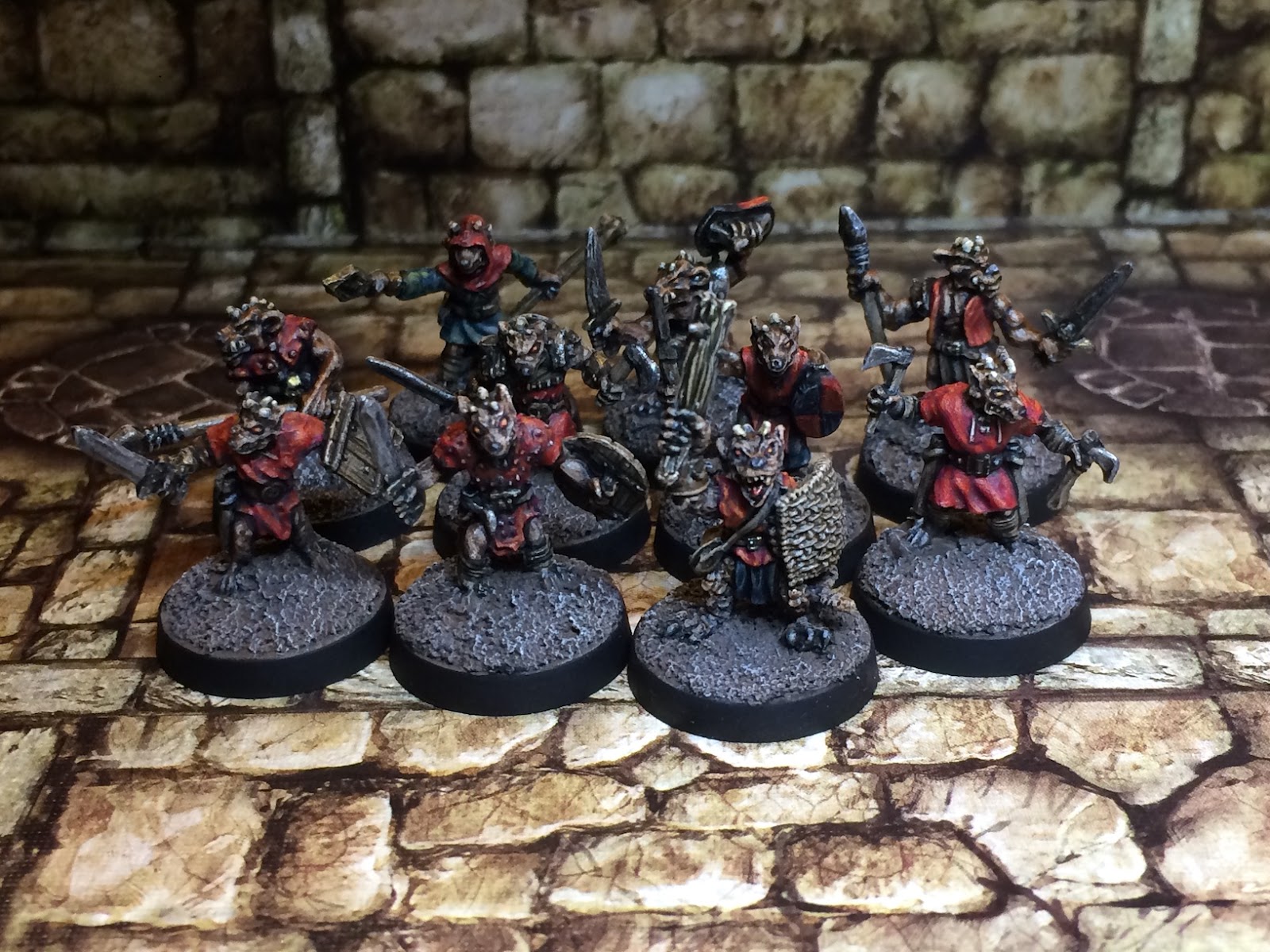
And there's something else too. Even if you have a lot of miniatures (and as a result of deeply misspent youth, I have), big encounter groups of monsters are often out of reach. I might manage to muster a hundred or so of my livid-skinned cave goblins (see the top of this post), but players will soon tire of them. So with humanoid monsters, the use of miniatures suggests a slightly different way of thinking: monster bands as NPC parties, with named individuals, various quirks and plenty of personality. And that is no bad thing, I think - though it's probably something for another post.