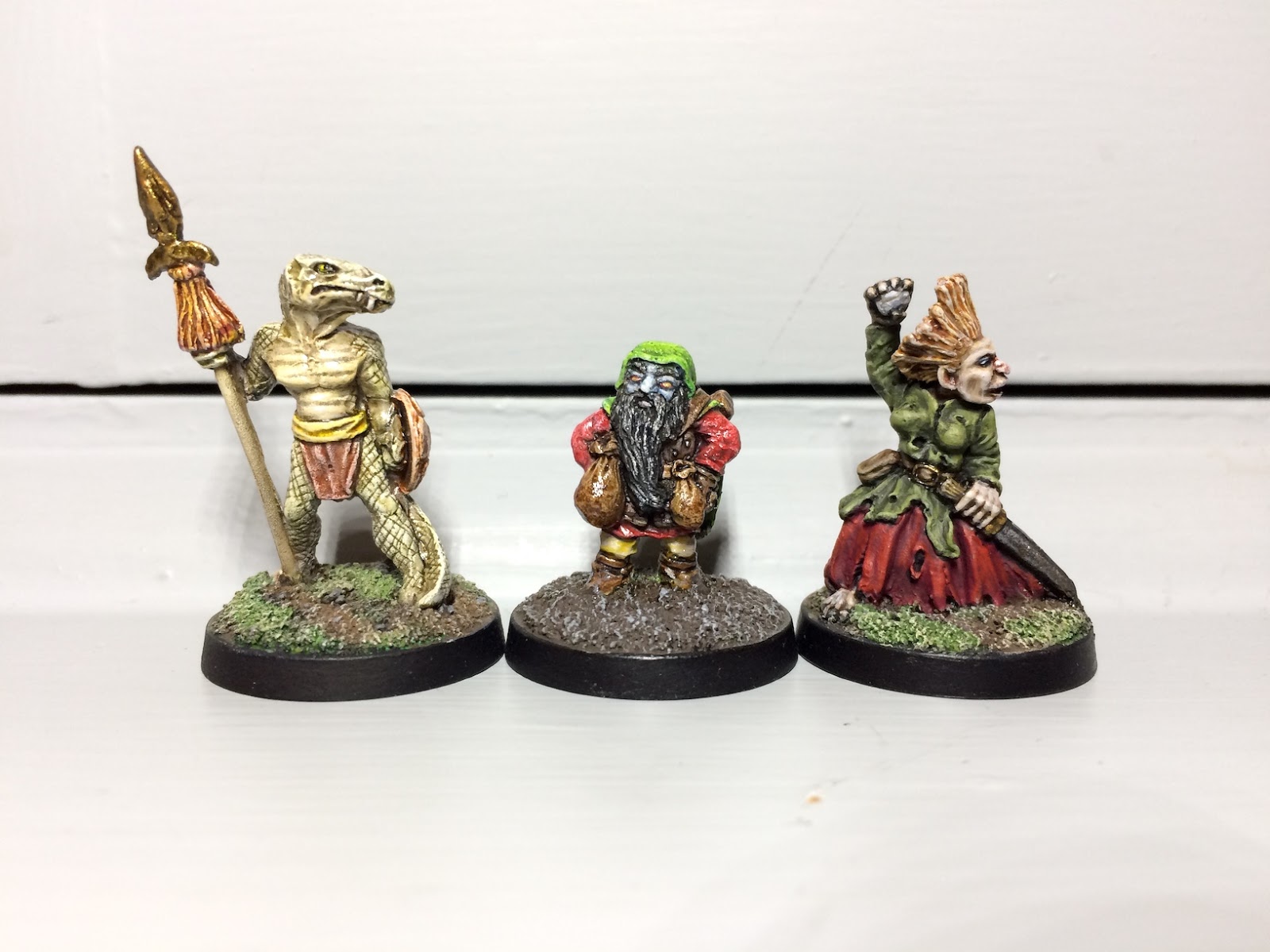
Showing posts with label Whitehack. Show all posts

Saturday, 2 January 2021

A third round of megadungeon mechanics: mercenaries


I've been thinking a bit more about how adventuring parties will be structured in my episodic megadungeon campaign (see here and here for previous thoughts). 

In some ways, this campaign is going to be much more of a wargame than most of the games I run, though there will be ample opportunities for roleplaying. But the game will take the form of successive armed raids on a (largely) subterranean stronghold of great size, and so tactics and organisation will play a large part. 

Each party will consist of the PCs plus an equal number of non-combatant lantern-bearers (torch-bearers, porters, etc.) and the same number of pack animals (mules, donkeys, camels, whatever). These are 'free' in that they're assumed to have been hired or bought before the game starts. So a party of three adventurers will be accompanied by three lantern-bearers and three pack animals. The fixed ratio makes it simple, and there's no 'on-screen' cost to the players. 

A party with just three combatants will represent easy pickings for monsters, however. So PCs would be advised to bolster their numbers with mercenaries. This decision is down to the party's leader - the PC with the highest CHA - but individual PCs can also choose to hire their own bodyguards.

So, how does hiring work? Well, it's simple: hired fighters get a share of the loot: an equal share (with certain exceptions - see below). 

That introduces a nice risk/reward consideration from the get-go. Do you hire 10 archers to rain arrows on the orcs on the first level? It might work well - but then your party of three will have to split any loot 13 ways, assuming that everyone survives. That assumption might not be safe, of course, but most parties will balk at getting such a small fraction of any takings.

Now, if the party's leader decides not to hire mercenaries, party members can still opt to split their shares with hired hands. So, a cautious dwarf might not like the idea of going in with just three fighting adventurers and might opt to split his share with three of his kin. Those dwarves will answer to him, of course.

There's also potential to play on the idea of the Doppelsöldner and allow the PCs to hire higher-level fighters for a higher share of the loot. Dungeons & Dragon's level system provides an obvious way to do this. But there will be scarcity limits on high-level fighters: no more than one third-level or two second-level hirelings per PC. So, if our three-strong first-level party hires three third-level fighters, the loot will be divided into 12 shares, with each of the hirelings taking three of those and the PCs getting only a quarter of the spoils between them.

Non-divisible treasures (magical swords, amulets, etc.) will be chosen by combatants in turn, starting with the highest-level character, whether PC or NPC, and then rolling dice for priority. So if our first-level party hires three third-level fighters and then finds the Drinker in the dungeon, one of those hirelings is likely to make off with it (which might be just as well).

Note that hirelings are not potential PCs in the way that lantern-bearers are. If your character gets killed, you can roll up a new character and embody him or her in one of the lantern-bearers, who, when offered the gear of the slain adventurer, has just acquired a taste for adventure. But hired fighters don't become PCs in the same way. They can, of course, be run temporarily by players who've lost their characters if the party is down to its last lantern-bearer.

This means that players can't leapfrog to higher-level characters after PC deaths. It also means that hiring high-level fighters is always costly unless they're slain on the job. Your party doesn't get to keep the Drinker because you took over Ulav the Fearless mid-game; instead, you roll up a new PC when the expedition ends.

That's the main system for hiring fighters. But there will be an alternative available once the party has amassed a bit of cash. They will be able to hire fighters for a day rate,  paid in advance. This rate will be much higher than that in the Rules Cyclopedia, so that it forces the players to make tough choices about how they spend their loot: hire help, progress in experience or buy better equipment. And fighters hired in this way will also be subject to the classic Rules Cyclopedia morale rules. They've already been paid, so if things go badly, they're more likely to break and run. After all, if you think that the orcs are about to finish off the party, you're not going to be too concerned about breaking your contract with a corpse. 

I also like the idea of unscrupulous PCs hiring equally unscrupulous orcs. As in Rules Cyclopedia, this will be significantly cheaper than hiring human fighters. But it will also be riskier. First, orcs will be morale 6 rather than the morale 8 for human mercenaries. Second, their loyalty will be vulnerable to reaction rolls in encounters with certain creatures (powerful ones that can speak orcish, such as ogres). And third, you always have to worry about situations in which your orcish hirelings outnumber you and are not afraid of you. I might, though, allow orcs to fight for half-shares under the share system, in which case they would still be subject to morale rolls (unlike human mercenaries fighting for a share)  but with morale 8 rather than 6 (i.e. the share incentive acts as the equivalent of a strong leader as described in the Rules Cyclopedia).

The net effect of all this is to make orcish hirelings a high-risk proposition that could be tempting in certain circumstances. If you're going to storm the hobgoblin stronghold, a few dozen orcish mercenaries could be a cheap way to achieve overwhelming numbers. But you don't want things to go too badly for them (prompting morale rolls) - or too well (so that there are lots of them inside and in control of the stronghold before the party establishes control). 


Wednesday, 8 April 2020

Strength, shields and spears - my house rules for Basic D&D

While in lockdown, I've been running D&D for my kids and some friends. We've got a seven-strong party with player ages ranging from nine to a fair few decades past that. And it's been great - not only as a way for the kids to see their friends every day but also as a gaming experience. I've been taking them through The Keep on the Borderlands, which I've never run or played before, and it's been a blast.

We're using Basic D&D (as contained in the Rules Cyclopedia). Although the red-box Basic set was probably the second RPG I ever read (after Runequest), I don't think I ever played it. I did play a bit of AD&D, but - as children - we disdained Basic as childish!

Clearly, that was absurd. The rules contained in the Cyclopedia are well constructed and sturdy, and they seem nicely modular. In choosing them over the superb Whitehack, I wanted three things: a proper 'rules as written' game of D&D with simple choices (against Whitehack's more freeform approach), an instantly available common reference for the players and a very well-defined system of character progression. After all, who knows how long lockdown will last?

Nevertheless, I had to tweak a few rules. We're now eight or so sessions in, and I'm quite pleased with the tweaks. So here they are.

1. STR as HP/STR and HP
I've blogged about this before, but I've never been able to get over the possibility that a first-level fighter might have STR 18 and HP 1. The Fantasy Trip's use of ST(R) as HP gets round this elegantly. And Into the Odd takes a similar approach by combining HP and STR as HP. When characters run out of HP, they take wounds off STR and have to save under their remaining STR to stay in the fight/conscious/alive. I love this system. As in The Fantasy Trip, I have characters take STR damage off a running total that leaves the 'true' STR stat unaffected for lifting portcullises, 'to hit' and damage bonuses, and so on.

It works really well because it preserves HP as the classic Robin Hood vs the Sheriff of Nottingham store of cunning parries, shaken-off light wounds and narrow dodging of death. And it means that characters who roll 1 for HP don't feel too aggrieved. Perhaps they're just green, clumsy or plain unlucky - all conditions that can be cured through advancement. And it means that the STR 18/HP1 fighter is still much hardier than the average fighter; even after taking a 6HP blow, he'll be much more likely to stay in the fight than the STR 6, HP 4 magician would. That's just as it should be, I think.

At the same time, the fragility of first-level characters (and others) is preserved. There's no need at all to fudge your initial HP roll (my son's thief has 1HP and only 10 STR, but has made both his STR saves so far!).  Low HP mean that you'll be taking STR saves sooner rather than later. But they don't mean that you'll always die or pass out on being struck by a goblin slingshot or hit with a kobold cudgel. Combat becomes less predictable, which can't be bad.

2. PC and NPC deaths
Now, the chances of a PC death with this system are reduced somewhat. I've generally ruled that if you fail your STR check, you're out of the fight (not necessarily unconscious, but groaning and unable to do anything useful), but if your comrades rescue you, you can be revived with proper care (say, a week of rest and the attendance of physicians or equivalents). If your friends get you back to base immediately, you'll probably be OK.

That helps with party continuity and plausibility, and also with forcing the PCs to adjust their plans. If someone breaks their leg in a fight, you can't take them with you. And if you leave them, they'll die. Decisions, decisions ...

Similarly, if you're forced to retreat from combat without rescuing your friend, he's dead. So far, such injuries have made our campaign more episodic, which is a good thing. Raids on the Caves of Chaos are all fun and games until someone gets hurt ...

And there's also a risk of immediate death in certain situations. Our sole death so far came when a PC tried to leap through the gnashing portcullis-mouth of a living tower (pinched from Return to the Keep on the Borderlands). I warned him that this was a DEX save with death as the consequence, and he still attempted - and failed - his roll. Splat!

I'd apply the same warning in a focused combat like a duel to the death with a master swordsman, but not to a sudden skirmish with orcs. It means that the battlefield is strewn with the dying as much with the dead; the orcs don't get the STR save, but their leader might. Important NPCs get STR saves, but faceless minions don't.

In proper wilderness adventures (the Caves of Chaos are too close to the keep to count!), a failed STR save probably entails death. So running out of HP is no laughing matter - but it's something that the strong can usually shrug off.

All in all, this system makes combat more interesting. Maimed companions demand decisions - and death always threatens but isn't always instant.

3. Target 20
I've shamelessly stolen this from Delta. It's great - no need for THAC0 and all that. It makes combat and other stuff much faster. Hooray!

4. Shields shall be splintered
And I've nicked this from Trollsmyth too. I have a more complex house rule for Whitehack, but it doesn't work in a roll-high system. The point is that shields should be valuable in combat - just as they were historically. And I just love the heraldry-driven complications that can arise from carrying the Broken Skull's tokens into the Bloody Tusk's territory ...

5. Spears go first - and polearms can be spears
I'm just about OK with Basic's individual-initiative system, in which two-handed weapons attack after others. I can rationalise certain things with reference to cramped dungeons and sudden ambushes. But it becomes laughable when a dagger-wielder takes on a halberdier in the open and goes first. So, the way I fix this is to allow spears to win individual initiative (whether wielded in one hand or two), which makes them the natural weapon of choice for soldiers. And of course they can be thrown too. So the archetypal spear-and-shield-wielding guardsman makes a lot of tactical sense.

On top of that, I allow polearms to be used as spears or as two-handed weapons in any given round. So, if you want to hold your foe at bay with the pointy bit of your halberd, you'll win initiative against a foe with a sword, axe or knife, but you'll only do d6 damage. If you want to swing it for the full d10, you lose initiative.

I'm well aware that this isn't strictly accurate - you can swing a polearm at a foe long before they get a chance to close with you. But there might be a glimmer of truth in it for a 'killing blow' - especially if we're assuming that most fights take place in fairly cramped conditions. And it makes for nicely balanced decisions.

I'm not quite sure what to do about poleaxes. It's fairly clear that the authors of Basic had little idea of what a poleaxe actually was (up to 15' long? And no spike? Cheaper than other polearms? Really?). As the poleaxe is the descendant of the Danish axe, they might both be covered by the battle-axe category - but then the poleaxe was the weapon of choice of the heavily armoured knight, so it should be the best thing on the battlefield! I suspect it's easiest for now just to group it with other polearms - although poleaxes are generally significantly shorter than halberds, so would be more wieldy in close and less good at the speary stuff. I probably have to accept that D&D just doesn't do that level of detail!

6. Magicians are rare
This is less of a rule than a tonal note. The only magician in our party is an elf. I'm keen to have sleep spells and magic missiles be awe-inducing interventions - not something that most bandits or guardsmen will have seen before. So magic-users are rare, distrusted and generally keen to conceal their powers.

Monday, 20 May 2019

The Fantasy Trip


Last year, I found my curiosity piqued by The Fantasy Trip and looked into a couple of the retroclones. I resolved to get hold of it when it was republished - in part, because I couldn't remember if I'd ever played the minigames on which it's based: Melee and Wizards. Steven Jackson Games were popular as lunchtime diversions when I was at primary school; we played Car Wars and OGRE quite a bit, but I'm not sure about Melee.

Having bought the Legacy Edition of The Fantasy Trip, I'm still not sure. The rules seem familiar, as do some of the counters. But it was a long time ago - and if we did play it back then, we played Car Wars and OGRE much more. I never owned any of them, and I do remember designing some grid-based combat games shortly after I moved schools - possibly to recapture the counter-and-grid thrills of those lunchtime sessions.

Anyway, the kids and I played four games of Melee over the weekend. It's terrific. I'm planning to use it for most RPG sessions with the kids and their friends from now on, simply because it'll make combat encounters so much more compelling than the various D&D clones we've tried. Whitehack will doubtless remain a go-to for small, focused groups, and I'm playing Tunnels & Trolls with some old friends next weekend, but for dungeon-crawling with the kids, The Fantasy Trip/Melee appears perfect.

So why is that? Well, the sheer amount of decisions to be made - formalised in the game as options - gives a tremendous range of outcomes. I can't think of any one-figure-per-player skirmish game that offers quite so many options in combat situations.

And yet the game is very simple. For Melee (the TFT combat system as a freestanding game), characters have three stats: strength (ST), dexterity (DX) and movement allowance (MA). You design your character(s) by deciding the balance of their ST and DX and then choose whatever weapons and armour you like.

And that's where the real genius of the game comes in. It combines a reasonable amount of realism with a tremendous amount of game balance. Strong characters can take and hand out more punishment: ST acts as your hit points, and allows you to use nastier weapons) But DX decides who attacks first - and the higher your DX, the higher your chance of landing a roll. Armour absorbs damage - but also reduces DX and MA.

So sufficient ST to wield a grisly weapon like a two-handed axe will impair your DX when you initially assign points between them - and heavy armour will impair it still further. But you will be appropriately tank-like and able to deal terrible damage on those rare occasions when you hit.

Alternatively, you could choose high DX to allow you to hit quickly and often. But against heavily armoured foes, you'll be relying on lucky shots to get through the armour.

You can see how this is perfect for gladiatorial combat: secutor v retiarius, or whatever.

And then you've got the hand-to-hand option - grappling, essentially, in which no weapon larger than a dagger is useful, but a dagger is very useful indeed. That creates a whole extra dimension. If you're determined to grapple with a foe, you'll probably want to drop your main weapons and draw a dagger - but there's a chance that they'll be able to do the same when you close, or even just clobber you with their main weapon and step back.

It's a fantastically elegant combat system. There are certainly lapses in realism; I suspect armour wasn't quite so constricting/slowing, at least initially, and of course many strong people are very dextrous too. YOu don't need to be terribly strong to use a two-handed sword or battleaxe; a two-handed sword isn't usually twice the weight of a regular sword. And the weapons list has some oddities (a pike axe?). But for a balanced game, it's just right.

Incidentally, while the RPG rules (In the Labyrinth) give a whole list of real-world weapons that might fit into the various categories, these make very little sense. The glaive and the naginata - essentially the same thing - are in different slots, for example. None of this matters, though - it's very easy to look at a miniature and decide that its big fantasy polearm is the very quintessence of pike axe.

After an initial one-on-one run through the rules, we played three lizardmen against three orcs, then a couple of games with two burly, armoured hobgoblins and a smallish giant against five orcs: two heavily armoured types and three skirmishers (two with javelins and one with a light crossbow). Both times, the orcs won, because they were able to surround the unsupported giant and pierce it with many weapons. There was something of the mammoth hunt about it, which seemed quite appropriate.

We're eager to play more, and to try the wizard rules. There are printable hex papers of appropriate size available online, so drawing out some floorplans on those will be no more onerous than drawing them out on traditional grid paper.

The labyrinth beckons ...

Monday, 3 December 2018

The knowledge economy

Back in August, I mused a bit about correlated stats - the idea that strength, size, constitution and hit points, for example, are often very closely related in real life in a way that they aren't in RPGs (where a character might have STR 18, SIZ 3 and CON 15, for example). I think Into the Odd's use of STR as hit points is an interesting bit of game economy that may also add realism. It's hard to think of anyone exceptionally strong who wouldn't be at least a little harder than average to beat to death!

Into the Odd has just STR, DEX and WP (willpower) - half the normal game stats and with just one mental attribute. Given that the player - rather than the character sheet - generally provides a PC's real intelligence, I think there's a very good case for boiling down mental attributes in particular, to encourage role-playing rather than rolls. 

Idle Doodler has been discussing his ideas for an RPG stat-line in a couple of recent posts, so I thought I'd get my main idea down here. I'm toying with the idea of replacing INT, WIS and (maybe) CHA with a single KNO stat representing knowledge. 

Why? Well, on most of the occasions that I have players test a mental attribute in Whitehack or The Black Hack, the roll hinges around knowledge to some degree. Does the wizard understand the runes on the tomb door? Can the lizardman make anything of the troglodyte language? Can the thief come up with a plausible explanation of why he's in this room? So I think knowledge covers those rolls better than intelligence (which might come with otherworldliness) or wisdom (which seems to cover common sense or an understanding of human nature rather than learning or general knowledge). 

And I think KNO might replace CHA fairly well too. Charisma often seems a slippery concept in games as it can cover persuasion, intimidation, distraction and seduction, among other things. A hulking brute who's tongue-tied but heavily armed and armoured might not need eloquence to persuade the goblins to let him past. And the silver-tongued sweet-talker might charm a tavern server but struggle with skeptical guards. Using a knowledge stat throws the sweet-talking or intimidation back onto the player, but would allow the GM to provide prompts for a successful KNO roll when inspiration falters.

It might go something like this:

Player: I shout at the guards."This is an impertinence! I demand to be let in!"

GM: They shrug ..

Player "I'm ...". Can I roll a knowledge check?

GM: "Sure"

Player: Success!

GM: Verlan Ottuk, the Duke of Yelt's right-hand man, is in town. He's known for his brusque manner and unassuming dress ...

Player: "I'm Verlan Ottuk. Your master shall hear of this!"

GM: The guards look uncertain and stand aside.

Of course, the GM could also have the guards make an KNO roll to see if they swallow it. And you could have opposed rolls Whitehack style - the higher wins, as long as it's equal or below the KNO stat. And you could apply advantage and disadvantage to reflect local conditions. Also, vivid roleplaying might entail advantage too.

There would be lots of fun to have with fumbles and criticals as well. A 20 on the player's part might mean that the real Verlan Ottuk is already taking tea with the guards' master. Or, more in a more subtle yet insidious twist, it might mean that he is expected, and so the PC is ushered straight into the master's presence (assuming that that isn't what the PC wants). A critical (the stat number itself in Whitehack) might mean that the PC is expected and shown to "their" rooms.

One thing KNO doesn't cover is spell resistance. But I don't really see how INT or WIS do that either. Into the Odd's WP obviously does. I'm tempted to see spell resistance as physical (i.e. it's harder to mind-control an ogre than an orc), but there's certainly something to ponder here.

Another positive for KNO is that it's natural for the stat to increase as players see more of the world. I almost wonder whether PCs start with 3d6 but non-adventuring types (local guards, villagers, monsters, etc.) might generally be assumed to have 2d6 - so an average of 7. Or perhaps everyone starts with 2d6 and PCs gain an extra point per level. Wizards might get a 3d6 roll, I suppose. Such assumptions might boost the ability of players to attempt more scams, ruses and mountebankery. And I'm all for that.

Thursday, 29 November 2018

Attraction/repulsion: magic items as NPCs


Following yesterday's post, I was thinking a bit more about the reappearance of the Drinker in our Whitehack campaign. This is a lethal magic sword - d20 damage - but it will attack its wielder's friends or even its wielder if it does not draw the blood of a living foe after being drawn from its scabbard.

When the PCs rediscovered it on the corpse of a knight that was slowly being turned to wood by a sinister giant tree, their reaction was characterised by terror and greed. The PC who had last owned it wanted it back, but when it was clear that finders keepers applied, he was desperate to keep his distance. And when the party was attacked by rootlings a few minutes later, the new owner was sharp enough to realise that the Drinker posed a greater threat to her than to creatures whose veins ran with sap rather than blood. So the sword stayed sheathed in favour of a much less effective weapon.

Like Ollam's Ring, the Drinker is exactly the kind of magical item I want in my campaigns: something that fades in and out of the story like a well-drawn NPC. The competing urges of attraction and repulsion that my players experienced when re-encountering the Drinker are precisely what I want them to feel in the presence of magical power.

Wednesday, 28 November 2018

Ollam's Ring: more thoughts on magic items


In the two weekend games I ran, there were three 'magic items' for the players to find: an ancient energy weapon, the Drinker and Ollam's Ring. One of the groups of PCs had twice encountered the Drinker before, which led to some amusing squabbles over ownership rights.

Ollam's Ring is a twist on a spell I often allow Wise PCs to use in Whitehack. The spell has a simple formula: the Wise character can turn invisible but suffers 1HP in damage each round (until they pass out, at which point they are no longer invisible, or they stop the spell). I really like this because it offers a good balance of risk and reward.

One of the games I ran last year featured a magic ring with the same power: 1 HP per round for invisibility. Those rounds tick away quickly, so the ring-wearer takes a big risk in using it.

Ollam's Ring is largely the same, but for one important difference: it glows. When not being worn, the ring glows with sufficient light to serve as a lantern - and to shine through clothing. It also shone through the belly of the fishman in which the PCs discovered it.

I was pleased with this. Why? Well, the ring has a prime function: stealth. And it's really, really useful for that when worn - albeit at a high cost in hit points. But when not in use, it achieves the opposite of its prime function, by making the bearer highly conspicuous. It's hard to escape pursuit in a cavern or in a forest at night when you've got an unearthly glow hanging round your neck.

That heightens the risk/reward aspect of the item. It's risk to carry as it's clearly valuable and hard to conceal.  Also - and this is something I really like - it creates the potential for a situation in which a player might want to get rid of it. If you're low on HP and heavily outnumbered, you might well decide that your best bet is to throw Ollam's Ring deep into the forest to draw your pursuers off.

And that's exactly how I want my magical items: ambiguous, treacherous yet alluring. So far in our Whitehack campaign, the Drinker has caused the death of a couple of PCs (directly and indirectly). The last time they found it, the PCs were happy to accept a reward for it, because they knew how dangerous it could be. This time, they appear to have forgotten the hard lesson they learned the first time. We'll see how it turns out ...

Tuesday, 27 November 2018

Down in the dungeon - with Whitehack and The Black Hack Second Edition


Although I often run RPGs without miniatures, I find them useful for new players, games with children and - especially - for games with lots of players. The third category often comprises the first two, making miniatures and floorplans especially useful.

Last weekend, I ran two games - the first for first-time players (my colleagues) and the second for my kids and their friends. I used the same scenario: a dungeon-crawl with an intro stolen wholesale from Jack Vance's The Eyes of the Overworld. 

For the first game, we used the second edition of The Black Hack. I loved running this. The player-facing rolls keep everyone involved, and the system's nicely intuitive (basically, everything's a d20 attribute check). I was very impressed with how the new armour system works. The degradation of armour's much easier to track than in the first edition, and gives the players lots of risk/reward decisions to make.

The Whitehack game was a blast too. It remains my favoured version of D&D for campaigns, because it allows a bit more subtlety and because there's a little more parity between players and NPCs. While I love The Black Hacks' dice-burning system for armour, traditional armour class allows you to fiddle around with monsters a bit more. For example, in Whitehack, I occasionally confront the PCs with brass automata who have AC 10 but only a single hit point each. That makes them tricky opponents without being overwhelming, and involves no bookkeeping whatsoever. It might be hard to achieve the same in The Black Hack.

I did, however, import The Black Hack's usage dice into Whitehack. These are very useful for rations,  ammunition and the like. They ensure that resource management and uncertainty remain core parts of the game.

For both weekend sessions, I used hand-drawn floorplans. These are my preferred option for miniature-based RPGs. They're quick to make, they afford much more design freedom than commercial tiles, and they're 'what you see is what you get': if I've drawn a troglodyte hide staked out on the floor of a room, then that's what's there when the PCs enter.


Drawing out the floorplans means that the 'master map' can be very sketchy. I started with a rough scrawl and then drew out a clearer fair copy once the floorplans were finished. The advantage of this approach is that all your effort is visible for the players (and the crudeness of the GM's map makes it almost unintelligible to players should they happen to glimpse it. 


I add 3D terrain where I have it, but I draw it in quickly in case I forget or misplace the scenics:

With ...

... and without
In the second game, we had eight players. The party split up, with two tackling the lower entrance while the rest headed for the orc outpost above. The floorplans were a huge help here, as it was easy to coordinate the action and for the players to visualise (eventually) how the two parts of the complex connected.


Another advantage of floorplans is that they speed things up. It's easy to glance at the table at the end of each turn and work out how far unseen monsters attracted by noise or scent will advanced through the dungeon. And of course it's far faster than drawing out rooms and corridors on a mat as you go. 


Thursday, 22 November 2018

The Black Hack Second Edition - first thoughts


All tomorrow's party ...


I bought the PDF of The Black Hack's second edition a couple of days ago and am going to be running it tomorrow with some first-time players. It looks terrific.

There are some interesting changes from the first edition of the game, notably with armour. In our first-edition games, armour points (effectively first-line hit points) were a bit of a problem, because they were easily overlooked or forgotten when the dice were flying. The second edition uses a dice pool; you 'burn' a die every time you use an armour point and can then roll them to recover when you have time to rest. That's a big improvement. It also ramps up the effectiveness of armour, shields and helmets, which now stop a blow rather than a point of damage. And it makes a shield highly desirable for an unarmoured fighter, which is just as it should be.

I don't like the rules for two-handed weapons so much. These too have been revised; it used to be that a two-handed weapon added 2 to the attack and defence rolls (making them harder) and to the damage roll (making it higher). Now they add 1d4. None of this sits well with me: there's nothing about a two-handed weapon that makes it harder to hit with - quite the opposite, in fact. Controlling a spear with two hands is much easier than with one, and the same's true of other pole-arms. And parrying with a two-handed weapon is much easier than with a one-handed one, given the greater control and the ability to slide your hands along the hilt or haft.

Presumably, these rules are an attempt to emulate the sort of ludicrously oversized two-handers you see in fantasy illustrations or the 1982 Conan film. If so, fair enough. But for realistic two-handed weapons, they don't work.

Still, they're easily fixed - and the rules explicitly encourage 'hacking'. The Black Hack uses class-based damage: d4 for wizards, d6 for thieves and clerics and a new special rule for warriors. For now, I'm going to leave the special rule (multiple d6 attacks as an option) and use d8 for warriors and one die higher for two-handed weapons (so, d6 for wizards, d8 for thieves/clerics and d10 for warriors). That should work well: the advantage is modest, and the disadvantage comes from not being able to use a shield - a big old deal, especially if you're unarmoured.

That means that the heavily armoured knight will favour a poleaxe or longsword while the lightly armoured skirmisher will want a shield and a one-handed weapon. I also like the option of allowing players with longswords or spears the ability to switch to two-handed use if (for example) their shield die is 'burnt'. Of course, if you switch to two-handed use during a fight, you've dropped your shield, so if you aren't in a position to pick it up at the conclusion of the battle, you've lost it. You might find a new one on a monster's corpse - which could lead to all sorts of interesting heraldry-related difficulties ...

I digress. The main thing about the new rules is that they've made the game even more simple and useable. And the streamlining of the rules is just one aspect of this. The bulk of the new book is taken up with random-generation tables that look tremendously useful.

There are tables for wizard names, for the characteristics and cures of diseases, poisons and drugs, for incidents that incite adventures, and for NPC concepts and adventures. There are settlement generators, hex-map generators and tavern generators. There's a dungeon generator, of course, and monster generators, and a richly flavoured bestiary.

All of this stuff is richly flavoured, quirky and often funny - but not as straight-up comic as the League of Gentlemen-ish Sorrowset adventure that accompanied the first edition. In particular, I love the tables for what the various monsters in the bestiary might be up to when encountered - whether it's a wizard arguing with his shadow or a demon taunting a soul trapped in a bottle. And there's plenty of material to answer one immortal question: "What has it got in its pockets?".

This terrific stuff makes up the bulk of the book - and makes it very easy to generate adventures on the fly. Any D&Dish game would benefit from this, regardless of whether Black Hack rules are used or not. I'll pick up the hardback at some point, as this stuff simply screams to be physically bookmarked.

There are also some nice new elements. I think you can see the influence of Whitehack in the way
 that character backgrounds can now influence game mechanics. And there are panic rules for PCs, which are great. I bought Torchbearer earlier this year, intrigued by its focus on resource-management in dungeon crawling. But I can't imagine I'll ever use it. The Black Hack does all that stuff much more simply.

Whitehack is likely to remain my favourite D&D ruleset for campaigns, given its elegance and greater sophistication (fighting prowess in The Black Hack is largely down to how strong your character is, for example), but the new edition confirms the The Black Hack as the go-to for one-shots. And I imagine I'll be using the tables from The Black Hack an awful lot in our ongoing Whitehack campaign.

The new book costs about a fiver in PDF (US$6). If you run fantasy RPGs, I can't imagine why you wouldn't want it.


Friday, 14 September 2018

Combat systems as a last resort

This is a question I often think about: why isn't the best skirmish-wargame system also the best RPG combat system?

There are some obvious answers: realistic skirmish systems are too dangerous for continuity in a typical D&D-style game; and skirmish systems don't allow for the sort of madcap creativity that's a staple of a decent RPG encounter.

Let's take that second point. Creative solutions to problems are where much of the fun in RPGs arises.    And the more that creativity leaks into combat encounters, the better. When I was a kid, I disliked the D&D combat system as a sterile mix of abstraction and attrition. Why not prefer RuneQuest or Warhammer FRP, where hilarity and dismemberment often arose from a humdrum fight? Since then, I've come to appreciate the D&D approach more - for its ease of bookkeeping and the tension that hit-point-depletion creates. But I wasn't entirely wrong. D&D combat can devolve into a sterile exercise in whittling hit points.

That's why the combat system should be the fall-back option. The GM should always allow players to  fight through methods that don't involve armour class. Will mechanics be involved? Yes, of course: there's an element of chance. But not usually combat mechanics.

Here's an example from our most recent game: a one-off, highly derivative scenario involving dwarf PCs reclaiming their ancestral home from invading evils. At one point, the dwarves triggered an alarm that animated a gargoyle and summoned hobgoblins from deeper in the dungeon. As the hobgoblins closed with some of the dwarves at the top of the stairs, one player asked if her character could throw herself at the legs of the nearest hobgoblin. Basically, she wanted to rugby-tackle him down the stairs.

That seemed entirely reasonable, given the positioning, so I offered her a DEX check with disadvantage. Failure would result in injury to her character from the hobgoblin, and a fumble would send her tumbling down the stairs herself. But if she succeeded, she would topple the hobgoblin, driving him out of the combat and hurting him the process. She rolled the two d20s, succeeded on both and smashed the unfortunate hobgoblin down the stairs, breaking his neck in the process (a high damage roll).

This was a simple snap decision, and I'm sure most GMs do that sort of thing all the time. But I think it's worth highlighting how much more interesting and dynamic combat encounters become when there's no automatic default to AC and to-hit-rolls.

Simple stat checks, along with the disadvantage and advantage system, is all you need for this. Here are some of the things that have come up in our games:

1. Jumping on an adversary from above. (DEX, with advantage for Deft [Whitehack] or thief [The Black Hack] characters)
2. Pushing an opponent over an edge in melee. (STR, with advantage for characters bigger or heavier than their opponents, and disadvantage for lighter ones. Failure is failure; fumbles mean you go over; a critical lets you land on them for extra damage.)
3. Stepping out of the way of a charging opponent so that they fall - or tripping them as they go past (DEX, with disadvantage for all but the Deft).
4. "Behind you!" (CHA, with disadvantage unless there are special circumstances)
5. Throwing something - a torch or liquid or dust - in an opponent's face (DEX with disadvantage except for the Deft/thieves).
6. Intimidation ("Throw down your weapons! You're surrounded!", etc.) (CHA with disadvantage except for the Wise).
7. Flying tackles (DEX as above - disadvantage for everyone!)
8. Shield-barging charges to scatter opponents (STR with disadvantage)
9. Taunting opponents so that they charge into disadvantageous circumstances (CHA or, better, just roleplay it)
10. Swinging on ropes, chains or other suitable things - either into combat or out of it, or over enemies while dropping things (DEX with disadvantage except for the Deft/thieves).

Of course, monsters and NPCs can attempt all these things too.

When the AC/'to hit'/HP grind becomes the last resort rather than the first, the game becomes a hell of a lot more entertaining. And it gets faster. You don't need to cross off some of an orc's hit points if he's just been barged into a gaping chasm - or persuaded to charge into a troll's lair.


Sunday, 26 August 2018

The case for miniatures in RPGs


When I got back into gaming a few years ago, the thing that struck me as strangest about contemporary RPGs was the assumption that you play D&D with miniatures and a grid.

We never did that when I was a kid. Yes, we sometimes had miniatures on the table, but they were used for convenience (marching order, formations in combat and various tactical situations) and were mostly ignored altogether. We almost never used any scenery that wasn't improvised on the spot ("This d4 is the pillar with the prisoner chained to it"), and we certainly didn't use a grid. The occasional book with pictures of Chessex mapping paper pointed to some absurd platonic ideal.

I can think of a single Dragon Warriors one-off that I ran that used entirely painted miniatures with a tower and floorplans (the tower was from the Citadel mighty fortress, with old Citadel dungeon floorplans representing each level and the cellar). But that was a late-stage exception.

And I think I can safely say that none of us every paid the slightest heed to the movement stats in whichever game we were playing (RuneQuest, AD&D, Dragon Warriors, Call of Cthulhu, whatever). We assumed humans could outrun things that were more sluggish, and we assumed that fast things (e.g orcs - I tended to enforce a certain Tolkien purism on this) would catch you sooner or later. 

Since resuming RPGs with kids, family and old friends, though, I've used miniatures about half the time. Holiday games are always 'theatre of the mind' - a term that we never used as kids, because it was the default. So too have been the classic Dragon Warriors scenarios and Dungeon World homebrew games we've run through. One-off dungeon-crawls for lots of kids are done with miniatures and commercially produced tiles, however, and our Whitehack campaigns this year and last have used miniatures (15mm last year, 28mm this). The one-offs I've run for my old gaming friends have been a bit of both (miniatures for Tales of Blades and Heroes, which requires them; theatre of the mind for Heroquest Glorantha and Dungeon World; and miniatures again for Whitehack). 

I added some thoughts on the use of miniatures on noism's blog last year, when I was generally veering away from their use:
I increasingly think that they're a constraining factor in all kinds of ways: cramping scales by limiting things to the size of the tabletop; limiting the GM's imagination to the available models (even if subliminally and irrationally); and entailing a huge amount of NPCs and stuff (e.g. for a fight in a crowded marketplace). 
Noism's comment that miniatures are a "straightjacket for the imagination" was exactly how I felt. 
But since then, I've grown a bit fonder of their use. There are lots of problems, of course.  
First, miniatures cramp scales by limiting encounter spaces to the available tabletop. It would be hard to do Tolkien’s Moria, with its vast chambers and 50-foot chasms, on the average dinner table – let alone a city square, a castle courtyard or a section of steppe. To do such things in 28mm scale, you need a lot of space.

Miniatures also have a pernicious tendency to limit the GM’s imagination. If you have an owlbear model, you’ll probably use it in your game. But if you’re using miniatures yet lack a scorpion man, you’re unlikely to write one in. Owning only 10 hobgoblin models militates against the inclusion of 50 in a subterranean barracks – limiting the range of challenges for high-level PCs. Most of my childhood games featured orcs, for the simple reason that I had lots of them. I still do, and they’ve been overrepresented in recent games for that reason.

You can (and should!) fight that tendency, of course. But then there’s the problem of identification. Yes, the players know that the owlbear is actually a scorpion man. But it still looks awfully like an owlbear. Nicely painted goblins might not convince as gnolls – and they certainly won’t do as the town guard. The potential for confusion grows when you field a combination of proxies: “This werewolf’s the black knight – and that ogre’s actually the wizard’s henchman”. 

It’s also hard to escape the thought if you’re going to use miniatures, you should do it properly – not only by having appropriate figures for PCs, NPCs and monsters, but also by having them all painted. That’s a huge amount of time on top of writing and running the games themselves.

Finally, miniatures make every encounter look like a fight. Cerebral challenges become physical. Place an ogre miniature outside the stronghold gate, and players will want to kill him. Thoughts of sneaking past, distracting or persuading will dwindle or vanish.

And yet ...

The greatest excitement I've ever generated at the table was with this:


 The coiled section, to the left, was the floor of an entire room; the PCs stumbled into it after spending miles in a huge earth tunnel. There was a gallery above it, which some of them had climbed onto before one of them decided to fire an ancient energy weapon into the slowly pulsating rubbery mass over which they were clambering - at which point, the room was replaced by a pit of loose earth and the rearing worm was placed on the table. We were using 15mm miniatures, so my home-made purple worm was fairly sizeable. The shrieking took some time to subside.


My son drew this on his character sheet after the session:


Now, you can get similar effects through description alone. But the sheer fun of that encounter would be hard to replicate without props (the closest I've come in 'theatre of the mind' was in a Dungeon World game in which the players realised that the bone-walled 'dungeon' they were exploring was actually the skeleton of a vast landwhale - and the reason the walls were shaking was because a lich was in the process of reanimating it.

And miniatures do help when kids are involved and when there are lots of players of whatever age. The physical constraints of models and maps can be limiting, but they can also stimulate the imagination - especially if you make a conscious effort to escape from two dimensions. The purple worm was a one-off, but the best reusable dungeon room I've created is the 'pudding gallery' in my Devil-Warrens megadungeon. This is a gallery on the first level of the dungeon that opens onto the second level below.

The first level is patrolled by kobolds, who guard themselves with a variety of traps. A clue for the players - which none have yet picked up on - is that one section of the gallery has collapsed; the opposite section turns into a sliding ramp when the kobolds pull a lever; the collapsed bit is the remains of an identical trap. And so some of the players end up being plunged into the second level; the room below the gallery has three slow-moving but deadly black puddings.

Above ...

I've run this room three or four times, for both kid and adult players (one party found the remains of the other), and it's worked well each time. But it would be much harder to make work in 'theatre of the mind', because visualising it is a little hard, and the intricacy of movement - on the gallery, over the trapped sections, in the room below - is hard to keep track of otherwise. The first time I used it, I placed the level-two floorplan the wrong way round; none of the players realised that the rubble was in the wrong place, but I had to radically redesign and 'canonise' the second level before the next session, given the way that the doors opened!

And below (at least when the rubble and statue line up properly ...)
Each time PCs have come through this section of the dungeon, we've had really good, memorable encounters - firefights with kobolds and their pet scorpions (which, to the horror of the players, were quite capable of jumping the gap in the gallery) above, and the terror of the puddings below. Best of all, perhaps, was when the kids' PCs revisited the dungeon to find that their hapless adult counterparts had released the puddings into the upper levels, so that rather than trying to climb back up, they needed to lower themselves down into the second level.

Miniatures can also help to turn the most humdrum location into something exciting. Below are the floorplans I drew for the lair of Brug and Brag, an ettin (though I didn't call him that; ettin in my games is simply a synonym for giant - and who's to say how many heads a giant or ogre might have?)


Forget five-room dungeons - this is a two-room dungeon, albeit with an intervening pit. Yet the encounter with Brug and Brag and his servants turned into a really exciting tactical session, which I think would have been harder to achieve without maps and models. I'd planned it as a quick interlude in a forest adventure, but it ended up as a dramatic climax in its own right.

After killing Brug and Brag's hound and henchman, the PCs rolled the barrels to form a barrier on one side of the pit and sniped at the giant from that side as he hurled rocks at them. Some of them sneaked carefully into the pit during the firefight to surprise him while others distracted him with taunts. It turned into much more of a set-piece than I'd expected - and the 'reveal' of Brug and Brag was a nice surprise; until the miniature was placed after the pit had been crossed, the PCs assumed that they were dealing with two creatures.

Brug (and Brag)

Of course, most of the problems with miniature use persist. And I think all sessions, even the most focused dungeon-crawls, should have lengthy episodes of conversation with NPCs. It helps to have miniatures for obviously helpful or neutral NPCs as well as potential foes, as this defuses the 'we must kill it' tendency.

The problem of scale is still there, but recent visits to ruins (including Vindolanda and Norham Castle, neither of which I had been to since school) reminded me that a real-life 'dungeon' would be cramped and 'tight' in the way that many RPG dungeons aren't. The constraints of miniatures and - yes - a grid can actually be helpful here.

Increasingly, I think that miniatures can be a help, but it's terrain or scenery that can become a hindrance. These days, I just hand-draw floorplans onto card or paper, which allows for much more variation than any commercial dungeon tiles or geomorphs, and - crucially - allows strict line of site to be preserved (things that can't be seen by the player don't go on the table). This often breaks down with commercial floorplans, especially in cave systems. But I also use three-dimensional props, ranging from ancient bits of Fantasy Forge or Grendel resin scenery to carved foam to painted blocks or cardboard.

As long as you're not expecting it all to match like some Golden Demon diorama, it can be liberating and creative - allowing a better sense of space than you could easily achieve through description. It works through a combination of the specific - the hand-drawn plans - and the semi-abstract: blocks and boxes used for elevations and impressionstic staircases that accommodate miniatures but don't pretend to model the stairs accurately. There's lots of inspiration to be had here from the likes of Matakishi and Runehammer. And don't their games look fun?

Impressionistic steps
Also, I've finally come to embrace movement rates - especially for chases involving black puddings or gelatinous cubes or the like. The first time PCs found themselves plunging down from the pudding gallery, the tension in a chase down a narrow corridor was greatly heightened by the fact that the players didn't know what the corridor would open into and whether there would be room for some 5" vs 3" manoeuvres when it did. The eventual escape - by a square or two on the grid - felt all the more hard won for the frantic movement-rate maths that had preceded it.

The old wargaming principle of 'what you see is what you get' is also a great help when it comes to statting up monsters. There's very rarely a reason not to run with whatever combo of weapons is shown on a miniature, which cuts down bookkeeping considerably.

And there's something else too. Even if you have a lot of miniatures (and as a result of deeply misspent youth, I have), big encounter groups of monsters are often out of reach. I might manage to muster a hundred or so of my livid-skinned cave goblins (see the top of this post), but players will soon tire of them. So with humanoid monsters, the use of miniatures suggests a slightly different way of thinking: monster bands as NPC parties, with named individuals, various quirks and plenty of personality. And that is no bad thing, I think - though it's probably something for another post.

Wednesday, 8 August 2018

Ten RPG principles that I like

Having read and played various RPG systems over the past month, I thought I'd jot down some of the rule principles that I really like. Why? Who knows - but these are the things that occur to me, even if some of them are slightly contradictory.

1. Stats should matter.
A strength of 12 should be significantly better than a strength of 11. So I prefer systems that use the stats themselves, rather than modifiers derived from them. That's the major strike against Dungeon World for me. I've no quarrel with systems that just have modifiers as stats. The "roll equal or under" or "roll under" systems of Whitehack, The Black Hack and Into the Odd handle provide a great way of using the character sheet to the full. I like the Mythras/RQ system of adding stats together to get raw percentage abilities too.

2. Shields should matter.
I've rambled on about this extensively, but for me it's a crucial part of making an ancient/medieval combat system feel realistic. Shields should be sufficiently useful that the choice of a two-handed weapon presents a risk/reward dilemma - unless the character is decked out in full plate like a fifteenth-century man-at-arms. Shields are cumbersome, of course, so there should also be risk/reward decisions on whether to attempt climbs or leaps with them.

3. Encumbrance should matter.
As I've said before, no one would fight with a backpack on if they could help it. Carrying stuff is a pain, and should also involve risk/reward, tactical and resource-management decisions. If you're looting a dragon's hoard, you're probably going to have to leave some of your gear behind so that you can carry more plunder. Now, most games have fairly detailed encumbrance systems - but so, so many of them get ignored or forgotten in practice. Encumbrance can only matter if the system is clear and up-front. Major props to The Black Hack here.

4. Hit points work best as a barometer of fatigue and morale
Hit points are obviously an abstraction and are probably best kept that way. For all my RuneQuest bias, I increasingly feel that the erosion of hit points in a specific location is actually quite unrealistic.  In real life, the accumulation of cuts and bruises to a limb in successive combats wouldn't be equivalent to getting that limb gradually sawn off - but that's how it can go in RQ and similar systems. So, perversely, the more abstract systems can often give a more realistic feel than the "gritty" ones.

Now, obviously, what applies to limbs also applies to whole bodies - unless hit points are blood loss, I suppose. For that reason, treating falling hit points as representing increasing fatigue or flagging morale seems the most sensible approach to me. "Fatigue" can incorporate all sorts of minor wounds too, of course. But the Into the Odd approach - where STR starts to fall and saves are required once HP are gone - handles this very well. The Fantasy Trip's STR as HP does a similar thing, of course. And The Black Hack's table of out-of-action results is good too. With Whitehack, we always roll a saving throw (vs death!) when HP fall below zero - I forget whether that's the official approach or not - with precisely zero representing unconsciousness.

5. Weapon damage should be swingy.
Now that I think of it, a fatigue/morale approach to HP makes this one less crucial, but I don't really like the idea of minimum damage above 1 HP. In Whitehack, I rule that one-handed weapons do 1d6, spears, longswords and battleaxes do 1d8 when wielded in two hands and dedicated two-handed weapons (greatswords, poleaxes, halberds) do 1d10. So players get an incentive to use big, nasty weapons, but they're not guaranteed a lot of damage (a poleaxe is a thoroughly nasty weapon, but it could still just scratch you as a one-handed warhammer might, if you managed to get largely out of its way).

6. Damage by character class is a good thing ...
At the same time, I think there's a lot to be said for abandoning weapon damage in favour of character-class damage - as The Black Hack does (I think the concept has been around for aeons, though). I like the idea that a trained fighter armed with a dagger is a lot more deadly than a pasty scholar armed with the same. And even if you give that pasty scholar a poleaxe, the trained fighter with the dagger is still likely to cause more grievous wounds if they go head to head.

7. But character classes are a bad thing.
This is the RQ player's classic sneer. But I do think character classes are, by and large, a terrible idea. Whitehack has the best presentation of them I've seen, as the Strong/Deft/Wise classes are so flexible (you might well have all three represented by knights in a party, for example). I've always loathed class-based weapon restrictions, though. While RPGs don't generally do a great job in emulating fantasy literature (and books based on RPGs merit their own circle in Hell), stuff like wizards being unable to wield swords, battleaxes or maces is just abominable. The same objections I had in primary school still hold up: um, Gandalf? Elric? Jagreen Lern? The Witch-King? Thulsa Doom if we throw in film references - and so on. And don't get me started on clerics not using swords (Templars, Hospitallers, Teutonic Knights, Friar Tuck ...).

8. Stats can benefit from condensing (or correlating).
I've always been suspicious of WIS and INT. And I'm more than a little cautious about STR and CON - which is why I like the Fantasy Trip/Into the Odd STR-as-HP approach. More on that here. After all, DEX seems to cover a wider span than STR and CON (and SIZ in RQ): actual dexterity, agility, speed of thought, reaction time ...

Into the Odd, with just three stats, scores highly here.

9. Skill systems are a bore.
OK, there are exceptions here. RuneQuest handles this sort of thing pretty well. But on the whole, I think it's smoother and slicker to just rely on stats. Whitehack, with its groups system (write down your vocation/species/affiliation next to a stat or two and tell us why this means you're good at whatever you're trying to do) is really elegant here.

10. Magic isn't to be trusted
I don't like magic as technology. But I do like technology as magic (Into the Odd's arcana; ancient energy weapons; that sort of thing). And there's something about "magic systems" that I don't really like (least of all in fiction!). I'm generally inclined for magic to be something that players only access through artefacts (made by dwarves or whatever) and is otherwise wielded against them but not by them. But Whitehack does handle things well by allowing spells to be negotiated with the GM in advance and by having them cost hit points. That latter point is very simple, elegant and powerful, I think: if you must cast spells, they should come at a corporeal price.


High-tech weaponry in Whitehack


One of the big successes in the Whitehack campaign I ran for my kids and their friends last year was the judicious introduction of high-tech firearms. These were discovered in the wreckage of a spaceship underneath Dragonfell - so named for a fiery "dragon" that plummeted into the side of the mountain centuries before.

The revelation that the dragon was actually a spaceship prompted equal measures of delight and outrage ("This was meant to be a fantasy game!"), but what really got the players going was the discover of three long, metallic staves that could be manipulated to fire destructive bolts of energy.

The mechanics for this were very simple: the weapons did 1d20 damage. I like to keep weapon damage in a one-to-whatever range (i.e. a single die) whenever possible; I'm not a huge fan of "1d8 + 3" or whatever, so I'm highly sympathetic to Dungeon World/The Black Hack-style damage by class - even though I'm not that keen on character classes otherwise. The swingy d20 meant that a monster might just be grazed (though alarmed) by the energy beam. It also meant that there was a reasonable chance of obliterating a five-hit-dice monster in a single blast. The players loved that.

What they didn't love so much was the revelation that each weapon had only six shots. Boom! Boom! Click, click, click ...

By the time they discovered this, all three energy weapons had been used fairly heavily. But they hadn't been keeping track of the shots. I had, of course. That led to some great tension, especially as the bad news came when they were far away from Dragonfell.

In our current Whitehack campaign, energy weapons have yet to feature, though Dragonfell is on the map. In time, we may find out whether the players have learned the lesson of using powerful weaponry sparingly.


Sunday, 22 July 2018

Into the Odd - and a project

I've been looking at various simple, D&D-derived rulesets recently. Whitehack is, and will probably remain, my go-to for long-running campaigns; the rules have enough sophistication to support considerable intricacy and range, and can also be elaborated on (for more detailed combat for example). But for one-offs and side-projects, I'm planning to run a bit of Into the Odd, a brilliantly atmospheric game with rules neatly packed into a single page of the PDF.

We played our first session tonight and greatly enjoyed it. The game has lots of novel features that make it run very smoothly. For instance, characters always hit in combat. So there's no roll to hit, just a roll to damage. Once hit points are whittled down, characters take damage to their strength score - and have to save against it to stay operational. So combat is likely to be short and decisive; Chris McDowall, the author, has blogged about the implications of that here.

Another great feature of the game is the way starting characters are created. You roll for just three stats (strength, dexterity and willpower: STR, DEX and WIL) and hit points (1D6). Then you cross-reference your highest stat and your hit points to find out what equipment you start with. Characters with low hit points and stats generally get better stuff. The results are glorious: just a few items of gear and the odd physical trait, but rich in atmosphere (and begging to be soundtracked by Tom Waits). Here are a couple of examples from the book:

  • "Pistol, bomb, shovel, glowing eyes"
  • "Halberd, fake pistol, artificial lung"

There are 60 possible results (if two characters end up with the same, the second shifts left or right on the table to get a different set). The entire character-creation process takes about a minute.

As I'll be running the game with at least three different groups in the coming months, it occurred to me that there's an intriguing project here: kitbashing, converting and painting up a miniature for each of the possible starting combinations. The results would be perfect for one-offs (and games with high PC mortality, which Into the Odd seems to be), as players could be handed the appropriate miniatures as soon as their characters are created.

Painting 60 miniatures is a tallish order, of course (and that's before getting into male and female variants of each). I've got a one-off game coming up next month, so I'll have the players roll two or three characters each in advance and then get to work on those, matching each miniature's sex and other specifications to each player's wishes. To begin with, I've ordered a couple of sprues of Warlord Games' "pike and shotte" miniatures to get a supply of arms with flintlock pistols and the odd spare musket: muskets, pistols and swords are the most common weapons on the tables.

The adventurer miniatures created in this way will also work as NPCs for our Whitehack games: militias and watchmen in particular, I think. And our Whitehack PC miniatures (e.g. a pistol-toting lizardman) could well feature as Into the Odd baddies. Win/win, then.


Wednesday, 4 July 2018

No one fights with a backpack on ...

A bit overladen for fighting ...


I've rambled on about encumbrance in RPGs before, but I'm going to do it again.

In our most recent Whitehack session, the loot-laden PCs were attacked by bestial inhabitants of the Blackwold Forest. They had camped out and had secreted much of their stuff in trees. When the encounter began, only those on watch were (lightly) armoured and none had their other stuff on their person. And when battle broke out, the PCs' manoeuvres left their loot vulnerable to theft; sure enough, a hairy, dwarf-like creature ran off with some of the booty.

Once the beast-people were slain, the chase led the PCs to the lair of the ettin Brug and Brag, whose ogre henchmen they had previously dispatched; the hairy creature was another of the ettin's servants.

I'm making two points here. First, PCs shouldn't want to fight loaded down with all their equipment if they can possibly help it. Second, the placement of gear and plunder leads to plenty of options for story-telling.

Let's take the first point. No one in their right mind would engage in hand-to-hand combat with a rucksack on. The first thing you'd do would be to dump it (a free action, I'd suggest). I'm suspicious of "backpacks" in a medieval-ish setting in the first place, but my players have all bought them from the equipment list already, so hey ho. In future campaigns, I might insist they stick to sacks. In any case, anyone trying to fight with a pack full of stuff should be at -3 to hit and damage (with a minimum of 1). I think the damage reduction is realistic here; it's really hard to get a good swing with a weapon if there's something heavy on your back.

Nor would someone sleep with their armour on, unless it was just a gambeson or something like that (I think padded jacks and gambesons are what most RPGs really mean when they say "leather armour"). Recovery should be impaired for any character who does so, and lack of sleep/comfort might impose a -1 penalty on all actions and tests for the remainder of the day (cumulative for each successive night).

What about the second point? Well, as our last session showed, stuff that's not being carried is vulnerable to being snatched.

This has interesting implications. It gives the PCs something to defend. The most obvious stratagem would be to dump their stuff in one spot and form a ring around it. That's interesting, because it potentially limits their tactical options. They've got to stay in one place, and you can't have an archer or a magician picking off the enemy from behind more heavily armoured friends if they're facing the wrong way.

It also raises the possibility of the PCs being driven back from their gear. Whitehack gives characters in "the Strong" class (i.e. fighters) the option of driving foes back in combat. I give this to certain monsters too, as it creates more dynamic and interesting tabletop melees. The more movement the better: static fights can be terribly boring, especially in D&D-style d20 systems, which lack the colourful skewerings and leg-loppings of Runequest and its ilk. So the dumping of backpacks can serve as a reminder to keep combat dynamic.

Imagine a band of orcs charging into a room. If there's a burly chieftain at the front (almost man-size, perhaps ...), he might well be able drive one or more of the PCs out of their line, creating a breach into which his followers could pour - and allowing back-rankers to make off with the PCs' stuff.

If the PCs survive, they've then got a motive to raid the orcish quarters. Perhaps all the assailants except a few imps were slain. But there are probably plenty of bigger and nastier orcs waiting back at base.

It's also easy to envisage scenarios where the PCs do the driving back and then pursue their routing foes. But what if some dungeon scavenger has devoured their stuff in the meantime, before retreating to its lair?

And when the PCs cut their losses and decide not to bother retrieving the carved wooden totems they recovered from the beastmen? Why, they might discover that those offer protection from the demons that patrol the lower reaches, and so are well worth retrieving after all.

Essentially, penalising PCs for fighting with their packs on is an engine for separating players from their stuff. And that, it seems to me, should be a crucial part of a dungeon-crawling game. In our campaign, the Drinker has passed through the hands of three PCs, two of whom have died. It was the object of the party's last raid on the Devil Warrens, as they were paid to retrieve it. Little do they know that it's now in the hands of a very nasty NPC indeed ...


Friday, 22 June 2018

Whitehack and The Black Hack

Whitehack's been my go-to RPG for some time now. I use it for regular games with the kids and their friends, for family sessions (my wife can occasionally be persuaded to play) and for occasional games with my old RPG muckers. It's great - sleek and elegant, and with nice, intuitive mechanics. The "roll equal or under" system sits nicely with those of us who were raised on RuneQuest rather than D&D, as does the freedom afforded by the flexible character-class system. I've tweaked it a bit with regard to shields and weapons, and it works very well.

I've heard good things, though, about The Black Hack, another take on old-school D&D. Astonished to find that the rules cost less than two quid on DriveThruRPG, I bought them the other day. And I'm very pleased I did.

So how do the two compare? At the most superficial level, Whitehack is more expensive (and not for sale as a PDF). It's also edited to a professional standard, which The Black Hack isn't. Editing aside, though, both are well written and clear. There's nothing in The Black Hack that's hard to understand, and my quibbles about the editing could be resolved in a quick sweep for run-on sentences and awry punctuation.

But what about the systems? Both use a "roll under" mechanic, and both make extensive use of a character's actual stats - STR, CON, DEX and so on. I love this: it very quickly gives the characters some "shape", and means that a DEX 13 thief is not identical to a DEX 15 one when it comes to fiddly tasks. A reliance on modifiers, rather than raw stats, is a weakness of Dungeon World, another re-imagining of old-school D&D that I like.

Where The Black Hack differs from Whitehack significantly, though, is in its combat system. Where Whitehack has an "attack value" stat modified by STR, The Black Hack uses the STR score itself. DEX is used for dodging and shooting, and INT or WIS for spell-casting. Saving throws are also done on the six stats rather than class-based derivatives.

Some might find this simplistic (while being strong helps in hand-to-hand fighting, surely the best swordsman isn't always the strongest?), but I can see it working just fine on the table. And it's easy to rationalise STR as including "strength-related skills" as well as raw brawn.

Like Dungeon World or Ganesha's Sellswords and Spellslingers skirmish game, The Black Hack has only the players rolling dice. Monster attacks are resolves by attempts to parry or dodge with STR or DEX; failure leads to the players rolling damage against themselves. Stronger monsters (i.e. those with more hit dice) give penalties to the roll. Like Whitehack, the Black Hack compresses a lot of information into the hit-dice number, but it goes further, so that armour, damage, hit points and penalties are all directly derived from a single number.

Spells are a major point of difference between the two games. Whitehack's "miracles" are created by the player through negotiation with the GM during character creation and cost hit points to cast. I like this; it captures the sense found in Tolkien and elsewhere that magic is physically draining (think of Gandalf after his initial encounter with the yet-to-be-revealed Balrog in Moria). The Black Hack has a spell list; a conjurer's chance of casting further spells that day falls with each casting. I like this too: it's got a nice unpredictability about it, so that you can't plan the use of magic too precisely.

The Black Hack also has a modern, dice-based system for encumbrance and supplies, including ammunition. You don't have to worry about counting individual arrows, but you'll know when your quiver's getting light. This is a bit like Dungeon World, I suppose, and a nice abstraction that might work well if imported to Whitehack.

Perhaps the most innovative element of the game is its approach to armour. Whitehack uses ascending armour class (0 is none, 6 is plate), which is clear and intuitive. In The Black Hack, traditional armour class is abandoned; instead, armour and shields act as a bank of "buffer" hit points that must be whittled down before wounds can be inflicted. This is highly abstract, of course, but no more so than hit points themselves. I like it: it means that heavily armoured warriors are more or less invulnerable at the start of a combat but become susceptible to injury the longer it lasts - and the more tired they get. Armour points regenerate after an hour.

It's easy to think of situations where this will strain realism; imagine, for example, two plate-armoured fighters who are just about to deal with the last of their orcish opponents when more orcs reveal themselves and start shooting. By the rules, I think, those fighters would be effectively unarmoured against the arrows if they've used up their armoured points. But of course you can easily rule that armour points renew themselves in such situations (perhaps fresh combatants replenish armour point automatically).

So what are the respective strengths of the systems? I think I'll stick with Whitehack for campaigns. It's a more subtle system, and its less rigid character classes allow for less stereotypical roles in the party. I'm increasingly flexible with the players, so that a Deft character can have a Wise miracle in return for forfeiting his attunement or something similar; a Strong character might forego one of the special fighting abilities in return for a miracle or a sneak-attack specialisation.

But I can see two clear roles for The Black Hack. First, we often play one-off family games on holiday or with visiting friends, and The Black Hack is perfect for that. Character creation is very quick, and the game has a tremendously no-frills approach. The set spells will work much better for occasional players than Whitehack's creative approach, and "time to table" is extremely short.

The other thing I'll be using The Black Hack for is out-and-out dungeon-crawling - games where the excitement comes as much from the rapid dwindling of your hit points as the coherence of the setting.  We've dabbled a bit in Descent, but I increasingly think that looking for the platonic dungeon-crawler board game is a fool's errand. Full-blown role-playing games simply do the job far better, giving you more opportunity for character individualisation and innovative problem-solving. Although The Black Hack is written primarily as a "theatre of the mind" game, with abstracted distances and ranges, it would work tremendously well as a miniature-based tabletop game. I occasionally lay out dungeon tiles for the kids on the premise that their characters have a map of the setting, and then let them work through it, with surprises coming from secret doors, treasure and - of course - inhabitants. The Black Hack looks ideal for that.

There are whispers, too, of demand for a one-off RPG session in my office. The Black Hack might just cater for that too ....