Showing posts with label RuneQuest. Show all posts

Thursday, 26 June 2025

Zebra People in a hurry!


 Here are some very hastily painted Zebra People (Pavis Survivors) for this weekend's Big Rubble game.

The horses don't look much like zebras, but if I recall correctly, the Praxian zebra riders are supposed to ride horses that have been transformed into zebras. So they'll do!

I did a lot of the main colour layers with acrylic marker/brush pens - the zebras and the saddles especially. Acrylic markers are handy for light colours; the great problem with them is that they tend to be lighter than they should be, so it's difficult to build layers from a dark base. But they're good for yellows, light greens and off-whites. 


I used acrylic ink and a thin brush for the stripes; next time, I'll probably stick less slavishly to real-world stripe density and make them more impressionistic zebras!

Wednesday, 25 June 2025

Broos for the Big Rubble


Hot on the heels of today's Zorak Zorani trolls, here are a couple of broos.


Trolls for the Big Rubble


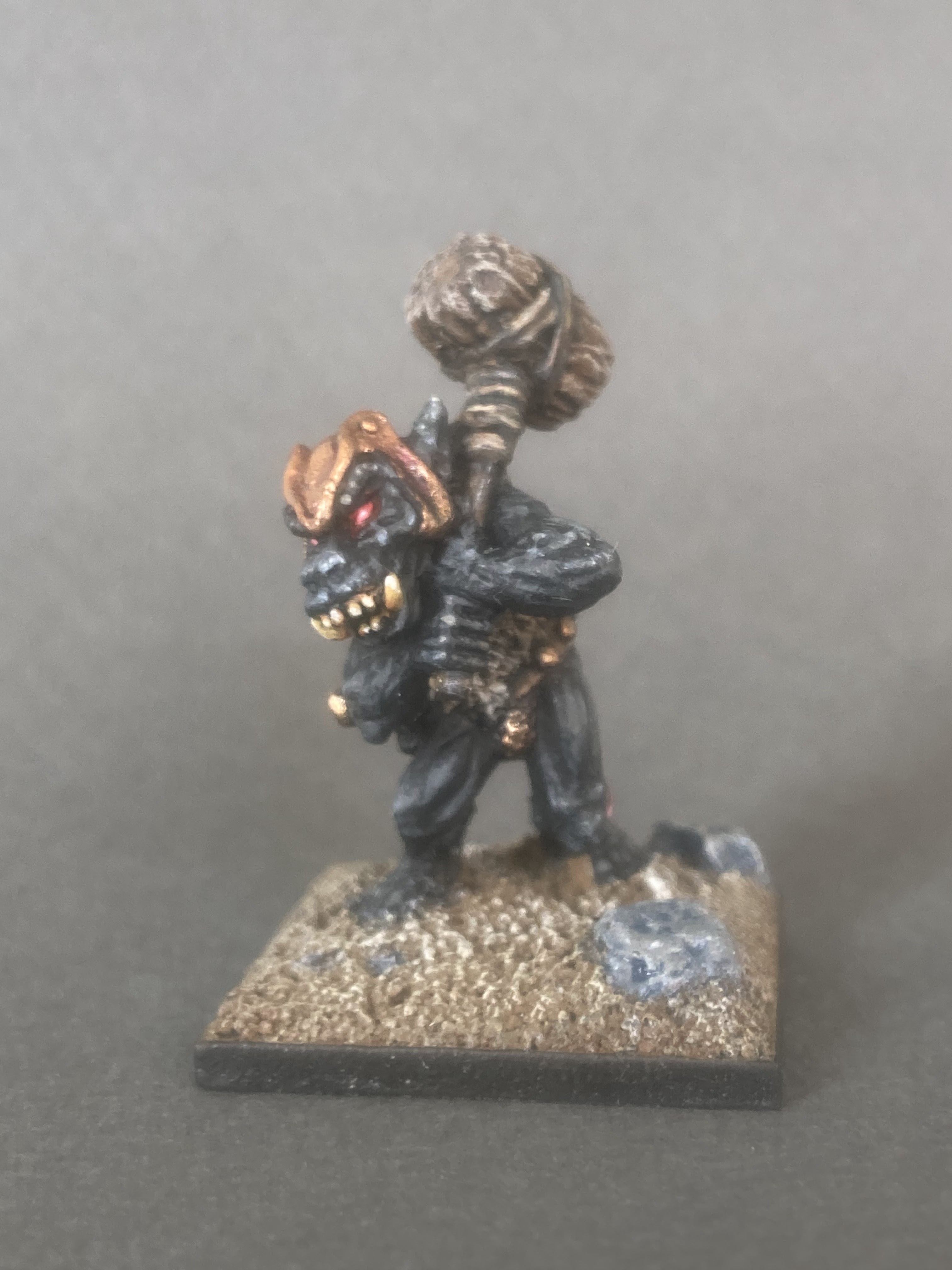
Here are some kitbashed Mantic orcs to be used as Zorak Zorani dark-troll berserkers in some Big Rubble skirmish games. 

These guys are suitably sized and fierce-looking, I think.


I think the goofy top hat isn't out of place with the whimsy that sometimes creeps into Glorantha.


I originally used this guy as a 15mm giant about a decade ago. 


The nice thing about Glorantha is that it provides you with specific runes to use for worshippers of any given god: here, disorder, darkness and death.


Monday, 23 June 2025

Dark trolls and trollkin for the Big Rubble


Here are some speed-painted stand-in trollkin for this weekend's Gloranthan skirmish game. 

I've long thought that a quest for perfect miniatures for Glorantha's peculiar inhabitants is a bit of a lost cause. Yes, there are a few excellent Uz (troll) miniatures available (though of widely differing sizes), but if you want to run some wargames or miniature-based RPGs in the Big Rubble, you need lots of trolls and trollkin. Far better, it seems to me, to paint some broadly similar creatures in a Gloranthan manner than fret about the exact length of troll snout

For me, the old Citadel Fantasy Tribe orcs are a decent match for Gloranthan dark trolls, at least as far as broad-brush description goes: about 7' tall if they stood up straight; snouts and prominent tusks; pot bellies and a hungry look.


The Grenadier orcs (as on the left above) are perhaps an even better fit, muzzle-wise, but the Citadel figures are possibly better in terms of stature and stance. And they work well enough together.

Trollkin, meanwhile, are meant to be of variable and somewhat neotenic appearance. The Oathmark goblin slaves do the trick for me - and, handily, they can be assembled with slings. I have some snoutier trollkin in the form of Grenadier goblins and Ral Partha RQ miniatures, but they'll all work fine together. 

These guys were speed-painted on Saturday; the clothing was just drybrushing stained with washes, so they were very quick. 


Tuesday, 17 June 2025

A dragonewt for RuneQuest


 Here's a slightly converted Lancer lizardman who's going to be acting as a dragonewt in some forthcoming Big Rubble skirmish games. I originally gave him a green-stuff beak and tail ending so that he could be a Shén in Tekumel. But he never made it to the painting table, and so he's now a beaked (second-stage) dragonewt for Glorantha. 


The photos aren't great; I think there's something wrong with my phone camera. But I'm quite pleased with how he looks in real life.


A nice thing about painting dragonewts is that no metallics need be involved; the creatures are supposed to rely on bone, stone and glass for their weapons and armour. 


The other nice thing about dragonewts is that they aren't supposed to look terribly similar to each other - so there's free rein for a wide variety of model types and colour schemes as the warband grows.


Tuesday, 3 June 2025

A Dark Troll for RuneQuest, etc.


 RuneQuest was the first RPG I ever got into, as quite a small child. I got the 2nd edition for my ninth or tenth birthday, I think. Recently, I ran quite a bit of it after our D&D adventurers found themselves transported to Glorantha. We switched systems and spent perhaps a year of real time playing through classic modules like Pavis and the Big Rubble and Borderlands - all of which were marvellous.


The Big Rubble is a superb concept for adventure games: a vast ruined city full of monsters and alien races (sometime indistinguishable), as well as plenty of loot. I've always thought it would make a great setting for a tabletop skirmish campaign. As I have plenty of broos miniatures, along with Citadel's Griselda and Wolfhead, a few baboons and access to plenty of historical miniatures, it seems a no-brainer. But trolls have always been a bit of a problem. Glorantha's snouted trolls aren't terribly like anything else, though I've pondered converting various gnolls and the like (possibly just 'converting by paint'). 


A while back, however, I bought the old Grenadier "Orcs of the Severed Hand" boxed set. I also picked up a couple of individual duplicates and a few each of the matching blistered trio, some of which I'd also retained since childhood. They make very good dark trolls, I think: appropriately snouted and tusked, and with quite sophisticated-looking equipment. 


This is the test piece: he's on a 25mm base, so quite large relative to humans. And if he deigned to stand up straight, he'd be a good 7' to scale with a huge head and arms, which is perfect. I'm also using some Asgard half-trolls and some of the old Citadel Gloranthan trolls. Those are based on Luise Perrin's illustrations for Borderlands, which have a much more traditional Scandinavian-folkloric appearance than the later (Trollpak on?) RuneQuest troll illustrations. But I'm happy mixing them together and uniting them by paint scheme. I also have a couple of Ral Partha RQ dark trolls to add to the mix; they work surprisingly well together.

Happily, there are matching goblins for the Grenadier orcs, which make perfect (if unusually well-equipped) trollkin. And I'm going to add in the two Ral Partha trollkin and some de-horned and de-tailed kobolds to bulk out the enlo hordes.

Edit: and here's a quick scale comparison with some WIP Gloranthan adventurers. I was trying to find some figures that would fit, size-wise, with old Citadel RuneQuest figures (represented here by Griselda and Wolfhead). The Frostgrave barbarian on the left strikes me as a perfect fit; the kitbashed Immortals/Warlord hoplite (perhaps with a Victrix head?) and Fireforge Russian work OK for me too.


Tuesday, 15 February 2022

Careful with that axe! Damage in D&D and RuneQuest - and a new house rule for shields


In the first edition of Dungeons and Dragons (1974), all player-character attacks did D6 damage. Strength bonuses were yet to be dreamed up - unless you were an ogre, in which case you did D6 + 2 damage, or a giant (2D6).

In many ways, this way of handling damage is superior to all that came afterwards, including the STR bonuses and varying weapon damages that came in later supplements and versions of the game - and in later games such as RuneQuest. And I'd argue that the rot had set in even with ogres and giants in 1974.

Why? Well, a single die of damage always allows the possibility of just a single point of damage being done - a light wound, in other words. And that's important. Even an ogre should be capable of just grazing someone as it swings its club. 

One thing I've noticed as our campaign has progressed through its Gloranthan phase is that many characters are incapable of not maiming the average unarmoured foe with a single hit. If you're armed with a dagger in RuneQuest, you do 1d4 +2 damage to start with. If you're only a bit bigger and stronger than average (STR and SIZ averaging 13), you'll be doing 2d4 +2. But the average human character has just 3 hit points in each arm. So the minimum damage from a normal human wielding a dagger will incapacitate that limb. A stronger-than-average character armed with a dagger or club can't fail to maim the average human's leg or abdomen with a single blow. And woe betide anyone in the path of a great axe (2d6 +2 damage).

Despite RuneQuest's reputation for lethality, these high minima get lost in the welter of huge damage totals that can result from impales and other specials hits. That's because RuneQuest characters tend to be heavily armoured and loaded up on protective magic. But for all the game's vaunted realism, something has slipped. Two unarmoured men in a knife fight could keep going through numerous light wounds before something more dangerous or deadly occurred - at least if Borges is any guide. D6 is better damage for a dagger than D4 +2.

For D&D house rules - or for a substantially rethought versions of the game - I'd be tempted to stick with 1D6 damage as the norm, with no strength bonuses (those I'd apply to the attack roll). But what about two-handed weapons? Well, I've seen house rules around that go with 'advantage' - roll 2D6 and pick the best. That's an elegant set-up - it increases the average damage without ruling out the possibility of a 1. 

Another option would be to use a D8. I'd probably keep that for ogres, though. Giants could deal out D10 or even D12, depending on their size. And D20 might be the preserve of dragons and their ilk. The important point is that all damage should have a minimum of 1. A single die is always preferable to multiple dice or single die plus bonus. 

Now, if two-handed weapons offer an advantage, shields need to offer a different advantage too. As many have acknowledged, a single point of armour class isn't much compensation. Trollsmyth's Shields Shall Be Splintered rule is great, but it does give PCs the knowledge that they can always avoid lethal blows when carrying an intact shield.

Why not just have shield-wielders roll to reduce damage? Opposed rolls don't slow the game down, as they can be rolled simultaneously.

So how about this for shields in old-school D&D games? 

Shields
A character equipped with a shield rolls 1D6 when hit in melee or missile combat for which he or she was prepared. The shield roll is deducted from the attacker's damage. If the attacker rolls a six and the shield-bearer rolls a 1, then the attacker can choose either to do the full 6 points of damage or to render the shield useless until repaired. 

Bucklers
Bucklers are small shields that are sufficiently small to be carried inconspicuously on a belt. They act as shields in all respects, but absorb only 1D4 points of damage. 

This rule should ensure that shields are valuable, but should also avoid characters benefiting from extra lives through their use. As the shattering of the shield is the attacker's option on the 6:1 roll, it's likely that most will go for full damage instead. So shields will break, but in considerably fewer than 1 in 36 cases. 

One more thing: hit points. There's no point in worrying about keeping minimum damage to 1 if lots of people are running around with only 1 hit point. Perhaps the minimum score for the first hit die of almost any creature should be 2. But a simpler solution might be that most people and humanoid monsters (and certainly all PCs) just have 6 hit points as the default.

There's a nice symmetry about all this. Most ordinary humans (orcs, dwarves, whatever) will survive a single melee attack. And a shield will improve their chances of survival considerably. But there's still chance that any single combat round could prove lethal - whether that's because someone slips a dagger through your visor or pulls off a perfect sword-stroke.

Monday, 7 February 2022

A quick method for resolving mass combats in RPGs

I've been running our party through the famous Cradle scenario from Pavis and the Big Rubble. We've been playing D&D (Rules Cyclopedia) between four and seven times a week for the past couple of years; a few months ago, the players found themselves dispatched to Glorantha upon a sorceress's errand. I converted all of their stats to RuneQuest; you can imagine the cries of dismay as 54 hit points dwindled to 14 - and only 4 in each arm!

For the second of the three tasks the sorceress set them, they had to defend the titular cradle. As of tonight, they're locked in battle with Lunars, water snakes and wyverns while the Watchdog of Corflu holds the Cradle fast in its fangs.

The battle pits the assorted defenders of the Cradle against dozens if not hundreds of Lunar troops. The player-characters form only a small portion of the defenders as the fight rages on the Cradle's deck (and potentially in the air and water too).

Now, resolving the combat involving the players is easy enough. But what about the battle all around?

What I've been doing is just using the combat factors from the marvellous fantasy wargame Hordes of the Things to resolve each of the various group fights with a single opposed die roll. When massed Lunar hoplites are fighting assorted Orlanthi, Storm Bull and Zola Fel cultists, I treat the Lunars as spears (with rear-rank support bonus) and the defenders as warband. So the roll is D6+5 for the Lunars vs D6+3 for the defenders. If the Lunars double the defenders' total, they destroy that block of defenders. If they merely beat them, they push them back. As warband, the defenders are weaker, but they do have the advantage (from the HOTT rules) of destroying spears if they beat them at all.

Obviously, all of the troop types from HOTT (or its parent game DBA) can be used as the situation demands. The water snakes count as behemoths, and when the wyvern riders attack, they'll be aerial heroes (+5!). The dark trolls, who have just emerged from the lower decks of the cradle, will fight as blades (+5).

So how does this interact with the PCs and their RuneQuest combat? Well, I resolve those fights individually first and then factor their outcomes into the surrounding battle. For example, the Lunars, coming down the Watchdog's head and shoulders onto the deck, have formed up three HOTT elements wide (in my head - we aren't using miniatures for this). Each element is supported by another, giving them the +1 for rear support. I'm assuming that each element consists of six hoplites (as in the scenario). If the PCs have taken out foes in their combat round, I give the defenders in that point of the line a +1 bonus.

Tonight, it worked like this. Our dwarves each laid low a Lunar hoplite in the middle of the line. So for that combat, I gave the defending warband element +4 rather than +3. They rolled 6 against the Lunars' 4, giving 10 against 9, so the defenders destroyed the front Lunar spear element and were now pushing up through to the rear rank.

Unlike in HOTT, I didn't have the supporting element destroyed too; I want the battle to last longer, and for the players to feel the advantage as they thin the Lunar ranks. And by swiftly resolving the combats to left and right of the engaged members of the party, I was able to describe what was happening on the deck without having to either make it up or resolve it through long periods of dice-rolling that didn't involve the players.

Earlier in the campaign, we did something similar using HOTT miniatures to simulate an attack on a caravan. The players cast their spells and rolled their attacks, and these influenced the HOTT game around them. It wasn't quite a full game of HOTT (for one thing, I had to stream it over Zoom via a document camera for those not in the room), but I think a full-on game of HOTT with RPG mechanics providing bonuses for the relevant combats would work perfectly. So, in a round in which the players killed all their foes, I'd give a +2 bonus to the element with which they're associated (or perhaps a -2 penalty to their foes, which makes the latter easier to double). That way, the players get to make all their usual combat rolls but still get to have an influence on the more abstracted battle taking place on the tabletop.

Wednesday, 3 April 2019

Tunnels and Trolls

Trolls in search of tunnels
The Easter holidays loom. And that entails portable family gaming in case of rainy days or evenings in. We usually take a board game or two with us when we go away, but it's good to have some theatre-of-the-mind RPG stuff on hand as well.

'Theatre of the mind' is how I played most RPGs in my youth; I can recall only one or two scenarios for which we used miniatures consistently. For most of the games I've run since returning to gaming, though, miniatures have been the default. We have lots of them, and they do help with large parties and younger players.

But most of the best games I've run in the past few years have been the miniatures-free sessions: an excursion to Hell in Heroquest Glorantha; a delve inside the slowly reanimating skeleton of a kaiju-like behemoth using Dungeon World; and a Whitehack scenario involving an insectoid scientist and his time-bending, terraforming experiments.

The advantages of miniature-based gaming are obvious: visual scene-setting and tactical possibilities. The disadvantages are fairly clear too: every encounter looks like a wargame; the imagination is constrained by the limits of terrain and tabletop; and a huge amount of time and effort is needed to keep things fresh. That's especially true of games with kids: "We killed that orc last time!".

There's one hoary RPG that was clearly designed without regard to miniatures: Tunnels and Trolls. I don't think I ever actually played this as a kid, but I often borrowed the rulebook from a friend or from the library. I recall being slightly baffled by it. The combat system seemed to be arbitrary to an undesirable extreme, despite the huge list of exotic weapons. And then there were those silly spell names. So it remained an unplayed oddity.

I decided to give it another look and bought the PDF of the fifth-edition rules. And, with adult eyes, I like what I see. It's amazing how advanced the game appears now. In many ways, it's similar to Dungeon World. Its 'saving throws' provide a universal, 2d6-based mechanic - or near-universal, as it's not the default for combat or spell-casting. But it is applicable to combat, as it covers any special ploy you attempt.

A great thing about the saving rolls is that they're heavily based on the character's core attributes. So DEX 11 is better than DEX 10, and so on. That's a huge advance on just having bands of modifiers.

Also, the combat system looks much more interesting than it did to my youthful and Runequest-jaded eyes. The default is that each side rolls damage (based on weapons and 'adds' derived from character attributes), and then the losing side takes the difference in actual damage, split equally between the parties.

That sounds simplistic. But there are plenty of hidden subtleties. For instance, while damage is shared out, not all characters will be equally able to absorb it. A plate-armoured dwarf with a CON (hit points) of 32 will laugh at all but the highest doses of damage. But an unarmoured wizard or lightly armoured rogue will often have to back out of the fight to stay alive - which means that any future damage will be focused on those still left in the fight. So that near-invulnerable dwarf could soon be in a lot more trouble.

And it's clear that those sudden switches in situation will lead to the attempting of death-defying feats, which is where the saving rolls come into combat.

There's also a simple mechanic that makes wounded monsters weaker, which in turn encourages the DM to do something unexpected on their part - or simply let them flee the field. That 'death spiral' adds a nice touch of realism and mirrors the 'don't stay in the kitchen' aspect of PC combat.

Rolling up a few characters with the kids has illustrated some other nice aspects of the game's design. Arms and armour are pricey, and characters will typically be much worse equipped than their counterparts in many other RPGs. That provides ample motivation for dungeon-crawling. My son rolled up a dwarf of formidable physique (ST 22 and CON 32), but could only equip him with a short sword, a face-mask and gauntlets.

I like the open nature of the attributes, too. While dwarves will start off strong (2 x rolled ST and CON), all characters can increase their stats as they gain levels. And higher ST and DEX will allow them access to more powerful weapons. That's hardly realistic, but it makes for a great game incentive; if you want to wield a greatsword effectively, you need to get your ST up to 21 and your DEX up to 18. That's more easily done than in many other games that incorporate training (e.g. RuneQuest), but it will still probably take a bit of work. And if you're happy to throw realism out of the window (two-handed swords aren't that heavy, and wielding a weapon with two hands is probably easier and more natural than with one), then it all works fine.

As for magic, the silly names don't bother me in the slightest now - Take that, you fiend! is probably a better name than D&D's Magic missile or RuneQuest's Disruption. All three games require a bit of thought about how these spells are actually described 'in universe', so T&T's light-hearted approach is neither here nor there. If you want a dark sword-and-sorcery flavour, just have the wizard describe the effects of their spell.

And actually, in the holidays, we might just go with the T&T silliness in all its Pratchety charm.


Sunday, 26 August 2018

The case for miniatures in RPGs


When I got back into gaming a few years ago, the thing that struck me as strangest about contemporary RPGs was the assumption that you play D&D with miniatures and a grid.

We never did that when I was a kid. Yes, we sometimes had miniatures on the table, but they were used for convenience (marching order, formations in combat and various tactical situations) and were mostly ignored altogether. We almost never used any scenery that wasn't improvised on the spot ("This d4 is the pillar with the prisoner chained to it"), and we certainly didn't use a grid. The occasional book with pictures of Chessex mapping paper pointed to some absurd platonic ideal.

I can think of a single Dragon Warriors one-off that I ran that used entirely painted miniatures with a tower and floorplans (the tower was from the Citadel mighty fortress, with old Citadel dungeon floorplans representing each level and the cellar). But that was a late-stage exception.

And I think I can safely say that none of us every paid the slightest heed to the movement stats in whichever game we were playing (RuneQuest, AD&D, Dragon Warriors, Call of Cthulhu, whatever). We assumed humans could outrun things that were more sluggish, and we assumed that fast things (e.g orcs - I tended to enforce a certain Tolkien purism on this) would catch you sooner or later. 

Since resuming RPGs with kids, family and old friends, though, I've used miniatures about half the time. Holiday games are always 'theatre of the mind' - a term that we never used as kids, because it was the default. So too have been the classic Dragon Warriors scenarios and Dungeon World homebrew games we've run through. One-off dungeon-crawls for lots of kids are done with miniatures and commercially produced tiles, however, and our Whitehack campaigns this year and last have used miniatures (15mm last year, 28mm this). The one-offs I've run for my old gaming friends have been a bit of both (miniatures for Tales of Blades and Heroes, which requires them; theatre of the mind for Heroquest Glorantha and Dungeon World; and miniatures again for Whitehack). 

I added some thoughts on the use of miniatures on noism's blog last year, when I was generally veering away from their use:
I increasingly think that they're a constraining factor in all kinds of ways: cramping scales by limiting things to the size of the tabletop; limiting the GM's imagination to the available models (even if subliminally and irrationally); and entailing a huge amount of NPCs and stuff (e.g. for a fight in a crowded marketplace). 
Noism's comment that miniatures are a "straightjacket for the imagination" was exactly how I felt. 
But since then, I've grown a bit fonder of their use. There are lots of problems, of course.  
First, miniatures cramp scales by limiting encounter spaces to the available tabletop. It would be hard to do Tolkien’s Moria, with its vast chambers and 50-foot chasms, on the average dinner table – let alone a city square, a castle courtyard or a section of steppe. To do such things in 28mm scale, you need a lot of space.

Miniatures also have a pernicious tendency to limit the GM’s imagination. If you have an owlbear model, you’ll probably use it in your game. But if you’re using miniatures yet lack a scorpion man, you’re unlikely to write one in. Owning only 10 hobgoblin models militates against the inclusion of 50 in a subterranean barracks – limiting the range of challenges for high-level PCs. Most of my childhood games featured orcs, for the simple reason that I had lots of them. I still do, and they’ve been overrepresented in recent games for that reason.

You can (and should!) fight that tendency, of course. But then there’s the problem of identification. Yes, the players know that the owlbear is actually a scorpion man. But it still looks awfully like an owlbear. Nicely painted goblins might not convince as gnolls – and they certainly won’t do as the town guard. The potential for confusion grows when you field a combination of proxies: “This werewolf’s the black knight – and that ogre’s actually the wizard’s henchman”. 

It’s also hard to escape the thought if you’re going to use miniatures, you should do it properly – not only by having appropriate figures for PCs, NPCs and monsters, but also by having them all painted. That’s a huge amount of time on top of writing and running the games themselves.

Finally, miniatures make every encounter look like a fight. Cerebral challenges become physical. Place an ogre miniature outside the stronghold gate, and players will want to kill him. Thoughts of sneaking past, distracting or persuading will dwindle or vanish.

And yet ...

The greatest excitement I've ever generated at the table was with this:


 The coiled section, to the left, was the floor of an entire room; the PCs stumbled into it after spending miles in a huge earth tunnel. There was a gallery above it, which some of them had climbed onto before one of them decided to fire an ancient energy weapon into the slowly pulsating rubbery mass over which they were clambering - at which point, the room was replaced by a pit of loose earth and the rearing worm was placed on the table. We were using 15mm miniatures, so my home-made purple worm was fairly sizeable. The shrieking took some time to subside.


My son drew this on his character sheet after the session:


Now, you can get similar effects through description alone. But the sheer fun of that encounter would be hard to replicate without props (the closest I've come in 'theatre of the mind' was in a Dungeon World game in which the players realised that the bone-walled 'dungeon' they were exploring was actually the skeleton of a vast landwhale - and the reason the walls were shaking was because a lich was in the process of reanimating it.

And miniatures do help when kids are involved and when there are lots of players of whatever age. The physical constraints of models and maps can be limiting, but they can also stimulate the imagination - especially if you make a conscious effort to escape from two dimensions. The purple worm was a one-off, but the best reusable dungeon room I've created is the 'pudding gallery' in my Devil-Warrens megadungeon. This is a gallery on the first level of the dungeon that opens onto the second level below.

The first level is patrolled by kobolds, who guard themselves with a variety of traps. A clue for the players - which none have yet picked up on - is that one section of the gallery has collapsed; the opposite section turns into a sliding ramp when the kobolds pull a lever; the collapsed bit is the remains of an identical trap. And so some of the players end up being plunged into the second level; the room below the gallery has three slow-moving but deadly black puddings.

Above ...

I've run this room three or four times, for both kid and adult players (one party found the remains of the other), and it's worked well each time. But it would be much harder to make work in 'theatre of the mind', because visualising it is a little hard, and the intricacy of movement - on the gallery, over the trapped sections, in the room below - is hard to keep track of otherwise. The first time I used it, I placed the level-two floorplan the wrong way round; none of the players realised that the rubble was in the wrong place, but I had to radically redesign and 'canonise' the second level before the next session, given the way that the doors opened!

And below (at least when the rubble and statue line up properly ...)
Each time PCs have come through this section of the dungeon, we've had really good, memorable encounters - firefights with kobolds and their pet scorpions (which, to the horror of the players, were quite capable of jumping the gap in the gallery) above, and the terror of the puddings below. Best of all, perhaps, was when the kids' PCs revisited the dungeon to find that their hapless adult counterparts had released the puddings into the upper levels, so that rather than trying to climb back up, they needed to lower themselves down into the second level.

Miniatures can also help to turn the most humdrum location into something exciting. Below are the floorplans I drew for the lair of Brug and Brag, an ettin (though I didn't call him that; ettin in my games is simply a synonym for giant - and who's to say how many heads a giant or ogre might have?)


Forget five-room dungeons - this is a two-room dungeon, albeit with an intervening pit. Yet the encounter with Brug and Brag and his servants turned into a really exciting tactical session, which I think would have been harder to achieve without maps and models. I'd planned it as a quick interlude in a forest adventure, but it ended up as a dramatic climax in its own right.

After killing Brug and Brag's hound and henchman, the PCs rolled the barrels to form a barrier on one side of the pit and sniped at the giant from that side as he hurled rocks at them. Some of them sneaked carefully into the pit during the firefight to surprise him while others distracted him with taunts. It turned into much more of a set-piece than I'd expected - and the 'reveal' of Brug and Brag was a nice surprise; until the miniature was placed after the pit had been crossed, the PCs assumed that they were dealing with two creatures.

Brug (and Brag)

Of course, most of the problems with miniature use persist. And I think all sessions, even the most focused dungeon-crawls, should have lengthy episodes of conversation with NPCs. It helps to have miniatures for obviously helpful or neutral NPCs as well as potential foes, as this defuses the 'we must kill it' tendency.

The problem of scale is still there, but recent visits to ruins (including Vindolanda and Norham Castle, neither of which I had been to since school) reminded me that a real-life 'dungeon' would be cramped and 'tight' in the way that many RPG dungeons aren't. The constraints of miniatures and - yes - a grid can actually be helpful here.

Increasingly, I think that miniatures can be a help, but it's terrain or scenery that can become a hindrance. These days, I just hand-draw floorplans onto card or paper, which allows for much more variation than any commercial dungeon tiles or geomorphs, and - crucially - allows strict line of site to be preserved (things that can't be seen by the player don't go on the table). This often breaks down with commercial floorplans, especially in cave systems. But I also use three-dimensional props, ranging from ancient bits of Fantasy Forge or Grendel resin scenery to carved foam to painted blocks or cardboard.

As long as you're not expecting it all to match like some Golden Demon diorama, it can be liberating and creative - allowing a better sense of space than you could easily achieve through description. It works through a combination of the specific - the hand-drawn plans - and the semi-abstract: blocks and boxes used for elevations and impressionstic staircases that accommodate miniatures but don't pretend to model the stairs accurately. There's lots of inspiration to be had here from the likes of Matakishi and Runehammer. And don't their games look fun?

Impressionistic steps
Also, I've finally come to embrace movement rates - especially for chases involving black puddings or gelatinous cubes or the like. The first time PCs found themselves plunging down from the pudding gallery, the tension in a chase down a narrow corridor was greatly heightened by the fact that the players didn't know what the corridor would open into and whether there would be room for some 5" vs 3" manoeuvres when it did. The eventual escape - by a square or two on the grid - felt all the more hard won for the frantic movement-rate maths that had preceded it.

The old wargaming principle of 'what you see is what you get' is also a great help when it comes to statting up monsters. There's very rarely a reason not to run with whatever combo of weapons is shown on a miniature, which cuts down bookkeeping considerably.

And there's something else too. Even if you have a lot of miniatures (and as a result of deeply misspent youth, I have), big encounter groups of monsters are often out of reach. I might manage to muster a hundred or so of my livid-skinned cave goblins (see the top of this post), but players will soon tire of them. So with humanoid monsters, the use of miniatures suggests a slightly different way of thinking: monster bands as NPC parties, with named individuals, various quirks and plenty of personality. And that is no bad thing, I think - though it's probably something for another post.

Wednesday, 22 August 2018

Wargames vs RPGs: RuneQuest, The Fantasy Trip and The Dolorous Stroke


I got into RuneQuest when I was at primary school. A friend's older brother had it, his younger brother inherited his books, and I asked for the rules for my next birthday. And that led to many glorious encounters, though very little in the way of campaigns; characters were very short-lived, and fights often ended badly.

In retrospect and despite all the glories of its setting, RuneQuest probably functioned for us as much as a brilliant skirmish wargame as an RPG. The roleplaying happened before the fighting - and then the fighting typically ended things. 

A year or two ago, a Lead Adventurer Forum regular, LeadAsbestos, noted that he'd often used RuneQuest simply as a low-figure skirmish game. My son and I tried out RQ2 in that way a while back and had a pretty good session pitting one crested dragonewt against a few trollkin. 

In the past, the big problem with RuneQuest was generating NPCs and monsters, as this took almost as long as creating PCs from scratch. So we tended to use stat blocks from scenarios (those Rainbow Mounds trollkin from Apple Lane must have been slaughtered again and again and again ...) and from FANGS, a supplement consisting of nothing but pre-generated monsters, many of whom were much more powerful than starting PCs. 

These days, though, there are automatic generators for NPCs (or at least for Mythras, the non-Chaosium incarnation of the RQ system). So statting up a few broo or dragonewts for a quick skirmish has never been easier. That's something I intend to do shortly, once I've properly digested the Mythras rules. 

The Fantasy Trip is another example of the way RPGs and skirmish games can intersect, with game being derived from the Melee microgame (I seem to dimly remember playing it; certainly, those plastic-boxed board games were in vogue at lunchtime when I was at primary school: Car Wars and Ogre in particular).

Then there's Song of Blades and Heroes and its mechanically similar RPG version, Tales of Blades and Heroes, which is great for one-off, miniature-based games and certainly enlivens combat. I've never played Savage Worlds, but I gather it performs the skirmish and RPG roles well.

It's probably true, though, that most RPG combat systems don't make for great skirmish games, because the fights are too long - too much hit-point attrition - or insufficiently tactical without GM input. Or because they're too complex. Song of Blades certainly handles 12 broo vs 5 adventurers much more smoothly than RuneQuest. And D&D-type systems can get a bit boring in symmetrical fights (two groups of three third-level fighters facing off, for example).

Conversely, most good skirmish systems aren't that great for RPGs, because they're too realistic - death can come too suddenly - or insufficiently flexible to allow for the creative ploys a group of D&D players might come up with (spilling oil on the floor, shouting "look behind you!", feigning death or whatever).

Anyway, I've been thinking about this today because I bought The Dolorous Stroke last night. It's a new skirmish game with RPGish elements from Emmy Allen, whose blog is trove of delights (add-on duelling systems for D&D, tables of hideous wounds, discussion of Machen's The White People ...). The kids and I have just given it a run-through, on which I shall report shortly.