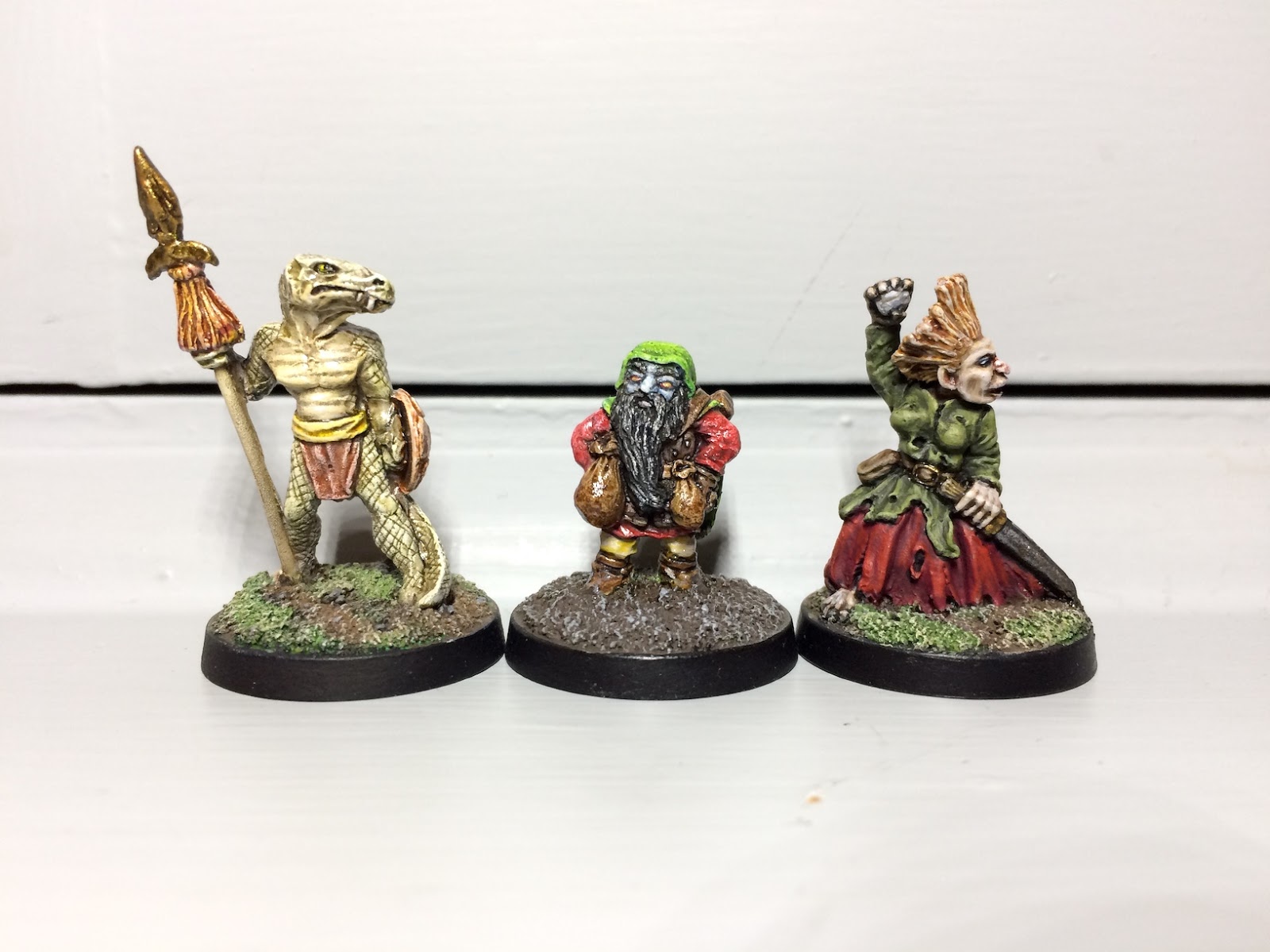
Friday, 18 February 2022
Playtesting house rules - and weapon-based initiative mods
House rule for critical hits
Here's a quick house rule for critical hits in my 'rethought' version of D&D (cooked up in response to a comment by Little Odo and this post on Grognardia).
To recap:
- shields absorb damage through an opposed D6 roll, unless damage is 6 to a shield roll of 1, in which case the attacker chooses whether to inflict full damage or break the shield; bucklers absorb D4;
- hit points are set at 6 for most first-level characters and monsters;
- All weapons do D6 damage unless the wielder is ogre-sized (D8) or (possibly) very strong;
- there are no damage bonuses (except for magical weapons);
- two-handed weapons allow the wielder's player to pick from the higher of two D6.
I like the balance of 6 HP vs D6 damage. But the problem is that rising HP (even if it's just one point per level) immediately take characters to a point where there's no risk of death from a single orc arrow. I don't want that!
Enter the critical hit. A straight critical on a roll of 20 on a D20 comes up far too often. So here's my rule:
- any unmodified attack roll of 20 allows an 'exploding' damage roll - that is, a roll of 6 on a D6 allows another damage die to be rolled and the total added together. Damage dice may explode infinitely, so long as the highest number on the die is rolled each time. Two-handed weapons explode when either of their 2D6 comes up with a 6. Note that an ogre doing D8 damage needs an 8 to 'explode'; likewise, a giant on D10 or D12 needs a roll of maximum damage. If a dragon hits you on a 20 and then rolls 20 damage, you're in for a short night ...
As a two-handed weapon essentially doubles the chance of exploding damage on a 20, there's a strong incentive to carry one - though at the cost of the D6 absorption that a shield offers. A critical is likely to overwhelm a shield; even if a 6 is rolled against a 6, the extra die will still get through.
Something I really like about this is that it (theoretically) allows even a first-level character to slay a dragon or a giant or similar sack of hit points. It means that the humble orc arrow still poses a risk - however unlikely - to the highest-level fighter. And it frees me up to allow higher-level characters to add hit dice rather than hit points with each level.
Thursday, 17 February 2022
More on my house rules for shields, hit points and damage
Shields
A character equipped with a shield rolls 1D6 when hit in melee or missile combat for which he or she was prepared. The shield roll is deducted from the attacker's damage. If the attacker rolls a six and the shield-bearer rolls a 1, then the attacker can choose either to do the full 6 points of damage or to render the shield useless until repaired.BucklersBucklers are small shields that are sufficiently small to be carried inconspicuously on a belt. They act as shields in all respects, but absorb only 1D4 points of damage.
These are designed to work with the original D&D rules, in which all weapons do 1D6 damage (unless wielded by something like an ogre or a giant). So the best shield parry will stop all the damage from the most powerful (or most accurate) human blow, but may not be capable of stopping a heavy blow from a larger and more powerful foe. An ogre uses a d8 for damage (rather than the original D6 +2), so there's a 1 in 4 chance that an ogre's blow will cause damage through even the best-placed shield.
As I set out in that post, I'm also tending towards a default 6 hit points for human-sized creatures (and first-level characters), although I might settle for a minimum score of 2 on a character's first hit die.
The reason for this is simple. I want each combat to have plenty of elements of uncertainty. One thing I love about RuneQuest combat is the sense of danger. For all your character's armour, you never know when that humble trollkin is going to roll a critical or an impale.
But at the same time, I don't want well-armed first-level characters to be walking on eggshells all the time. I think well-armed men-at-arms (e.g. first-level fighters) should fancy their chances when faced with lightly armed brigands (or orcs, for that matter).
Giving first-level characters and their foes six hit points each means that combat is risky, but that better armour - and especially shields - are likely to greatly reduce that risk if only one side has them. So three men-at-arms in mail with shields can feel confident (though not safe) in taking on three unarmoured brigands with cudgels.
With 6 HP apiece, D6 damage and a D6 absorption through a shield (unless the shield:damage ratio is 1:6), each attack has the potential to be deadly. But we're not in the situation where characters will inevitably fall if a blow connects. There's room for a little back and forth - with each wound received making the chance of a decisive attack more likely. And that ups the potential for derring-do, because a PC can take a calculated risk with their six HP in a way that's simply not possible when they only have 1.
But what about stat bonuses? After all, some people are tougher than others - or hit harder. I don't want to use STR-based damage bonuses, because those raise the minimum damage above 1. The strongest character can still cause just a scratch when they swing a sword.
Might an exceptionally strong character use the common 2D6-and-take-the-higher house rule (normally reserved for two-handed weapons) and roll an ogre-sized D8 when using a two-handed weapon? I quite like the sound of that - but it would have to be for very strong characters. There is a way of gradating this, though: characters with 16 or 17 STR might do a D8 with a two-handed weapon, and those with 18 might get the 2D6/take-the-higher rule with one-handed weapons and the D8 for two-handers.
I don't much like CON as a stat - and especially not as one that affects HP. It seems to me that strength (as reflected in muscle and bone size and density) is the physical characteristic that would boost HP; CON, as a nebulous measure of disease resistance, stamina and fitness, doesn't have an obvious role to play here.
But here's the thing. If HP are set at 6 for a first-level character (or NPC), then any bonus takes the character out of the danger zone for at least one round. If you have 7 HP, you're not going to be killed by that orc arrow or guardsman's crossbow bolt.
Perhaps, then, 6 shouldn't be the starting point. What if we make 3 or 4 the starting HP and have bonuses to HP from STR? A starting score of 4 with STR 13-15 +1 and 16-18 +2? Or a starting score of 3 with STR 13-15 +1, 16-17 +2 and 18 +3?
In that case, monster HP can be altered slightly by type. If one is separating goblins from orcs in the (distinctly un-Tolkien) D&D style, then perhaps goblins have 3, orcs have 4 and orc leaders and hobgoblins have 5 or 6?
We could also have character-class penalties for HP. Perhaps magicians, withered by study and unnatural practices, have starting HP of 2 or 3 against 3 or 4. And creatures smaller than human size could be reduced to HP 2 or 3 (though not 1).
There's something satisfying, though, about the symmetry of 6 HP and D6 damage. And if we're assuming that 6 is a lethal blow for most people, we might assume that it's a blow that would be lethal for almost anyone.
What, then, do we do with levelling up? The 6 HP/D6 damage symmetry immediately makes anyone with even 7 HP exceptional. So perhaps the increment is 1 hit point per level rather than 1 hit die. Or perhaps fighters get 2 HP while other classes get 1. That way, the second-level fighter is immediately a more awe-inspiring figure - one who can risk an arrow or a sword stroke without fearing death. And by fourth level, even a full-on hit from an ogre won't kill at a stroke.
Decisions, decisions ...
Tuesday, 15 February 2022
Careful with that axe! Damage in D&D and RuneQuest - and a new house rule for shields
Monday, 4 January 2021
Megadungeon mechanics part five: the joys of one hit die and the implications of what has gone before
I mentioned in the previous post in this series that my forthcoming megadungeon campaign will be more like a wargame than our main D&D campaign. That could be misleading, though, as I mean it in only one very specific sense: that combats will mostly be of the one-hit variety. This is going to be - for most players - a low-level campaign. A character that gets to level two will be cherished. And one that gets to level three will be prized.
In part, this limited advancement will come down to player decisions. As I've noted before, I'm using gold for XP - but only if that gold is spent on unspecified advancement-related stuff: training, study, sacrifices, etc. I'm also going to make equipment - notably armour - much more expensive than it is in the common iterations of D&D. I want a mail hauberk to be a significant treasure item in its own right. Full plate harness might cost as much as levelling up. And then there's the process of hiring mercenaries that I've set out: the common way to do this is to have them fight for an equal (or double or triple) share of the expedition's loot, which will cut down the amount of gold available to PC. When they can be hired for a day-rate, that day-rate will be high. All of this means that the players will be constantly choosing between advancement, equipment and assistance.
It also means that most PCs will be on a solitary hit die for much of the time. I'm toying with the idea of having PCs roll their hit dice for each expedition, although that might prompt a mutiny. But as monsters will be doing fighter weapon damage (d8/d10) for the most part, even second-level fighters will be vulnerable to a lucky stroke from a hobgoblin poleaxe (d10).
So characters will be more like Balin (taken out by one orc-arrow) than Boromir (pin-cushioned by countless arrows and still fighting to the last). This has three main implications.
1. Big battles can be handled easily. If the players hire 20 mercenaries to raid a goblin lair, we might conceivably have 50 or more miniatures on the table. But if we know that most of the goblins will be killed in a single attack and that many of the mercenaries (and PCs) will be too, we can look forward to an initial frenzy of d20 rolls and then a rapid clearing of the battlefield. Mass combat won't involve much more book-keeping than a typical skirmish wargame, and the deadliness should keep it exciting. I expect a lot of traditional PC activity (sneaking, stealing, trickery) to take place during large-scale combats as well as as an alternative to them.
2. Shields shan't be splintered. Because I want highly dangerous encounters, I won't be using Trollsmyth's excellent "shields shall be splintered" rule. We use that in our regular D&D campaign, and it's great. But in the megadungeon game of fully equipped expeditions, it will just lead to mules being burdened with umpteen spare shields. What I'll probably do to compensate is have larger shields modify AC by 2 or 3 rather than 1, which will be reserved for bucklers. So a tower/kite/buckler hierarchy of 3/2/1 modifiers is probably the way to go - although I'll be thinking about this a bit more.
3. Tactical retreats will be common. When running our main D&D group through the Caves of Chaos last year, I though that one of the most satisfying sessions was when a raid on the hobgoblin caves utterly failed. It ended with some PCs badly wounded and the hobgoblins hunting for them with hounds in the forest. And of course, the PCs swore revenge - which was all the more satisfying when it was eventually achieved. If your characters have only one hit die apiece, you're going to be very sensitive to the turning of the battle's tide. And that leads on to the next point.
4. Game sessions may involve multiple expeditions. I really like this concept: that three or four hours of play might not be confined to a single raid, but could feature two or three. In running our 250+-session lockdown campaign, I've observed that the joy of the game comes as much from the story that emerges between the sessions as from the sessions themselves. I want to reproduce that even in an episodic and occasional campaign, so that grudges can form, vengeance can be taken and best-laid plans can gang aft aglae. And the best way of doing that is to have more story in a single session. For that reason, downtime will be almost instant. Once the PCs are out of the dungeon, we move straight on to preparing the next expedition: "Two months pass, and your wounds are healed. Assemble your new party! What's the plan now?". As the megadungeon will have many entrances, there should always be a different approach worth trying - whether that's launching a diplomatic mission to attempt to recruit another faction to your current cause, attacking from a different direction or hiring a squadron of stone-masons to block up some of the entrances of the dungeon altogether.
With the lights out, it's more dangerous ...
I've also been considering some other implications of my previous posts. Most obviously, the continuity conceit of the last lantern-bearer won't work if many of the PCs have infravision. So perhaps all PCs should be humans. That frees up dwarfs and elves to be villains, which is just as it should be.
Then there's the presence of pack animals. I want these to be essential for expeditions to the megadungeon, for realism (food, blankets, water), to simplify encumbrance considerations and to allow for the removal of large items of treasure. They do, of course, make the party more visible, noisy and exposed - but I think that can be turned to the party's - and the game's - advantage too. If you're pursued by angry dire wolves, you might think about hobbling your mules and abandoning them to their awful fate so that you can get away. That's one option that the last lantern-bearer often has - and it's one reason that he always gets away.
The danger to mules also means that it's not only monsters that move around the dungeon, but treasure too. That provides a great boost to emergent narrative, I think. If the dire wolves dragged down your mules outside the hobgoblin stronghold, what has happened to the golden idol you looted from the troglodytes? The hobgoblins probably have it - but what have they done with it? Could you somehow play the vengeful trogs off against them? Or have they returned it to the trogs and forged an alliance with them as a result? Does that mean that their lair will now be guarded by chameleon-like stink lizards that you won't see until they're upon you? Or has a drooling ogre rescued the statue from the dire wolves' leavings and dragged it to his cave where he's now attempting to woo it by piling severed heads in front of it each day?
That's for the players to find out ...
Thursday, 22 November 2018
The Black Hack Second Edition - first thoughts
| All tomorrow's party ... |
I bought the PDF of The Black Hack's second edition a couple of days ago and am going to be running it tomorrow with some first-time players. It looks terrific.
There are some interesting changes from the first edition of the game, notably with armour. In our first-edition games, armour points (effectively first-line hit points) were a bit of a problem, because they were easily overlooked or forgotten when the dice were flying. The second edition uses a dice pool; you 'burn' a die every time you use an armour point and can then roll them to recover when you have time to rest. That's a big improvement. It also ramps up the effectiveness of armour, shields and helmets, which now stop a blow rather than a point of damage. And it makes a shield highly desirable for an unarmoured fighter, which is just as it should be.
I don't like the rules for two-handed weapons so much. These too have been revised; it used to be that a two-handed weapon added 2 to the attack and defence rolls (making them harder) and to the damage roll (making it higher). Now they add 1d4. None of this sits well with me: there's nothing about a two-handed weapon that makes it harder to hit with - quite the opposite, in fact. Controlling a spear with two hands is much easier than with one, and the same's true of other pole-arms. And parrying with a two-handed weapon is much easier than with a one-handed one, given the greater control and the ability to slide your hands along the hilt or haft.
Presumably, these rules are an attempt to emulate the sort of ludicrously oversized two-handers you see in fantasy illustrations or the 1982 Conan film. If so, fair enough. But for realistic two-handed weapons, they don't work.
Still, they're easily fixed - and the rules explicitly encourage 'hacking'. The Black Hack uses class-based damage: d4 for wizards, d6 for thieves and clerics and a new special rule for warriors. For now, I'm going to leave the special rule (multiple d6 attacks as an option) and use d8 for warriors and one die higher for two-handed weapons (so, d6 for wizards, d8 for thieves/clerics and d10 for warriors). That should work well: the advantage is modest, and the disadvantage comes from not being able to use a shield - a big old deal, especially if you're unarmoured.
That means that the heavily armoured knight will favour a poleaxe or longsword while the lightly armoured skirmisher will want a shield and a one-handed weapon. I also like the option of allowing players with longswords or spears the ability to switch to two-handed use if (for example) their shield die is 'burnt'. Of course, if you switch to two-handed use during a fight, you've dropped your shield, so if you aren't in a position to pick it up at the conclusion of the battle, you've lost it. You might find a new one on a monster's corpse - which could lead to all sorts of interesting heraldry-related difficulties ...
I digress. The main thing about the new rules is that they've made the game even more simple and useable. And the streamlining of the rules is just one aspect of this. The bulk of the new book is taken up with random-generation tables that look tremendously useful.
There are tables for wizard names, for the characteristics and cures of diseases, poisons and drugs, for incidents that incite adventures, and for NPC concepts and adventures. There are settlement generators, hex-map generators and tavern generators. There's a dungeon generator, of course, and monster generators, and a richly flavoured bestiary.
All of this stuff is richly flavoured, quirky and often funny - but not as straight-up comic as the League of Gentlemen-ish Sorrowset adventure that accompanied the first edition. In particular, I love the tables for what the various monsters in the bestiary might be up to when encountered - whether it's a wizard arguing with his shadow or a demon taunting a soul trapped in a bottle. And there's plenty of material to answer one immortal question: "What has it got in its pockets?".
This terrific stuff makes up the bulk of the book - and makes it very easy to generate adventures on the fly. Any D&Dish game would benefit from this, regardless of whether Black Hack rules are used or not. I'll pick up the hardback at some point, as this stuff simply screams to be physically bookmarked.
There are also some nice new elements. I think you can see the influence of Whitehack in the way
that character backgrounds can now influence game mechanics. And there are panic rules for PCs, which are great. I bought Torchbearer earlier this year, intrigued by its focus on resource-management in dungeon crawling. But I can't imagine I'll ever use it. The Black Hack does all that stuff much more simply.
Whitehack is likely to remain my favourite D&D ruleset for campaigns, given its elegance and greater sophistication (fighting prowess in The Black Hack is largely down to how strong your character is, for example), but the new edition confirms the The Black Hack as the go-to for one-shots. And I imagine I'll be using the tables from The Black Hack an awful lot in our ongoing Whitehack campaign.
The new book costs about a fiver in PDF (US$6). If you run fantasy RPGs, I can't imagine why you wouldn't want it.
Friday, 14 September 2018
Combat systems as a last resort
There are some obvious answers: realistic skirmish systems are too dangerous for continuity in a typical D&D-style game; and skirmish systems don't allow for the sort of madcap creativity that's a staple of a decent RPG encounter.
Let's take that second point. Creative solutions to problems are where much of the fun in RPGs arises. And the more that creativity leaks into combat encounters, the better. When I was a kid, I disliked the D&D combat system as a sterile mix of abstraction and attrition. Why not prefer RuneQuest or Warhammer FRP, where hilarity and dismemberment often arose from a humdrum fight? Since then, I've come to appreciate the D&D approach more - for its ease of bookkeeping and the tension that hit-point-depletion creates. But I wasn't entirely wrong. D&D combat can devolve into a sterile exercise in whittling hit points.
That's why the combat system should be the fall-back option. The GM should always allow players to fight through methods that don't involve armour class. Will mechanics be involved? Yes, of course: there's an element of chance. But not usually combat mechanics.
Here's an example from our most recent game: a one-off, highly derivative scenario involving dwarf PCs reclaiming their ancestral home from invading evils. At one point, the dwarves triggered an alarm that animated a gargoyle and summoned hobgoblins from deeper in the dungeon. As the hobgoblins closed with some of the dwarves at the top of the stairs, one player asked if her character could throw herself at the legs of the nearest hobgoblin. Basically, she wanted to rugby-tackle him down the stairs.
That seemed entirely reasonable, given the positioning, so I offered her a DEX check with disadvantage. Failure would result in injury to her character from the hobgoblin, and a fumble would send her tumbling down the stairs herself. But if she succeeded, she would topple the hobgoblin, driving him out of the combat and hurting him the process. She rolled the two d20s, succeeded on both and smashed the unfortunate hobgoblin down the stairs, breaking his neck in the process (a high damage roll).
This was a simple snap decision, and I'm sure most GMs do that sort of thing all the time. But I think it's worth highlighting how much more interesting and dynamic combat encounters become when there's no automatic default to AC and to-hit-rolls.
Simple stat checks, along with the disadvantage and advantage system, is all you need for this. Here are some of the things that have come up in our games:
1. Jumping on an adversary from above. (DEX, with advantage for Deft [Whitehack] or thief [The Black Hack] characters)
2. Pushing an opponent over an edge in melee. (STR, with advantage for characters bigger or heavier than their opponents, and disadvantage for lighter ones. Failure is failure; fumbles mean you go over; a critical lets you land on them for extra damage.)
3. Stepping out of the way of a charging opponent so that they fall - or tripping them as they go past (DEX, with disadvantage for all but the Deft).
4. "Behind you!" (CHA, with disadvantage unless there are special circumstances)
5. Throwing something - a torch or liquid or dust - in an opponent's face (DEX with disadvantage except for the Deft/thieves).
6. Intimidation ("Throw down your weapons! You're surrounded!", etc.) (CHA with disadvantage except for the Wise).
7. Flying tackles (DEX as above - disadvantage for everyone!)
8. Shield-barging charges to scatter opponents (STR with disadvantage)
9. Taunting opponents so that they charge into disadvantageous circumstances (CHA or, better, just roleplay it)
10. Swinging on ropes, chains or other suitable things - either into combat or out of it, or over enemies while dropping things (DEX with disadvantage except for the Deft/thieves).
Of course, monsters and NPCs can attempt all these things too.
When the AC/'to hit'/HP grind becomes the last resort rather than the first, the game becomes a hell of a lot more entertaining. And it gets faster. You don't need to cross off some of an orc's hit points if he's just been barged into a gaping chasm - or persuaded to charge into a troll's lair.
Friday, 24 August 2018
A couple more thoughts on The Dolorous Stroke: mortal wounds and asymmetry
After our brief try-out of The Dolorous Stroke the other night, a couple of other thoughts occurred to me. The first was the phrase "mortal wound".
This was an absolute staple of my childhood reading in epics and myths. But I haven't heard it used for years - and not once, I think, since I got back into gaming. Why? I suspect it's because most wargames and RPGs don't really cater for the idea of a mortally wounded warrior who staggers around the battlefield taking out a few more foes before succumbing to his injuries.
And that's a real shame. It's such a huge part of the stories that inspired fantasy gaming in the first place. There are lots of epic and mythological examples. Take Cuchulain, for example:
Then Lugaid threw the spear, and it went through and through Cuchulain's body, and he knew he had got his deadly wound; and his bowels came out on the cushions of the chariot, and his only horse went away from him, the Black Sainglain, with half the harness hanging from his neck, and left his master, the king of the heroes of Ireland, to die upon the plain of Muirthemne. Then Cuchulain said: "There is great desire on me to go to that lake beyond, and to get a drink from it."
"We will give you leave to do that," they said, "if you will come back to us after."
"I will bid you come for me if I am not able to come back myself," said Cuchulain.
Then he gathered up his bowels into his body, and he went down to the lake. He drank a drink and he washed himself, and he returned back again to his death, and he called to his enemies to come and meet him.
There was a pillar-stone west of the lake, and his eye lit on it, and he went to the pillar-stone, and he tied himself to it with his breast-belt, the way he would not meet his death lying down, but would meet it standing up. Then his enemies came round about him, but they were in dread of going close to him, for they were not sure but he might be still alive.
And then there's Boromir (whose death has a distinct echo of Cuchulain's):
Then Boromir had come leaping through the trees. He had made them fight. He slew many of them and the rest fled. But they had not gone far on the way back when they were attacked again, by a hundred Orcs at least, some of them very large, and they shot a rain of arrows: always at Boromir. Boromir had blown his great horn till the woods rang, and at first the Orcs had been dismayed and had drawn back; but when no answer but the echoes came, they had attacked more fierce than ever. Pippin did not remember much more. His last memory was of Boromir leaning against a tree, plucking out an arrow; then darkness fell suddenly.
Wednesday, 22 August 2018
Wargames vs RPGs: RuneQuest, The Fantasy Trip and The Dolorous Stroke
Wednesday, 8 August 2018
Ten RPG principles that I like
1. Stats should matter.
A strength of 12 should be significantly better than a strength of 11. So I prefer systems that use the stats themselves, rather than modifiers derived from them. That's the major strike against Dungeon World for me. I've no quarrel with systems that just have modifiers as stats. The "roll equal or under" or "roll under" systems of Whitehack, The Black Hack and Into the Odd handle provide a great way of using the character sheet to the full. I like the Mythras/RQ system of adding stats together to get raw percentage abilities too.
2. Shields should matter.
I've rambled on about this extensively, but for me it's a crucial part of making an ancient/medieval combat system feel realistic. Shields should be sufficiently useful that the choice of a two-handed weapon presents a risk/reward dilemma - unless the character is decked out in full plate like a fifteenth-century man-at-arms. Shields are cumbersome, of course, so there should also be risk/reward decisions on whether to attempt climbs or leaps with them.
3. Encumbrance should matter.
As I've said before, no one would fight with a backpack on if they could help it. Carrying stuff is a pain, and should also involve risk/reward, tactical and resource-management decisions. If you're looting a dragon's hoard, you're probably going to have to leave some of your gear behind so that you can carry more plunder. Now, most games have fairly detailed encumbrance systems - but so, so many of them get ignored or forgotten in practice. Encumbrance can only matter if the system is clear and up-front. Major props to The Black Hack here.
4. Hit points work best as a barometer of fatigue and morale
Hit points are obviously an abstraction and are probably best kept that way. For all my RuneQuest bias, I increasingly feel that the erosion of hit points in a specific location is actually quite unrealistic. In real life, the accumulation of cuts and bruises to a limb in successive combats wouldn't be equivalent to getting that limb gradually sawn off - but that's how it can go in RQ and similar systems. So, perversely, the more abstract systems can often give a more realistic feel than the "gritty" ones.
Now, obviously, what applies to limbs also applies to whole bodies - unless hit points are blood loss, I suppose. For that reason, treating falling hit points as representing increasing fatigue or flagging morale seems the most sensible approach to me. "Fatigue" can incorporate all sorts of minor wounds too, of course. But the Into the Odd approach - where STR starts to fall and saves are required once HP are gone - handles this very well. The Fantasy Trip's STR as HP does a similar thing, of course. And The Black Hack's table of out-of-action results is good too. With Whitehack, we always roll a saving throw (vs death!) when HP fall below zero - I forget whether that's the official approach or not - with precisely zero representing unconsciousness.
5. Weapon damage should be swingy.
Now that I think of it, a fatigue/morale approach to HP makes this one less crucial, but I don't really like the idea of minimum damage above 1 HP. In Whitehack, I rule that one-handed weapons do 1d6, spears, longswords and battleaxes do 1d8 when wielded in two hands and dedicated two-handed weapons (greatswords, poleaxes, halberds) do 1d10. So players get an incentive to use big, nasty weapons, but they're not guaranteed a lot of damage (a poleaxe is a thoroughly nasty weapon, but it could still just scratch you as a one-handed warhammer might, if you managed to get largely out of its way).
6. Damage by character class is a good thing ...
At the same time, I think there's a lot to be said for abandoning weapon damage in favour of character-class damage - as The Black Hack does (I think the concept has been around for aeons, though). I like the idea that a trained fighter armed with a dagger is a lot more deadly than a pasty scholar armed with the same. And even if you give that pasty scholar a poleaxe, the trained fighter with the dagger is still likely to cause more grievous wounds if they go head to head.
7. But character classes are a bad thing.
This is the RQ player's classic sneer. But I do think character classes are, by and large, a terrible idea. Whitehack has the best presentation of them I've seen, as the Strong/Deft/Wise classes are so flexible (you might well have all three represented by knights in a party, for example). I've always loathed class-based weapon restrictions, though. While RPGs don't generally do a great job in emulating fantasy literature (and books based on RPGs merit their own circle in Hell), stuff like wizards being unable to wield swords, battleaxes or maces is just abominable. The same objections I had in primary school still hold up: um, Gandalf? Elric? Jagreen Lern? The Witch-King? Thulsa Doom if we throw in film references - and so on. And don't get me started on clerics not using swords (Templars, Hospitallers, Teutonic Knights, Friar Tuck ...).
8. Stats can benefit from condensing (or correlating).
I've always been suspicious of WIS and INT. And I'm more than a little cautious about STR and CON - which is why I like the Fantasy Trip/Into the Odd STR-as-HP approach. More on that here. After all, DEX seems to cover a wider span than STR and CON (and SIZ in RQ): actual dexterity, agility, speed of thought, reaction time ...
Into the Odd, with just three stats, scores highly here.
9. Skill systems are a bore.
OK, there are exceptions here. RuneQuest handles this sort of thing pretty well. But on the whole, I think it's smoother and slicker to just rely on stats. Whitehack, with its groups system (write down your vocation/species/affiliation next to a stat or two and tell us why this means you're good at whatever you're trying to do) is really elegant here.
10. Magic isn't to be trusted
I don't like magic as technology. But I do like technology as magic (Into the Odd's arcana; ancient energy weapons; that sort of thing). And there's something about "magic systems" that I don't really like (least of all in fiction!). I'm generally inclined for magic to be something that players only access through artefacts (made by dwarves or whatever) and is otherwise wielded against them but not by them. But Whitehack does handle things well by allowing spells to be negotiated with the GM in advance and by having them cost hit points. That latter point is very simple, elegant and powerful, I think: if you must cast spells, they should come at a corporeal price.
High-tech weaponry in Whitehack
One of the big successes in the Whitehack campaign I ran for my kids and their friends last year was the judicious introduction of high-tech firearms. These were discovered in the wreckage of a spaceship underneath Dragonfell - so named for a fiery "dragon" that plummeted into the side of the mountain centuries before.
The revelation that the dragon was actually a spaceship prompted equal measures of delight and outrage ("This was meant to be a fantasy game!"), but what really got the players going was the discover of three long, metallic staves that could be manipulated to fire destructive bolts of energy.
The mechanics for this were very simple: the weapons did 1d20 damage. I like to keep weapon damage in a one-to-whatever range (i.e. a single die) whenever possible; I'm not a huge fan of "1d8 + 3" or whatever, so I'm highly sympathetic to Dungeon World/The Black Hack-style damage by class - even though I'm not that keen on character classes otherwise. The swingy d20 meant that a monster might just be grazed (though alarmed) by the energy beam. It also meant that there was a reasonable chance of obliterating a five-hit-dice monster in a single blast. The players loved that.
What they didn't love so much was the revelation that each weapon had only six shots. Boom! Boom! Click, click, click ...
By the time they discovered this, all three energy weapons had been used fairly heavily. But they hadn't been keeping track of the shots. I had, of course. That led to some great tension, especially as the bad news came when they were far away from Dragonfell.
In our current Whitehack campaign, energy weapons have yet to feature, though Dragonfell is on the map. In time, we may find out whether the players have learned the lesson of using powerful weaponry sparingly.
Monday, 23 July 2018
Into the Odd - first game and thoughts
![]() |
| Under the bridge ... |
After a wrong turn involving a bomb, a bear trap and some very distressed bystanders, the PCs managed to do just enough to effect the rescue.
We all enjoyed the game. The character-creation system manages to be swift and, er, characterful, which is no mean achievement. Everyone was ready to go in five minutes. And the setting's Dickensian flavour prompted a great set of names: Slugga the Pyrotechnist, the Professor (a nod to Conrad's The Secret Agent), 'Little' Dorrit (actually six feet tall) and Bacon. That tells a tale of its own, I think: it's rare for an RPG party to have such congruent names, especially if that party has been rolled up on the spot.
The combat system's terrific. As you always almost take damage if you get into a fight, there's a RuneQuest-ish sense of danger about getting stuck in. That means that caution, cunning and cajolery come into play far more than in standard D&D-type games. Fights are best avoided - or conducted from positions of overwhelming superiority (peppering a hapless lone cultist with musket balls, for example).
There are a few areas in the rules where you need to apply common sense. I ruled that reloading a firearm took a whole turn, so pistols and muskets were essentially single-use items in each combat encounter. The list of starting packages implies this, as many characters will be equipped with both a gun and a melee weapon. I also assumed that a character armed with a brace of pistols could choose to fire both for d8 damage or use each in successive rounds for d6. I imagine virtually all GMs would do the same.
I found NPC stats very easy to handle on the fly. At one point, we had an encounter with six cultists, so I simply gave them hit points of 1, 2, 3, 4, 5 and 6. With STR, DEX and WIS assumed at 10 each, there was very little book-keeping.
We didn't use any arcana, but bombs were thrown and rockets fired. One player now has designs on creating a sort of Heath Robinson one-use flight pack from rockets. I've told him that it'll need a DEX check to avoid being caught in the blast, but he's determined to give it a go ...
Later this week, we'll have a go at The Iron Coral, the introductory adventure in the rulebook.
Wednesday, 4 July 2018
No one fights with a backpack on ...
| A bit overladen for fighting ... |
I've rambled on about encumbrance in RPGs before, but I'm going to do it again.
In our most recent Whitehack session, the loot-laden PCs were attacked by bestial inhabitants of the Blackwold Forest. They had camped out and had secreted much of their stuff in trees. When the encounter began, only those on watch were (lightly) armoured and none had their other stuff on their person. And when battle broke out, the PCs' manoeuvres left their loot vulnerable to theft; sure enough, a hairy, dwarf-like creature ran off with some of the booty.
Once the beast-people were slain, the chase led the PCs to the lair of the ettin Brug and Brag, whose ogre henchmen they had previously dispatched; the hairy creature was another of the ettin's servants.
I'm making two points here. First, PCs shouldn't want to fight loaded down with all their equipment if they can possibly help it. Second, the placement of gear and plunder leads to plenty of options for story-telling.
Let's take the first point. No one in their right mind would engage in hand-to-hand combat with a rucksack on. The first thing you'd do would be to dump it (a free action, I'd suggest). I'm suspicious of "backpacks" in a medieval-ish setting in the first place, but my players have all bought them from the equipment list already, so hey ho. In future campaigns, I might insist they stick to sacks. In any case, anyone trying to fight with a pack full of stuff should be at -3 to hit and damage (with a minimum of 1). I think the damage reduction is realistic here; it's really hard to get a good swing with a weapon if there's something heavy on your back.
Nor would someone sleep with their armour on, unless it was just a gambeson or something like that (I think padded jacks and gambesons are what most RPGs really mean when they say "leather armour"). Recovery should be impaired for any character who does so, and lack of sleep/comfort might impose a -1 penalty on all actions and tests for the remainder of the day (cumulative for each successive night).
What about the second point? Well, as our last session showed, stuff that's not being carried is vulnerable to being snatched.
This has interesting implications. It gives the PCs something to defend. The most obvious stratagem would be to dump their stuff in one spot and form a ring around it. That's interesting, because it potentially limits their tactical options. They've got to stay in one place, and you can't have an archer or a magician picking off the enemy from behind more heavily armoured friends if they're facing the wrong way.
It also raises the possibility of the PCs being driven back from their gear. Whitehack gives characters in "the Strong" class (i.e. fighters) the option of driving foes back in combat. I give this to certain monsters too, as it creates more dynamic and interesting tabletop melees. The more movement the better: static fights can be terribly boring, especially in D&D-style d20 systems, which lack the colourful skewerings and leg-loppings of Runequest and its ilk. So the dumping of backpacks can serve as a reminder to keep combat dynamic.
Imagine a band of orcs charging into a room. If there's a burly chieftain at the front (almost man-size, perhaps ...), he might well be able drive one or more of the PCs out of their line, creating a breach into which his followers could pour - and allowing back-rankers to make off with the PCs' stuff.
If the PCs survive, they've then got a motive to raid the orcish quarters. Perhaps all the assailants except a few imps were slain. But there are probably plenty of bigger and nastier orcs waiting back at base.
It's also easy to envisage scenarios where the PCs do the driving back and then pursue their routing foes. But what if some dungeon scavenger has devoured their stuff in the meantime, before retreating to its lair?
And when the PCs cut their losses and decide not to bother retrieving the carved wooden totems they recovered from the beastmen? Why, they might discover that those offer protection from the demons that patrol the lower reaches, and so are well worth retrieving after all.
Essentially, penalising PCs for fighting with their packs on is an engine for separating players from their stuff. And that, it seems to me, should be a crucial part of a dungeon-crawling game. In our campaign, the Drinker has passed through the hands of three PCs, two of whom have died. It was the object of the party's last raid on the Devil Warrens, as they were paid to retrieve it. Little do they know that it's now in the hands of a very nasty NPC indeed ...
Saturday, 30 June 2018
This is brilliant!
Monday, 9 April 2018
Dungeon-crawling
| Two adventuring lizardmen confront a troll |
Yesterday afternoon, I ran a simple dungeon-bash for my kids. My ulterior motive was to test out some of the tweaks I've been toying with for Whitehack (shields, defensive fighting and combat priorities). I also wanted to try something resolutely old-school: multiple PCs per player.
As it turned out, we only had one player, at least to begin with: my son, who took charge of three lizardmen fighters (the strong in Whitehack terms). My daughter soon joined in, though, to play the monsters.
For speed and expediency, I laid out dungeon tiles in advance, the pretext being that the lizardmen had a map of the complex, now occupied by a villainous rakshasa who had stolen treasures from their tribe. So they knew the layout but not what lurked within it. Their aim was to retrieve two treasures, as well as some of the rare fungus that grew in the caves to which the complex was connected.
After an initial skirmish with the rakshasa's pig-faced orcish servants, in which one of the PCs was killed, and narrow avoidance of a basilisk, the surviving lizardmen raised a portcullis to enter a troll's den in search of fungus.
To my daughter's delight and my son's dismay, the troll regenerated in classic Poul Anderson fashion (it also said "Hooo!" a lot). It made short work of one lizardman, while the other grabbed the fungus and retreated. But then my son hit upon a scheme; he lured the troll away from devouring his friend's carcass and dropped the portcullis on it. That allowed him to escape while the impaled troll set about dismembering and reconfiguring itself to squirm out from under the spikes.
By the time the surviving lizardman was rescuing the first stolen treasure from a brace of gnolls, the troll was on his trail. But he was able to manoeuvre the gnolls into its path, and then skirted round a table to investigate the rakshasa's throne room. The rakshasa - I used an old Grenadier elephant version - attacked, but was then confronted by the troll. I wasn't using the Monster Manual profile for the rakshasa; he was merely an exotic-looking bad guy; and the troll eventually destroyed him (the children battled it out as the monsters while the lizardman looked on). All that remained was for the lizardman to provoke the troll with a pit (the monsters' latrine) at his back, then sidestep at the last moment - thus plunging the troll, after a failed DEX check, into the murky depths.
It was a blast - D&D stripped back to its basics. It confirmed something I've often thought: that the quest for a perfect"dungeon-crawler" boardgame is a bit of a wild-goose chase, because a boardgame just can't measure up to the flexibility of an RPG and the resourcefulness of the players.
Having one player run three PCs worked fine too - though it helped that all three had the same goals and motivation. I think that's probably the best way to proceed: each set of PCs should be thematically linked: a wizard and his sworn bodyguards; three nest-brothers of Black Swamp tribe; a burglar and his apprentices.
Sunday, 8 April 2018
The long and the short of it
One thing about RuneQuest that gives it an edge over D&D is how it handles priority in combat. Rather than a more-or-less arbitrary initiative roll, it determined the order of attack by "strike rank" - primarily made up of weapon length and the character's reach (based on RQ's SIZ stat) and reflexes (DEX).
This is clearly explained in the RQ2 text:
A slow, small person with a long spear is still likely to get the jump on a large fast person using his fist.Surprise, movement and drawing weapons are also taken into account:
A fast, large man with a long weapon can be slow to react when a dwarf with a short sword and two heads steps out of the wall.All of this makes intuitive sense. In the D&D variants (as ever, I'm mainly thinking of Whitehack here), DEX - as the sole modifier of initiative rolls - has too much influence. There isn't a SIZ stat to compensate, though, so weapon length looks the obvious thing to consider when assessing "reach" (surely one of the most crucial concepts in combat).
A rough hierarchy of the typical D&D armoury might run something like this:
Spears
Other long polearms (halberds, guisarmes, bills, etc).
Two-handed swords, poleaxes, other two-handed axes
Long-bladed, single-handed swords (longswords, arming swords, rapiers, etc)
Short swords, one-handed axes, maces and warhammers
Daggers
Fists/grappling
When a melee ensures, I'm going to use this to determine who attacks first. Initiative rolls (and DEX modifiers) apply only in the case of a tie.
You might argue that a spear isn't necessarily longer than a halberd, and that a halberd has an effective thrusting point too. That's fair enough - but if used in that manner, a halberd would do no more damage than a spear and would also require two hands to use (it's not optimised for thrusting). So a halberdier can opt to use his weapon to thrust, counting as a spear , but will then do the same damage as a spear that round.
One thing I'm inclined to do is give two-handed weapons - including spears - a higher damage die. All weapons in Whitehack do 1d6 damage, though there are negative and positive modifiers (-1 for a shortsword, -2 for a dagger, +1 for a one-handed axe or sword or a polearm, +2 for a greatsword or battle axe, etc.). Negative modifiers don't reduce damage below 1.
I'm going to stick with 1d6 for most one-handed weapons (swords, spears, axes, maces, whatever). Shortswords lose out to longer weapons in attack priority, but do the same damage (gladiuses always look quite nasty to me). The advantage of a shortsword, of course, is that it's easier to climb or run with - and easier to conceal. And I think the same applies to daggers.
Weapons that can be wielded in one or two hands use a d8 when both hands are used (longswords - aka bastard swords - are the most obvious example here, but I'd apply it to spears too). This can't be combined with a shield, of course. Weapons that always require two hands - greatswords, poleaxes, halberds, etc. - use the d10. I prefer 1d8 to 1d6 +2 for a longsword wielded in two hands, because a big weapon can still cause a small wound.
These adaptations favour spears, which seems appropriate to me. Spears should have advantages in any game based on ancient or medieval warfare; swords were typically second-choice weapons. This system gives them a reach advantage that combines either with higher damage for two-handed use or a shield.
One further tweak I'm going to make is to apply a 'closing' rule for daggers, fists and grappling. Here's how it works. If a dagger-wielder is facing a spearman, the spearman attacks first. But if the dagger-wielder manages to wound his opponent, the dagger-wielder has priority in the subsequent round - and keeps it as long as he continues to draw blood. If he misses, the spearman restores range.
Finally, I'm inclined to make grappling rely on consecutive successes (I can't remember which game does this, but I recall that one does). So, your first success gives you a hold (and priority as with daggers above). your second success is a throw (d4 damage) and a third success gives you a pin. Specially trained characters can effect a lock or a choke on a fourth success. A character being grappled can continue to attack with a dagger or shortsword (or draw one), but longer weapons are rendered ineffective.
Saturday, 3 March 2018
Shields again
This post follows on from this one, in which I loosely marshalled some thoughts on tweaks to the d20 combat system (using Whitehack).
My proposal for shield was this: a character equipped with a shield can attempt to block an attack with an opposed d20 roll. If the character with the shield rolls higher than the attacker but equal or lower to his own attack value (AV), then the attack is blocked. Draws are resolved in favour of the attacker; critical attacks allow the attacker to choose whether to do a normal critical or break the defender's shield.
Of course, shields come in various sizes. Bucklers have considerable advantages, because they're so small. You could take one down the pub (in the 21st century or in a pseudo-medieval fantasy world) without causing alarm. And you could certainly climb and crawl with one. So, let's give bucklers a -2 AV penalty when parrying. That makes them pretty handy for an unarmoured or highly skilled fighter, and well worth having. The shield of a kobold or small goblin could be used as a buckler by a human-sized PC, but would work as a full-sized shield for its original owner (who has less body mass to cover with it).
Conventional round or "heater" shields use unmodified AV. But these will impose penalties on difficult climbs or similar manoeuvres (typically -1).
Large shields - like a Norman kite or a Roman scutum - give a +1 AV bonus when used to block. But these are even more cumbersome (-2 for most manoeuvres requiring agility, and more at the GM's discretion). And they may have to be discarded in certain circumstances (narrow tunnels, for example).
Huge shields - pavises, perhaps, or tower shields, or the shields of ogres - give a +2 AV bonus but rule out climbing or jumping across chasms.
Friday, 2 March 2018
The scrum problem: more thoughts on RPG combat and some Whitehack hacks!
![]() |
| Stuck in the middle with ... yeugh! |
Other games do things differently, of course. Runequest's combat feels fast and realistic, but a consequence of speed is that the PC is highly likely to end up dead or maimed. As I've discussed before, that's great for a game in which combat is a last-resort, high-stakes affair - the climax of a session rather than part of its punctuation. But it's not so good for a dungeon crawl.
Tales of Blades and Heroes, the underrated RPG version of the classic skirmish wargame Song of Blades and Heroes, has a great risk/reward element. As in the skirmish game, players choose to attempt between one and three actions; two or more failures have unpleasant consequences - but two or more successes can be combined into more powerful attacks. And because the game has a "downed" or disadvantaged status for combatants, the balance of power can change quite quickly. It doesn't have hit points, though, so unlucky PCs can be killed quite quickly - they have a fate point or some such, if memory serves.
And Dungeon World really frees things through the Powered by the Apocalypse system, wherein descriptions trigger "moves". A combat description ("I slash at the orc's throat with my knife") might be the "hack & slash" combat move, but another ("I dive through the ogre's legs to get behind him") might be "defy danger". What's so great about this system is that it encourages the players to think creatively and doesn't limit them to combat mode - even when their characters are hard pressed by foes.
So there's a strong argument for greater choice in combat situations. But how to do this in D&D-style games without clogging the basic d20 system with complexity?
The most obvious way is just to encourage players to attempt whatever they want. Most good GMs do this anyway. But it's a good idea to remind players at the start of a session that chandeliers are there to be swung on, chairs to be flung in enemies' ways and embers to be kicked in their faces. Mechanically, a sound rule of thumb is that any "stat-check" option (a DEX check to kick embers in faces, for example) doesn't do actual damage to foes, but inconveniences them or buys the PCs time. And the negative consequences for failure are some minor disadvantage - a missed attack opportunity, an negative (worst of 2d20) roll or a positive (best of 2d20) for the enemies.
Also, tactical retreats should be eminently possible. I'd allow a player to back away from a fight at half-move without any risk - and certainly no free hacks. Attacks would be forfeited, but defence would be unaffected - so, with the shield/parry tweak I'm going to propose below, a character could defend himself perfectly well against a pursuing attacker (who would suffer no penalties from following up). In the "scrum" combat of the recent Whitehack games I've run, players haven't retreated enough. They should be able to draw off attackers (perhaps so a colleague can achieve something in the meantime) and retreat to positions of strength (doorways, most obviously).
Then there are shields. As I argued in my earlier post, shields should matter a lot. They should be truly valuable in combat - much more so than a +1 increment to armour class - but they should be heavy, bulky and something that dungeoneers often have to discard in favour of treasure or escape.
My solution? Adding an opposed roll to d20 combat. I've no idea whether other iterations of D&D already do this, but for Whitehack, here's how I see it. In Whitehack's wonderfully streamlined d20 system, an attacker succeeds by rolling equal to or under his attack value (AV) and over his opponent's armour class (AC). Rolling the AV itself is a critical. In my games, henceforth, a defender with a shield matches the attacker's roll with one of his own. He's aiming to roll higher than the attacker's roll but lower than his own AV (broadened to be 'defence value' too).
So, if Vareesh the Red (AV 14) swings a sword at Tarya Twicefallen (AV 12, AC 3, shield), he needs to roll between 14 and 4 to succeed. But Tarya can block his blow with her shield if she rolls higher than his roll and lower than or equal to her own AV of 12. If Vareesh rolls 7, Tarya turns the blow with a roll of 8 to 12.
In the case of critical hits, the attacking player can choose to either disregard the shield roll (even if it exceeds the attacker's AV ) or break the shield. So, let's say Tarya ripostes after blocking Vareesh's blow. She rolls a 12 - a critical. She decides to do double damage (as with a regular critical) to Vareesh, but she could have opted to break his shield-straps instead.
A shield block can be used only against a single attack in a given turn. But let's expand the system too, to allow characters to fight defensively: forfeiting their attack for a weapon-based parry. This can't be used against the same attacker as a shield, but it could be used against a second attacker (or a second attack from the same attacker). And of course, it can be used by a character without a shield, to allow them to try to hold off an assailant until a friend can help. The same principles apply - including the choice on a critical of double damage or a broken weapon.
At the same time, we should abandon Whitehack's d6-based damage for all weapons and allowed two-handed weapons such as poleaxes and greatswords to do d12 damage (there might be nuances within that - perhaps a greatsword might do d12 + 1, while a poleaxe might reduce AC by 1, for example).
This, I think, gives the players significantly more choice - both within the combat round and without. Wield a two-handed weapon and gain greater damage capacity at the expense of a shield. Fight defensively, or retreat to a place of greater safety, but lose out on the potential to cut your enemy down there and then. These choices involve significant risk/reward tradeoffs - and that's just as it should be.
![]() |
| Shield and plate |
But because shields are heavy, can get in the way and can break (particularly if a GM chooses to cleave one on a critical for narrative purposes), they involve tradeoffs of their own. Carry a shield, but be prepared to have to abandon it because of its bulk in certain circumstances. Grab a shield from a fallen foe - but risk being mistaken for them by a rival faction. Recall the words of Samwise Gamgee in Cirith Ungol:
'The Morgul-stuff, Gorbag's gear, was a better fit and better made', said Sam; 'but it wouldn't do, I guess, to go carrying his tokens into Mordor, not after this business here.'