|
| Fast 'n' dirty! |
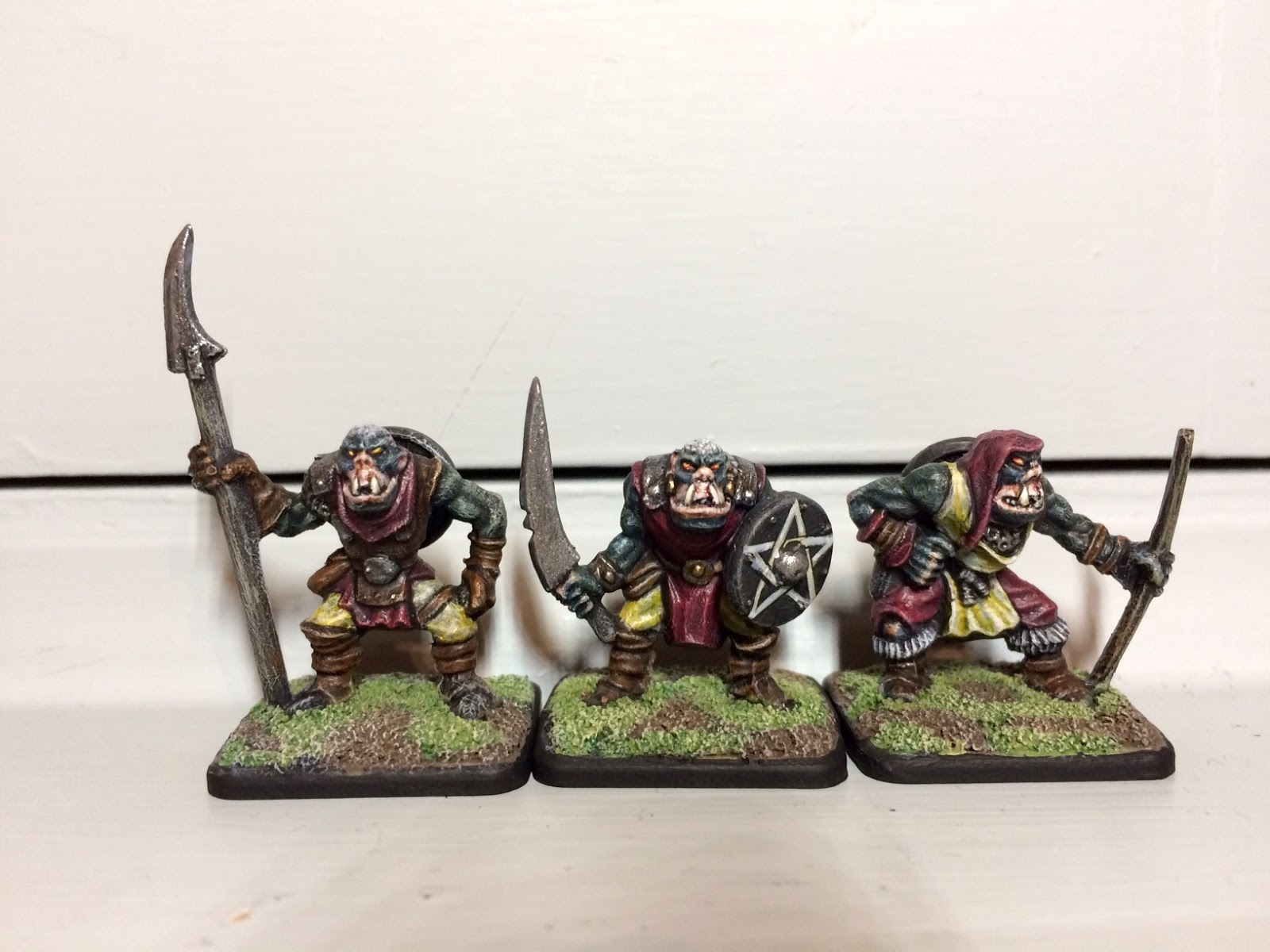
I've been meaning to finish off a few skirmish warbands for the children of some of our friends - a project I started far too long ago. So getting a few more finished quickly was the key thing. Here's how I did them.
The first step was to undercoat the orcs in black gesso. After that, I drybrushed them in mid-grey:
I then drybrushed them in white. The two layers of drybrushing create a rough gradient that provides highlights and shading through thin coats of colour.
I painted in the metals next. Metallic paints are the worst for polluting other areas of the miniature, so I wanted them in before the colours.
The colours for other areas are heavily diluted with water, so that the greyscale gradient shows through:
Then come the washes (Citadel washes in this case). If I'd been particularly pressed for time, I'd have used a single wash of sepia over everything. But as it was, I went with brown over metals, leather, hair, fur and weapon hafts; yellow over yellow cloth; red over red cloth; sepia over the green skin; and watered-down Blood for the Blood God over the pinkish areas of skin.
I then painted the tusks in buff, then highlighted them quickly in white. I used the same dab of white to pick out the eyes and brush lightly over the hair.
Next came a very few highlights in Vallejo silver-grey (which is the same as GW's Wych Elf Flesh). It's a nice 'universal' highlight as a kind of non-descript off-white that works on almost any colour. I highlighted only the pinkish flesh and the odd bit of the yellow clothing and fur, where raised areas had become too dark.
After that, I painted the eyes red and then added a dot of yellow, washed the shields in watery black, which I also used to black-line any messy delineations between colours, and roughed out a shield design in buff. I also used a bit of silver to roughly highlight the metal (an obvious stage to skip if time were short).
A few last touches finished them off, and then it was time for the bases.
The paintwork is pretty rough, but it is (I hope!) roughly pretty too. The advantage of this approach, apart from speed, is that you need take very little care. Most areas are painted by simply washing first a paint and then a purpose-made wash over the greyscale effect created by drybrushing. Only the faces and the shields get any real attention.
It occurs to me that this colour scheme - the same that I used on my
pig-faced orcs - is very close to the Monster Manual's description:
Orcs appear particularly disgusting because their coloration — brown or brownish green with a bluish sheen — highlights their pinkish snouts and ears.
As Gygax said that he conceived of his orcs as less porcine than Sutherland's illustration, these fellows may come fairly close to the original conception of the D&D orc. Whatever - at least they're done now!