Showing posts sorted by date for query shields. Sort by relevance Show all posts

Saturday, 1 August 2026

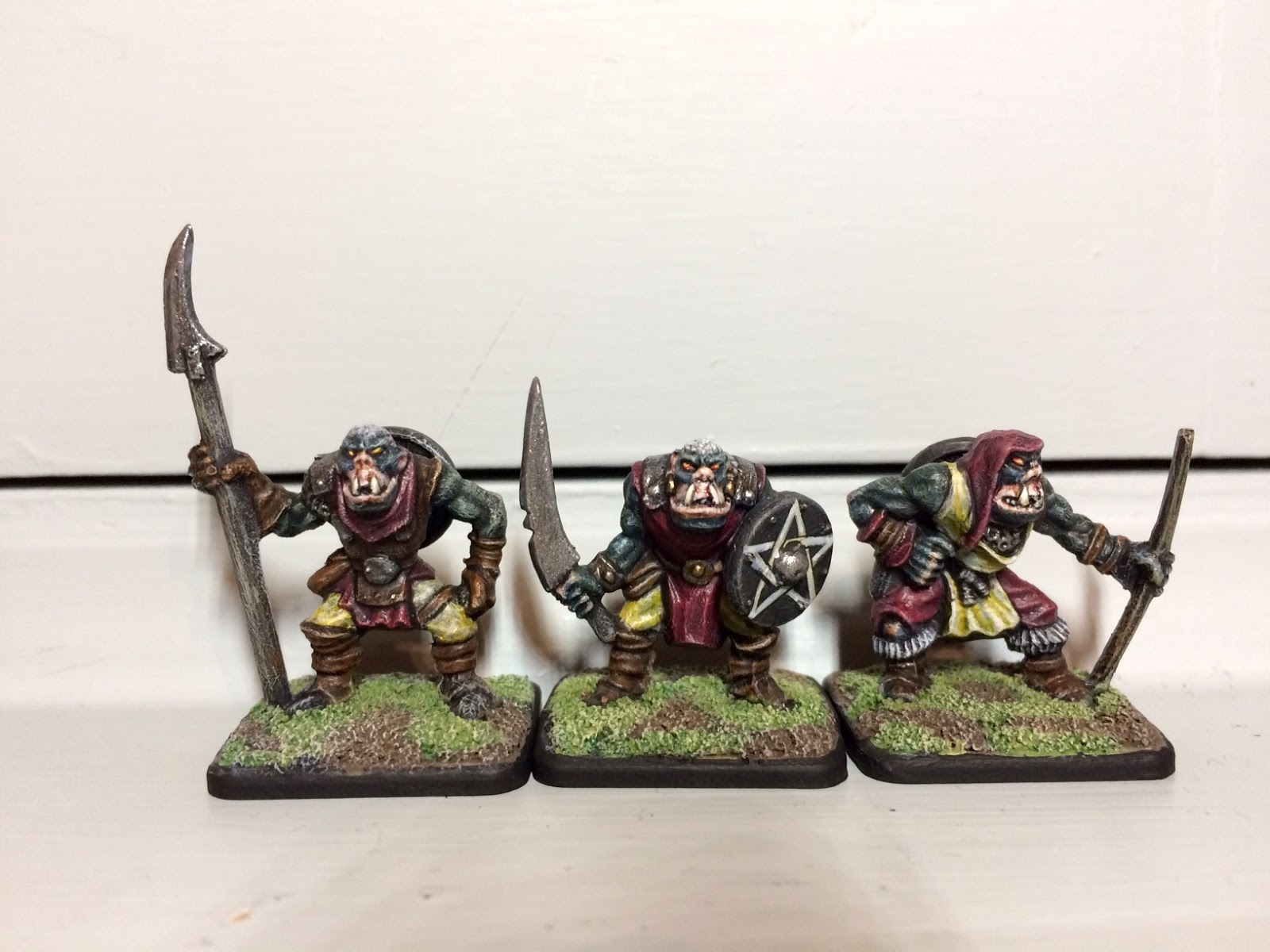
Pig-faced orcs!


 This weekend is going to be dominated by that toad. But I managed to kitbash these D&D-style pig-faced orcs before knuckling down. I've given them all Monster Manual-compliant gear. 

These are made largely from Frostgrave cultists and cultist knights, with heads from Wargames Atlantic and shields from Victrix.

Tuesday, 13 June 2023

"Goblin-soldiers of greater stature ..."


 Some newly kitbashed orcs: I bought these stumpy Hail Caesar Romans some time ago with the notion of turning them into the Uruk-hai of Isengard. They have the short stature, the short swords and broad builds of Tolkien's descriptions. 

To go the whole hog, I'd need to give them long bows of yew, but I may end up keeping them much as they are to be deployed as 'blades' in Hordes of the Things and, en masse, as goblin rabble buffed with some magic items in Kings of War. And, when I have enough made, they can be used as 'Romans' in Impetus (with less disciplined goblins acting as auxiliaries). I'll probably give them the White Hand on their shields, though. The description is of "a small white hand in the centre of a black field"; the large bosses of the scuta makes it difficult to place a small hand in the centre of the shield itself, but by putting the 'black field' in the upper half of the shield, I can probably achieve the correct effect (and take some artistic licence in the bottom half - checks or other colours or whatever).

It's the "short, broad-bladed swords" that have always made me think of Roman legionaries - though I'm doubtless influenced by this old White Dwarf cover by Angus Fieldhouse:


Sunday, 2 April 2023

Oathmark orcs


Some Oathmark orcs. They're not quite done - I'm going to add some vegetation to the bases and probably dull and weather the shields a bit. 

Sunday, 17 July 2022

Marauders of the Wastes


Any dusty sci-fi setting needs some primitive marauders to come howling out of the wastes at inopportune moments. These Copplestone half-orcs looked the part, I thought.

I envisage three main uses for these fellows in our sci-fi games. 

First, they'll offer a challenge for players who want to eschew the pew-pew for some brutal hand-to-hand action. 

Second, they'll provide a consolation prize for any player who gets knocked out early from a multiplayer game ("OK, these guys turn up - you're in charge. They want to take as many heads as possible/steal some tech/destroy all technology."). Because they don't have guns, they'll represent a fair step down from the starting force, regardless of the rules we're using. 

Third, they'll act as a band of wandering monsters, which we usually include in our games to add some spice. We typically set aside x monsters with stats and then roll dx if a d6 rolled at the end of the turn comes up with a 6. 

I'm going to add some accompanying beasts with the same markings as the shields. And I have a few more on the way: some with bows, which will give them at least some ranged capability.

Friday, 18 February 2022

Playtesting house rules - and weapon-based initiative mods


My son and I ran a quick playtest of my D&D house rules tonight. We pitted two first-level fighters against each other. Each had 6 HP and added his level (1) and his opponent's AC to the 'target 20' roll. Initiative was rolled on D6 each round. 

The first fighter had a gambeson (AC 7), a sword (D6) and a shield (D6 absorption). The second had mail (AC 5) and a two-handed sword (2D6, take the best). I was originally going to have a shield reduce AC, but forgot all about it. I think I'll keep it that way - shields seem plenty powerful!

We initially played three combats. The shield-armed fighter won the first, so we added a second mail-clad fighter with a normal sword and no shield to help the chap with the two-handed sword. The shield-armed fighter won that too, albeit with a great stroke of luck in his first attack. And then shield guy won the third fight tool.

After my son went to bed, I ran a few more fights. Shield guy won most, but greatsword guy got a couple back. 

I was quite pleased with how this played out. A shield was very important - and that's just as it should be. 

The fellow with the greatsword was a bit unlucky, in that all of his best shots were met with solid shield parries, but there was also a sense that he was a bit green and lightly armoured to be putting all his trust in a big weapon. 

And that, I think, is just as it should be too. Historically, two-handed cutting weapons tended to be the preserve of champions, bodyguards and forlorn-hope types (higher level!) - or else those with very effective armour. I ran three few fights in which greatsword guy had AC3, and he won two out of three of those. Better armour and a higher level would have swung things greatly in his favour. 

One thing I'm considering, though, is giving two-handed weapons +1 to initiative rolls. As two-handed swords, poleaxes and halberds are long, their users should probably get a higher chance of having first strike. My shield rules help here, as the fighter with the shorter weapon can trust in his shield until he closes.

Then there are spears. I'll probably give them +2 initiative. Halberdiers and billmen should be able to choose from round to round whether they want to use their weapon as a spear or a two-handed weapon - so +2 initiative or +1 and best of 2D6 damage. After all, what are halberds if not a combination of a spear and a two-handed axe?

All of that leads to a spear and shield combination being the best combination for the fighter who values his or her life. And guess what? If history's any guide, that's exactly as it should be too!


House rule for critical hits


 Here's a quick house rule for critical hits in my 'rethought' version of D&D (cooked up in response to a comment by Little Odo and this post on Grognardia). 


To recap: 

  • shields absorb damage through an opposed D6 roll, unless damage is 6 to a shield roll of 1, in which case the attacker chooses whether to inflict full damage or break the shield; bucklers absorb D4;
  • hit points are set at 6 for most first-level characters and monsters;
  • All weapons do D6 damage unless the wielder is ogre-sized (D8) or (possibly) very strong;
  • there are no damage bonuses (except for magical weapons);
  • two-handed weapons allow the wielder's player to pick from the higher of two D6.

I like the balance of 6 HP vs D6 damage. But the problem is that rising HP (even if it's just one point per level) immediately take characters to a point where there's no risk of death from a single orc arrow. I don't want that!

Enter the critical hit. A straight critical on a roll of 20 on a D20 comes up far too often. So here's my rule:

  • any unmodified attack roll of 20 allows an 'exploding' damage roll - that is, a roll of 6 on a D6 allows another damage die to be rolled and the total added together. Damage dice may explode infinitely, so long as the highest number on the die is rolled each time. Two-handed weapons explode when either of their 2D6 comes up with a 6. Note that an ogre doing D8 damage needs an 8 to 'explode'; likewise, a giant on D10 or D12 needs a roll of maximum damage. If a dragon hits you on a 20 and then rolls 20 damage, you're in for a short night ...

As a two-handed weapon essentially doubles the chance of exploding damage on a 20, there's a strong incentive to carry one - though at the cost of the D6 absorption that a shield offers. A critical is likely to overwhelm a shield; even if a 6 is rolled against a 6, the extra die will still get through.

Something I really like about this is that it (theoretically) allows even a first-level character to slay a dragon or a giant or similar sack of hit points. It means that the humble orc arrow still poses a risk - however unlikely - to the highest-level fighter. And it frees me up to allow higher-level characters to add hit dice rather than hit points with each level. 


Thursday, 17 February 2022

More on my house rules for shields, hit points and damage


The other day, I set out my house rules for shields in D&D (BECMI, Swords and Wizardry, The White Hack, whatever ...). I want to expand on them a little, so here they are again:

Shields

A character equipped with a shield rolls 1D6 when hit in melee or missile combat for which he or she was prepared. The shield roll is deducted from the attacker's damage. If the attacker rolls a six and the shield-bearer rolls a 1, then the attacker can choose either to do the full 6 points of damage or to render the shield useless until repaired. 

Bucklers
Bucklers are small shields that are sufficiently small to be carried inconspicuously on a belt. They act as shields in all respects, but absorb only 1D4 points of damage. 

These are designed to work with the original D&D rules, in which all weapons do 1D6 damage (unless wielded by something like an ogre or a giant). So the best shield parry will stop all the damage from the most powerful (or most accurate) human blow, but may not be capable of stopping a heavy blow from a larger and more powerful foe. An ogre uses a d8 for damage (rather than the original D6 +2), so there's a 1 in 4 chance that an ogre's blow will cause damage through even the best-placed shield. 

As I set out in that post, I'm also tending towards a default 6 hit points for human-sized creatures (and first-level characters), although I might settle for a minimum score of 2 on a character's first hit die. 

The reason for this is simple. I want each combat to have plenty of elements of uncertainty. One thing I love about RuneQuest combat is the sense of danger. For all your character's armour, you never know when that humble trollkin is going to roll a critical or an impale.

But at the same time, I don't want well-armed first-level characters to be walking on eggshells all the time. I think well-armed men-at-arms (e.g. first-level fighters) should fancy their chances when faced with lightly armed brigands (or orcs, for that matter).

Giving first-level characters and their foes six hit points each means that combat is risky, but that better armour - and especially shields - are likely to greatly reduce that risk if only one side has them. So three men-at-arms in mail with shields can feel confident (though not safe) in taking on three unarmoured brigands with cudgels. 

With 6 HP apiece, D6 damage and a D6 absorption through a shield (unless the shield:damage ratio is 1:6), each attack has the potential to be deadly. But we're not in the situation where characters will inevitably fall if a blow connects. There's room for a little back and forth - with each wound received making the chance of a decisive attack more likely. And that ups the potential for derring-do, because a PC can take a calculated risk with their six HP in a way that's simply not possible when they only have 1.

But what about stat bonuses? After all, some people are tougher than others - or hit harder. I don't want to use STR-based damage bonuses, because those raise the minimum damage above 1. The strongest character can still cause just a scratch when they swing a sword.

Might an exceptionally strong character use the common 2D6-and-take-the-higher house rule (normally reserved for two-handed weapons) and roll an ogre-sized D8 when using a two-handed weapon? I quite like the sound of that - but it would have to be for very strong characters. There is a way of gradating this, though: characters with 16  or 17 STR might do a D8 with a two-handed weapon, and those with 18 might get the 2D6/take-the-higher rule with one-handed weapons and the D8 for two-handers.

I don't much like CON as a stat - and especially not as one that affects HP. It seems to me that strength (as reflected in muscle and bone size and density) is the physical characteristic that would boost HP; CON, as a nebulous measure of disease resistance, stamina and fitness, doesn't have an obvious role to play here.

But here's the thing. If HP are set at 6 for a first-level character (or NPC), then any bonus takes the character out of the danger zone for at least one round. If you have 7 HP, you're not going to be killed by that orc arrow or guardsman's crossbow bolt. 

Perhaps, then, 6 shouldn't be the starting point. What if we make 3 or 4 the starting HP and have bonuses to HP from STR? A starting score of 4 with STR 13-15 +1 and 16-18 +2? Or a starting score of 3 with STR 13-15 +1, 16-17 +2 and 18 +3?

In that case, monster HP can be altered slightly by type. If one is separating goblins from orcs in the (distinctly un-Tolkien) D&D style, then perhaps goblins have 3, orcs have 4 and orc leaders and hobgoblins have 5 or 6?

We could also have character-class penalties for HP. Perhaps magicians, withered by study and unnatural practices, have starting HP of 2 or 3 against 3 or 4. And creatures smaller than human size could be reduced to HP 2 or 3 (though not 1).

There's something satisfying, though, about the symmetry of 6 HP and D6 damage. And if we're assuming that 6 is a lethal blow for most people, we might assume that it's a blow that would be lethal for almost anyone. 

What, then, do we do with levelling up? The 6 HP/D6 damage symmetry immediately makes anyone with even 7 HP exceptional. So perhaps the increment is 1 hit point per level rather than 1 hit die. Or perhaps fighters get 2 HP while other classes get 1. That way, the second-level fighter is immediately a more awe-inspiring figure - one who can risk an arrow or a sword stroke without fearing death. And by fourth level, even a full-on hit from an ogre won't kill at a stroke.

Decisions, decisions ...

Tuesday, 15 February 2022

Careful with that axe! Damage in D&D and RuneQuest - and a new house rule for shields


In the first edition of Dungeons and Dragons (1974), all player-character attacks did D6 damage. Strength bonuses were yet to be dreamed up - unless you were an ogre, in which case you did D6 + 2 damage, or a giant (2D6).

In many ways, this way of handling damage is superior to all that came afterwards, including the STR bonuses and varying weapon damages that came in later supplements and versions of the game - and in later games such as RuneQuest. And I'd argue that the rot had set in even with ogres and giants in 1974.

Why? Well, a single die of damage always allows the possibility of just a single point of damage being done - a light wound, in other words. And that's important. Even an ogre should be capable of just grazing someone as it swings its club. 

One thing I've noticed as our campaign has progressed through its Gloranthan phase is that many characters are incapable of not maiming the average unarmoured foe with a single hit. If you're armed with a dagger in RuneQuest, you do 1d4 +2 damage to start with. If you're only a bit bigger and stronger than average (STR and SIZ averaging 13), you'll be doing 2d4 +2. But the average human character has just 3 hit points in each arm. So the minimum damage from a normal human wielding a dagger will incapacitate that limb. A stronger-than-average character armed with a dagger or club can't fail to maim the average human's leg or abdomen with a single blow. And woe betide anyone in the path of a great axe (2d6 +2 damage).

Despite RuneQuest's reputation for lethality, these high minima get lost in the welter of huge damage totals that can result from impales and other specials hits. That's because RuneQuest characters tend to be heavily armoured and loaded up on protective magic. But for all the game's vaunted realism, something has slipped. Two unarmoured men in a knife fight could keep going through numerous light wounds before something more dangerous or deadly occurred - at least if Borges is any guide. D6 is better damage for a dagger than D4 +2.

For D&D house rules - or for a substantially rethought versions of the game - I'd be tempted to stick with 1D6 damage as the norm, with no strength bonuses (those I'd apply to the attack roll). But what about two-handed weapons? Well, I've seen house rules around that go with 'advantage' - roll 2D6 and pick the best. That's an elegant set-up - it increases the average damage without ruling out the possibility of a 1. 

Another option would be to use a D8. I'd probably keep that for ogres, though. Giants could deal out D10 or even D12, depending on their size. And D20 might be the preserve of dragons and their ilk. The important point is that all damage should have a minimum of 1. A single die is always preferable to multiple dice or single die plus bonus. 

Now, if two-handed weapons offer an advantage, shields need to offer a different advantage too. As many have acknowledged, a single point of armour class isn't much compensation. Trollsmyth's Shields Shall Be Splintered rule is great, but it does give PCs the knowledge that they can always avoid lethal blows when carrying an intact shield.

Why not just have shield-wielders roll to reduce damage? Opposed rolls don't slow the game down, as they can be rolled simultaneously.

So how about this for shields in old-school D&D games? 

Shields
A character equipped with a shield rolls 1D6 when hit in melee or missile combat for which he or she was prepared. The shield roll is deducted from the attacker's damage. If the attacker rolls a six and the shield-bearer rolls a 1, then the attacker can choose either to do the full 6 points of damage or to render the shield useless until repaired. 

Bucklers
Bucklers are small shields that are sufficiently small to be carried inconspicuously on a belt. They act as shields in all respects, but absorb only 1D4 points of damage. 

This rule should ensure that shields are valuable, but should also avoid characters benefiting from extra lives through their use. As the shattering of the shield is the attacker's option on the 6:1 roll, it's likely that most will go for full damage instead. So shields will break, but in considerably fewer than 1 in 36 cases. 

One more thing: hit points. There's no point in worrying about keeping minimum damage to 1 if lots of people are running around with only 1 hit point. Perhaps the minimum score for the first hit die of almost any creature should be 2. But a simpler solution might be that most people and humanoid monsters (and certainly all PCs) just have 6 hit points as the default.

There's a nice symmetry about all this. Most ordinary humans (orcs, dwarves, whatever) will survive a single melee attack. And a shield will improve their chances of survival considerably. But there's still chance that any single combat round could prove lethal - whether that's because someone slips a dagger through your visor or pulls off a perfect sword-stroke.

Monday, 4 January 2021

Megadungeon mechanics part five: the joys of one hit die and the implications of what has gone before


I mentioned in the previous post in this series that my forthcoming megadungeon campaign will be more like a wargame than our main D&D campaign. That could be  misleading, though, as I mean it in only one very specific sense: that combats will mostly be of the one-hit variety. This is going to be - for most players - a low-level campaign. A character that gets to level two will be cherished. And one that gets to level three will be prized. 

In part, this limited advancement will come down to player decisions. As I've noted before, I'm using gold for XP - but only if that gold is spent on unspecified advancement-related stuff: training, study, sacrifices, etc. I'm also going to make equipment - notably armour - much more expensive than it is in the common iterations of D&D. I want a mail hauberk to be a significant treasure item in its own right. Full plate harness might cost as much as levelling up. And then there's the process of hiring mercenaries that I've set out: the common way to do this is to have them fight for an equal (or double or triple) share of the expedition's loot, which will cut down the amount of gold available to PC. When they can be hired for a day-rate, that day-rate will be high. All of this means that the players will be constantly choosing between advancement, equipment and assistance. 

It also means that most PCs will be on a solitary hit die for much of the time. I'm toying with the idea of having PCs roll their hit dice for each expedition, although that might prompt a mutiny. But as monsters will be doing fighter weapon damage (d8/d10) for the most part, even second-level fighters will be vulnerable to a lucky stroke from a hobgoblin poleaxe (d10).

So characters will be more like Balin (taken out by one orc-arrow) than Boromir (pin-cushioned by countless arrows and still fighting to the last). This has three main implications.

1. Big battles can be handled easily. If the players hire 20 mercenaries to raid a goblin lair, we might conceivably have 50 or more miniatures on the table. But if we know that most of the goblins will be killed in a single attack and that many of the mercenaries (and PCs) will be too, we can look forward to an initial frenzy of d20 rolls and then a rapid clearing of the battlefield. Mass combat won't involve much more book-keeping than a typical skirmish wargame, and the deadliness should keep it exciting. I expect a lot of traditional PC activity (sneaking, stealing, trickery) to take place during large-scale combats as well as as an alternative to them.

2. Shields shan't be splintered. Because I want highly dangerous encounters, I won't be using Trollsmyth's excellent "shields shall be splintered" rule. We use that in our regular D&D campaign, and it's great. But in the megadungeon game of fully equipped expeditions, it will just lead to mules being burdened with umpteen spare shields. What I'll probably do to compensate is have larger shields modify AC by 2 or 3 rather than 1, which will be reserved for bucklers. So a tower/kite/buckler hierarchy of 3/2/1 modifiers is probably the way to go - although I'll be thinking about this a bit more. 

3. Tactical retreats will be common. When running our main D&D group through the Caves of Chaos last year, I though that one of the most satisfying sessions was when a raid on the hobgoblin caves utterly failed. It ended with some PCs badly wounded and the hobgoblins hunting for them with hounds in the forest. And of course, the PCs swore revenge - which was all the more satisfying when it was eventually achieved. If your characters have only one hit die apiece, you're going to be very sensitive to the turning of the battle's tide. And that leads on to the next point.

4. Game sessions may involve multiple expeditions. I really like this concept: that three or four hours of play might not be confined to a single raid, but could feature two or three. In running our 250+-session lockdown campaign, I've observed that the joy of the game comes as much from the story that emerges between the sessions as from the sessions themselves. I want to reproduce that even in an episodic and occasional campaign, so that grudges can form, vengeance can be taken and best-laid plans can gang aft aglae. And the best way of doing that is to have more story in a single session. For that reason, downtime will be almost instant. Once the PCs are out of the dungeon, we move straight on to preparing the next expedition: "Two months pass, and your wounds are healed. Assemble your new party! What's the plan now?". As the megadungeon will have many entrances, there should always be a different approach worth trying - whether that's launching a diplomatic mission to attempt to recruit another faction to your current cause, attacking from a different direction or hiring a squadron of stone-masons to block up some of the entrances of the dungeon altogether.

With the lights out, it's more dangerous ...

I've also been considering some other implications of my previous posts. Most obviously, the continuity conceit of the last lantern-bearer won't work if many of the PCs have infravision. So perhaps all PCs should be humans. That frees up dwarfs and elves to be villains, which is just as it should be. 

Then there's the presence of pack animals. I want these to be essential for expeditions to the megadungeon, for realism (food, blankets, water), to simplify encumbrance considerations and to allow for the removal of large items of treasure. They do, of course, make the party more visible, noisy and exposed - but I think that can be turned to the party's - and the game's - advantage too. If you're pursued by angry dire wolves, you might think about hobbling your mules and abandoning them to their awful fate so that you can get away. That's one option that the last lantern-bearer often has - and it's one reason that he always gets away.

The danger to mules also means that it's not only monsters that move around the dungeon, but treasure too. That provides a great boost to emergent narrative, I think. If the dire wolves dragged down your mules outside the hobgoblin stronghold, what has happened to the golden idol you looted from the troglodytes? The hobgoblins probably have it - but what have they done with it? Could you somehow play the vengeful trogs off against them? Or have they returned it to the trogs and forged an alliance with them as a result? Does that mean that their lair will now be guarded by chameleon-like stink lizards that you won't see until they're upon you? Or has a drooling ogre rescued the statue from the dire wolves' leavings and dragged it to his cave where he's now attempting to woo it by piling severed heads in front of it each day? 

That's for the players to find out ...


Tuesday, 2 June 2020

D&D goblins - or Middle Earth orcs!


Childhood survivals and impulsive eBay purchases have left me with a large supply of 28mm goblins. Not, in the main, the zany, impish, smirking goblins that became popular from the later 1980s, but nasty, fearsome orcs. They're goblins in D&D terms of course: the goblins of the Monster Manual are essentially Tolkien's orcs while the pig-headed beastmen of that volume take their name and tribal affiliations from Tolkien but very little else.

Goblins from Acropolis, Citadel, Ral Partha, Rieder* and Citadel
*This one's a Rieder orc

In Middle Earth, of course, orcs and goblins are the same thing. The Uruk-hai are just as much goblins as the smallest snaga. Indeed, in the text of The Lord of the Rings, Uruks are described as "goblins" more often than are the smaller types.


Citadel Grom's Goblin Guard trooper

Early manufacturers of fantasy miniatures recognised this, probably because they were drawing on The Lord of the Rings directly rather than on derivative materials. So Ral Partha's Wizards, Warriors and Warlocks range featured "Giant Goblins" who were clearly the Uruk-hai of Isengard - complete with the White Hand on their shields and the S-rune on their helmets. They are a little bigger than the other goblins in the ranges, but are still squat, short creatures. And that's as it should be: it's clear from the text of The Lord of the Rings that Uruks are significantly shorter than Men - which is what makes the half-orcs (described as Men rather than Orcs) so remarkable.


Citadel Fiend Factory Red Goblin

Anyway, given all the goblins that I have kicking around, I thought I'd kill two birds with one stone: create a wargaming army of Middle Earth orcs and amass a huge supply of goblins for D&D. So I'm painting all these goblins from diverse manufacturers in the same simple style. I'm basing them all on 25mm squares so that they can be used in common-frontage wargames (MicroHotT, Book of War, perhaps Oathmark). Although that's 5mm wider than the traditional 20mm, a lot of these figures occupy the space quite nicely, as they're "squat and broad" (matching Tolkien's description of the Uruks at Helm's Deep). 


There are a few goblins I'm throwing into this project that aren't really Tolkienesque - like this Metal Magic 'red goblin' with his hammer and sickle! But he'll work OK as a goblin smith or something in D&D.

Metal Magic Red Goblin

For the colour scheme, I wanted something that would broadly fit both Tolkien's descriptions and those of D&D. Tolkien's orcs are 'swart' and 'sallow', but they should also look appropriately subterranean. D&D goblins have livid skin in grey or earthy tones. I started with a grey base, washed it in sepia and then highlighted it in grey, buff and Vallejo's Pale Flesh. I think the end result reasonably covers all bases: they're sallow, thanks to the buff, and could reasonably be described as 'swart' too. 

For the eyes, I went with a glowing red/yellow. This fits with D&D's 'glowing red eyes', but is perhaps stretching Tolkien's only description of orcish eyes as 'like coals'. When I was a child, I read this as indicating that the orc's eyes were glowing like red-hot coals, but that's clearly not the only reading. The eyes could be coal-black or simply burning with rage or malice. Still, eyes like glowing coals is still a valid interpretation, and it fits with the orcish ability to see in the dark. So I'm content to go that way. What I'm still not sure on is whether to give them pupils. I'll make a decision once I've got more done.

As far as liveries and heraldry go, I'm going with the Red Eye where no other emblem is present. Where there's a White Hand, or where one looks appropriate, I'll use that instead - and cheerfully mix them together until I have enough Isengarders to work separately. The Citadel Fiend Factory goblins have a wolf emblem, so I'm painting that in red and black to fit the description of goblin banners being red and black at the Battle of the Five Armies.

Wednesday, 8 April 2020

Strength, shields and spears - my house rules for Basic D&D

While in lockdown, I've been running D&D for my kids and some friends. We've got a seven-strong party with player ages ranging from nine to a fair few decades past that. And it's been great - not only as a way for the kids to see their friends every day but also as a gaming experience. I've been taking them through The Keep on the Borderlands, which I've never run or played before, and it's been a blast.

We're using Basic D&D (as contained in the Rules Cyclopedia). Although the red-box Basic set was probably the second RPG I ever read (after Runequest), I don't think I ever played it. I did play a bit of AD&D, but - as children - we disdained Basic as childish!

Clearly, that was absurd. The rules contained in the Cyclopedia are well constructed and sturdy, and they seem nicely modular. In choosing them over the superb Whitehack, I wanted three things: a proper 'rules as written' game of D&D with simple choices (against Whitehack's more freeform approach), an instantly available common reference for the players and a very well-defined system of character progression. After all, who knows how long lockdown will last?

Nevertheless, I had to tweak a few rules. We're now eight or so sessions in, and I'm quite pleased with the tweaks. So here they are.

1. STR as HP/STR and HP
I've blogged about this before, but I've never been able to get over the possibility that a first-level fighter might have STR 18 and HP 1. The Fantasy Trip's use of ST(R) as HP gets round this elegantly. And Into the Odd takes a similar approach by combining HP and STR as HP. When characters run out of HP, they take wounds off STR and have to save under their remaining STR to stay in the fight/conscious/alive. I love this system. As in The Fantasy Trip, I have characters take STR damage off a running total that leaves the 'true' STR stat unaffected for lifting portcullises, 'to hit' and damage bonuses, and so on.

It works really well because it preserves HP as the classic Robin Hood vs the Sheriff of Nottingham store of cunning parries, shaken-off light wounds and narrow dodging of death. And it means that characters who roll 1 for HP don't feel too aggrieved. Perhaps they're just green, clumsy or plain unlucky - all conditions that can be cured through advancement. And it means that the STR 18/HP1 fighter is still much hardier than the average fighter; even after taking a 6HP blow, he'll be much more likely to stay in the fight than the STR 6, HP 4 magician would. That's just as it should be, I think.

At the same time, the fragility of first-level characters (and others) is preserved. There's no need at all to fudge your initial HP roll (my son's thief has 1HP and only 10 STR, but has made both his STR saves so far!).  Low HP mean that you'll be taking STR saves sooner rather than later. But they don't mean that you'll always die or pass out on being struck by a goblin slingshot or hit with a kobold cudgel. Combat becomes less predictable, which can't be bad.

2. PC and NPC deaths
Now, the chances of a PC death with this system are reduced somewhat. I've generally ruled that if you fail your STR check, you're out of the fight (not necessarily unconscious, but groaning and unable to do anything useful), but if your comrades rescue you, you can be revived with proper care (say, a week of rest and the attendance of physicians or equivalents). If your friends get you back to base immediately, you'll probably be OK.

That helps with party continuity and plausibility, and also with forcing the PCs to adjust their plans. If someone breaks their leg in a fight, you can't take them with you. And if you leave them, they'll die. Decisions, decisions ...

Similarly, if you're forced to retreat from combat without rescuing your friend, he's dead. So far, such injuries have made our campaign more episodic, which is a good thing. Raids on the Caves of Chaos are all fun and games until someone gets hurt ...

And there's also a risk of immediate death in certain situations. Our sole death so far came when a PC tried to leap through the gnashing portcullis-mouth of a living tower (pinched from Return to the Keep on the Borderlands). I warned him that this was a DEX save with death as the consequence, and he still attempted - and failed - his roll. Splat!

I'd apply the same warning in a focused combat like a duel to the death with a master swordsman, but not to a sudden skirmish with orcs. It means that the battlefield is strewn with the dying as much with the dead; the orcs don't get the STR save, but their leader might. Important NPCs get STR saves, but faceless minions don't.

In proper wilderness adventures (the Caves of Chaos are too close to the keep to count!), a failed STR save probably entails death. So running out of HP is no laughing matter - but it's something that the strong can usually shrug off.

All in all, this system makes combat more interesting. Maimed companions demand decisions - and death always threatens but isn't always instant.

3. Target 20
I've shamelessly stolen this from Delta. It's great - no need for THAC0 and all that. It makes combat and other stuff much faster. Hooray!

4. Shields shall be splintered
And I've nicked this from Trollsmyth too. I have a more complex house rule for Whitehack, but it doesn't work in a roll-high system. The point is that shields should be valuable in combat - just as they were historically. And I just love the heraldry-driven complications that can arise from carrying the Broken Skull's tokens into the Bloody Tusk's territory ...

5. Spears go first - and polearms can be spears
I'm just about OK with Basic's individual-initiative system, in which two-handed weapons attack after others. I can rationalise certain things with reference to cramped dungeons and sudden ambushes. But it becomes laughable when a dagger-wielder takes on a halberdier in the open and goes first. So, the way I fix this is to allow spears to win individual initiative (whether wielded in one hand or two), which makes them the natural weapon of choice for soldiers. And of course they can be thrown too. So the archetypal spear-and-shield-wielding guardsman makes a lot of tactical sense.

On top of that, I allow polearms to be used as spears or as two-handed weapons in any given round. So, if you want to hold your foe at bay with the pointy bit of your halberd, you'll win initiative against a foe with a sword, axe or knife, but you'll only do d6 damage. If you want to swing it for the full d10, you lose initiative.

I'm well aware that this isn't strictly accurate - you can swing a polearm at a foe long before they get a chance to close with you. But there might be a glimmer of truth in it for a 'killing blow' - especially if we're assuming that most fights take place in fairly cramped conditions. And it makes for nicely balanced decisions.

I'm not quite sure what to do about poleaxes. It's fairly clear that the authors of Basic had little idea of what a poleaxe actually was (up to 15' long? And no spike? Cheaper than other polearms? Really?). As the poleaxe is the descendant of the Danish axe, they might both be covered by the battle-axe category - but then the poleaxe was the weapon of choice of the heavily armoured knight, so it should be the best thing on the battlefield! I suspect it's easiest for now just to group it with other polearms - although poleaxes are generally significantly shorter than halberds, so would be more wieldy in close and less good at the speary stuff. I probably have to accept that D&D just doesn't do that level of detail!

6. Magicians are rare
This is less of a rule than a tonal note. The only magician in our party is an elf. I'm keen to have sleep spells and magic missiles be awe-inducing interventions - not something that most bandits or guardsmen will have seen before. So magic-users are rare, distrusted and generally keen to conceal their powers.

Sunday, 5 April 2020

Elven swords as minor magic items

Decisions, decisions ...

Almost every GM must have at some point purloined the likes of Sting, Glamdring and Orcrist from The Hobbit. As a reminder, these are elven swords "made in Gondolin for the Goblin-wars. Their blades glow blue when orcs are near.

A neat magical item, then. But where's the catch? My view of magical items is that they're at their best when they bestow minuses as well as plusses. The best magic items in legends and literature are ambivalent: think of Stormbringer, Tyrfing or Andvaranaut.

Tolkien's elven swords don't have any obvious disadvantage in the books. Most GMs would probably include them as "+1 swords, glow when orcs are near" (or goblins - D&D's division of the species makes this tricky to translate!). Fair enough - but I think it's better to drop the bonus and make their magic more minor.

After all, a sword that acts as an early-warning system is a considerable advantage in its own right. So here's how I treat "elven swords" in our D&D games:

1. They glow when non-human and non-demi-human chaotic creatures are near. So they'll help detect a disguised demon but not an evil priest or chaotic bandit.
2. They give no mechanical advantages in combat; they are, however, elegant and well made.
3. They have to be fully drawn to glow (you can't just loosen one in its scabbard to check the edge).
4. As a result of 3 above, you have to have the sword readied as you advance with it. That means that you can't use a bow or crossbow, or a two-handed weapon, at the same time.
5. As elves are on the small side in D&D (unlike Tolkien), elven 'swords' are short swords or 'normal' (i.e. arming) swords. They do not come in bastard or two-handed varieties. Daggers are much rarer than swords.
6. You can carry a drawn sword in your shield hand, but you'll have to drop it to use the shield in combat; in our D&D games, shields are highly desirable thanks to Trollsmyth's tremendous 'shields shall be splintered' rule. So, if you have a better weapon for combat (a one-handed bastard sword, say), you'll need to weigh up whether the early warning trumps optimal combat readiness.
7. While you get an early warning, you also give an early warning: the blue light from an elven sword is fierce and bright.

There are still ways to optimise situations, of course. A shield-armed character might carry the drawn sword in his shield hand and a spear or axe ready to throw before switching to the sword. And an adventurer sneaking round the underworld with an elven sword might duck down empty corridors to inspect the blade safely. But characters still have to make decisions of minor difficulty. And that's just as it should be.

And it's always worth remembering that some people react to such swords very badly indeed:

The Great Goblin gave a truly awful howl of rage when he looked at it, and all his soldiers gnashed their teeth, clashed their shields and stamped. They knew the sword at once. It had killed hundreds of goblins in its time, when the fair elves of Gondolin hunted them in the hills or did battle before their walls. They had called it Orcrist, Goblin-cleaver, but the goblins called it simply Biter. They hated it and hated worse anyone who carried it.


Wednesday, 1 April 2020

A very ugly orc


This is an old Citadel Fantasy Tribes orc from the early 80s. I've painted loads of these fellows before, chiefly in a 'fish-white' scheme in a nod to Alan Garner's svart-alfar. 

But, as we're playing a lot of D&D at the moment (in the house and over Zoom), I thought I might try some with square bases (for Book of War and MicroHotT) and a more Gygaxian colour scheme ("brown or brownish-green" with "pinkish snout and ears" - I didn't bother with the "bluish sheen" prescribed by the Monster Manual as well). 

This guy's a test. I'm quite happy with him, though I can't seem to get a terribly good photo.


The Fantasy Tribe orcs predate Warhammer and were, presumably, designed with D&D in mind. They're certainly not Tolkienesque, like some of the slottabased C15 orcs, which had long arms, bow legs and short stature. Those were produced around the time that Citadel obtained a licence for official Lord of the Rings miniatures; some may have been trial runs for that range. But the Fantasy Tribe lot were taller, ganglier and armed, inter alia, with crossbows and polearms - the quintessential weapons of the D&D orc. 


The range was huge, thanks to the practice of swapping a dozen or more heads between a dozen or more bodies. I used a similar - though bluer - scheme on some other orcs a few years back, and also on a Fimir; I was planning to use the lot of them together as a Fomorian warband for Of Gods and Mortals. I may yet do so.


Here's the new fellow with his predecessor:


For the shields, I was aiming for something that looked primitive enough for an orc to draw itself. The older shield works a bit better, but I like the idea of having some in black and some in white. I based the design on the figurehead of a Viking longship. The two bluish orcs on the right of the photo with the Fimir might end up being rebased to work with this lot. Then again, I have plenty more ...


Wednesday, 26 December 2018

Some speed-painted orcs

Fast 'n' dirty!

I've been meaning to finish off a few skirmish warbands for the children of some of our friends - a project I started far too long ago. So getting a few more finished quickly was the key thing. Here's how I did them.

The first step was to undercoat the orcs in black gesso. After that, I drybrushed them in mid-grey:


I then drybrushed them in white. The two layers of drybrushing create a rough gradient that provides highlights and shading through thin coats of colour.


I painted in the metals next. Metallic paints are the worst for polluting other areas of the miniature, so I wanted them in before the colours.

The colours for other areas are heavily diluted with water, so that the greyscale gradient shows through:


Then come the washes (Citadel washes in this case). If I'd been particularly pressed for time, I'd have used a single wash of sepia over everything. But as it was, I went with brown over metals, leather, hair, fur and weapon hafts; yellow over yellow cloth; red over red cloth; sepia over the green skin; and watered-down Blood for the Blood God over the pinkish areas of skin.


I then painted the tusks in buff, then highlighted them quickly in white. I used the same dab of white to pick out the eyes and brush lightly over the hair.


Next came a very few highlights in Vallejo silver-grey (which is the same as GW's Wych Elf Flesh). It's a nice 'universal' highlight as a kind of non-descript off-white that works on almost any colour. I highlighted only the pinkish flesh and the odd bit of the yellow clothing and fur, where raised areas had become too dark.


After that, I painted the eyes red and then added a dot of yellow, washed the shields in watery black, which I also used to black-line any messy delineations between colours, and roughed out a shield design in buff. I also used a bit of silver to roughly highlight the metal (an obvious stage to skip if time were short).


A few last touches finished them off, and then it was time for the bases.


The paintwork is pretty rough, but it is (I hope!) roughly pretty too. The advantage of this approach, apart from speed, is that you need take very little care. Most areas are painted by simply washing first a paint and then a purpose-made wash over the greyscale effect created by drybrushing. Only the faces and the shields get any real attention.

It occurs to me that this colour scheme - the same that I used on my pig-faced orcs - is very close to the Monster Manual's description:
Orcs appear particularly disgusting because their coloration — brown or brownish green with a bluish sheen — highlights their pinkish snouts and ears.
As Gygax said that he conceived of his orcs as less porcine than Sutherland's illustration, these fellows may come fairly close to the original conception of the D&D orc. Whatever - at least they're done now!

Thursday, 22 November 2018

The Black Hack Second Edition - first thoughts


All tomorrow's party ...


I bought the PDF of The Black Hack's second edition a couple of days ago and am going to be running it tomorrow with some first-time players. It looks terrific.

There are some interesting changes from the first edition of the game, notably with armour. In our first-edition games, armour points (effectively first-line hit points) were a bit of a problem, because they were easily overlooked or forgotten when the dice were flying. The second edition uses a dice pool; you 'burn' a die every time you use an armour point and can then roll them to recover when you have time to rest. That's a big improvement. It also ramps up the effectiveness of armour, shields and helmets, which now stop a blow rather than a point of damage. And it makes a shield highly desirable for an unarmoured fighter, which is just as it should be.

I don't like the rules for two-handed weapons so much. These too have been revised; it used to be that a two-handed weapon added 2 to the attack and defence rolls (making them harder) and to the damage roll (making it higher). Now they add 1d4. None of this sits well with me: there's nothing about a two-handed weapon that makes it harder to hit with - quite the opposite, in fact. Controlling a spear with two hands is much easier than with one, and the same's true of other pole-arms. And parrying with a two-handed weapon is much easier than with a one-handed one, given the greater control and the ability to slide your hands along the hilt or haft.

Presumably, these rules are an attempt to emulate the sort of ludicrously oversized two-handers you see in fantasy illustrations or the 1982 Conan film. If so, fair enough. But for realistic two-handed weapons, they don't work.

Still, they're easily fixed - and the rules explicitly encourage 'hacking'. The Black Hack uses class-based damage: d4 for wizards, d6 for thieves and clerics and a new special rule for warriors. For now, I'm going to leave the special rule (multiple d6 attacks as an option) and use d8 for warriors and one die higher for two-handed weapons (so, d6 for wizards, d8 for thieves/clerics and d10 for warriors). That should work well: the advantage is modest, and the disadvantage comes from not being able to use a shield - a big old deal, especially if you're unarmoured.

That means that the heavily armoured knight will favour a poleaxe or longsword while the lightly armoured skirmisher will want a shield and a one-handed weapon. I also like the option of allowing players with longswords or spears the ability to switch to two-handed use if (for example) their shield die is 'burnt'. Of course, if you switch to two-handed use during a fight, you've dropped your shield, so if you aren't in a position to pick it up at the conclusion of the battle, you've lost it. You might find a new one on a monster's corpse - which could lead to all sorts of interesting heraldry-related difficulties ...

I digress. The main thing about the new rules is that they've made the game even more simple and useable. And the streamlining of the rules is just one aspect of this. The bulk of the new book is taken up with random-generation tables that look tremendously useful.

There are tables for wizard names, for the characteristics and cures of diseases, poisons and drugs, for incidents that incite adventures, and for NPC concepts and adventures. There are settlement generators, hex-map generators and tavern generators. There's a dungeon generator, of course, and monster generators, and a richly flavoured bestiary.

All of this stuff is richly flavoured, quirky and often funny - but not as straight-up comic as the League of Gentlemen-ish Sorrowset adventure that accompanied the first edition. In particular, I love the tables for what the various monsters in the bestiary might be up to when encountered - whether it's a wizard arguing with his shadow or a demon taunting a soul trapped in a bottle. And there's plenty of material to answer one immortal question: "What has it got in its pockets?".

This terrific stuff makes up the bulk of the book - and makes it very easy to generate adventures on the fly. Any D&Dish game would benefit from this, regardless of whether Black Hack rules are used or not. I'll pick up the hardback at some point, as this stuff simply screams to be physically bookmarked.

There are also some nice new elements. I think you can see the influence of Whitehack in the way
 that character backgrounds can now influence game mechanics. And there are panic rules for PCs, which are great. I bought Torchbearer earlier this year, intrigued by its focus on resource-management in dungeon crawling. But I can't imagine I'll ever use it. The Black Hack does all that stuff much more simply.

Whitehack is likely to remain my favourite D&D ruleset for campaigns, given its elegance and greater sophistication (fighting prowess in The Black Hack is largely down to how strong your character is, for example), but the new edition confirms the The Black Hack as the go-to for one-shots. And I imagine I'll be using the tables from The Black Hack an awful lot in our ongoing Whitehack campaign.

The new book costs about a fiver in PDF (US$6). If you run fantasy RPGs, I can't imagine why you wouldn't want it.


Tuesday, 28 August 2018

What if the monsters are adventurers too?


In an earlier post, I noted that the "numbers appearing" in OD&D's monster descriptions are very high - running into the hundreds in many cases. That's great when monsters live in tribes. But what if they operate in much smaller gangs? What if they're essentially adventuring parties?

Let's take "dungeon ecology". Having a vast area of subterranean ruins peopled by one or more tribes of humanoid monsters gets us into "number appearing" territory. That suggests the Mines of Moria as a default: large numbers of orcs (or whatever) that you definitely don't want to meet all at once, or at all if you can help it. Any small groups encountered are likely to be guards or scouts - and, unless extreme care is exercised, will probably summon more of their kind. There's excellent potential for the adventure as a chase - get in, get what you're after (treasure, knowledge, passage under the mountains) and get out.

But move away from the tribal model, and you get something different: a defined group of antagonists who become proper villains rather than faceless mooks. Rather than Moria, you get something more like The Texas Chain Saw Massacre. Or Kill Bill without the faceless minions.

There's a lot to be said for that. It's closer to the way a lot of RuneQuest games played out (because broos, trolls or tusk riders tended to be a lot tougher than the average PC), and it implies that the PCs aren't Achilles-style heroes who can cut down enemies by the barracks-ful.

Miniatures-based games incline towards this sort of play, for two reasons. First, the wargaming 'what you see is what you get' principle helps you to individualise monsters. Second, with many monster types, you won't have that many miniatures available.

Let's take this group of orcs. I painted them up to experiment with Spooktalker's method of just painting the jet-black skin black of a fire giant, without any highlights.


The one with the red band round his helmet looks more intelligent (and a little more human than the rest). So he's clearly the leader. Could he be a sorcerer? Probably. And why is he holding a relatively crude cudgel when he's got an ornate two-handed sword on his back. Perhaps it's a magic cudgel.

That gets us started. Let's give him three spells from the 1st-3rd-level list in The Black Hack: Fireball, Sleep and Magic Mouth. Sleep, especially, makes him very dangerous - and presents opportunities for the orcs to capture the PCs. Let's give him 3 hit dice, 6 armour points, a two-handed sword and a magic club that, if not parried, causes a CON save or 1d3 turns of unconsciousness - but just once per encounter (whether or not the save is made). We'll call it Brimir's Bludgeon. And we'll call him Ithrak. He carries a small amount of stolen gold and silver jewellery, all of which is of fine workmanship - demonstrating an unusual discernment for a monster. This includes two amulets which match the shields of Zrakil and Athrog (see below). He also has the Livre of Argumand, a spellbook written in a demonic tongue and bound in demon-hide. This contains the three spells he knows and several others he has yet to decipher. If the players meet him on subsequent occasions, he will may have learned more spells. Ithrak is driven by a desire to acquire more sorcerous powers.

What about the big guy roaring at the sky? (He's a Gremlin Miniatures orc and a shameless rip-off of Aly Morrison's superb Baron Brightgore miniature.) Let's call him Braalu. He also wields a mace despite having a two-handed sword, so let's add provide a reason for that. What could it be? How about a thunderclap effect on the first impact of each encounter that causes a WIS save for all foes within earshot or a turn of flight. But let's also say that each week of owning the mace drains a point of INT, permanently, to a minimum of 3. For every four points lost, the owner loses a language. Braalu has long since lost the power of speech, although he still responds to Ithrak's commands. Let's otherwise make him a 2nd-level fighter with high hit points and give him the berserker rule (disadvantage when parrying his attacks in The Black Hack). Braalu is driven by bloodlust, a resentful awareness of his descent into near-animal intelligence, and loyalty to Ithrak.

The top-knotted hobgoblin with the mace has an appointment with a Biostrip bath, so let's ignore him. But the savage-looking fellow with the horned helmet, axe and knife is fierce and heavily armoured. We'll give him 8 armour points and two attacks. He's a 3rd-level fighter otherwise and is Ithrak's lieutenant, now that Braalu has lost most of his mind. We'll call him Gathrak. He's even cleverer than Ithrak, though he knows no sorcery, and exceptionally ambitious. But he's clever enough to hide it well. He will, however, be perfectly happy to deal a deathblow to Ithrak if the opportunity presents itself. And he's cunning enough to present himself as a peacemaker to the PCs if such a situation arises. He's also Ithrak's brother and an enthusiastic torturer. And he's an excellent tracker, by scent. He carries little on his person but his weapons, a small kit of torture devices and a carved demonic idol about half a foot high. Gathrak is driven by a desire to obtain Ithrak's sorcerous powers.

The other two, Zrakil with the spear and Athrog with the sword, are ordinary orcs, though large and physically robust (maximum hit points). But Ithrak has bound a minor demon into each of their shields. This compels them to fight by his side and to use the armour points from their shields to protect him rather than them. Each shield is controlled by a corresponding amulet that Ithrak wears around his neck. Carrying the shield while you wear its amulet bestows no benefit. Gathrak knows how the magic works and covets the amulets. Zrakil and Athrog have 6 armour points each of their own, plus the 4 each that they will bestow on the amulet-wearer from their shields. NB: if Athrog or Zrakil is slain and someone else takes their shields, the armour points will immediately replenish themselves - and the shield-bearer will be compelled to put them at Ithrak's disposal even if trying to attack him. Zrakil and Athrog are driven by fear of their leaders and hatred of living things (including their leaders).

Actually, Athrog and Zrakil should be flanking Ithrak, not Braalu.


Ithrak's band will often be accompanied by other humanoids - or even humans - that they have pressed into service. Even  Zrakil and Athrog lord it over these unfortunates.

Who are they? Some might remember tales of the wizard Argumand, who bred a race of ebon-skinned, fire-eyed orcs to serve him. A few might recall whispers that he was eventually devoured by these treacherous servants.

Where are they? They might have established themselves in some ruin or isolated manor. If they have been there long, they will have underlings, guards and half-orc whelps. But they may also be abroad, seeking sorcerous knowledge and a temporary slaking of the thirst for violence that throbs in their black hearts.

What do they want? Whatever the PCs are after!