Showing posts with label RPGs. Show all posts

Tuesday, 10 October 2023

RAFM wizard


 Here's an old RAFM wizard from the 80s: part of the wonderfully characterful Wanderers and Warriors range. He's part of my 25mm megadungeon/old-school D&D project - the idea is to have a host of player-character types so that players can quickly pick a suitable miniature and get going once they're rolled up a character. I could see this fellow ('Nimrod the Bold Wizard', according to the catalogue) working well as a villain too.

I originally conceived this as a 1/72 project; I'm using the same monsters and even some of the same character figures (especially elves and dwarves). But there are just so many better character options in 25mm.

Wednesday, 9 November 2022

A Hinchliffe/Broadsword goblin and some 25mm RPG miniatures


Here's a Hinchliffe goblin (now produced by Broadsword Miniatures). I really like these venerable orcs; were I to do the Battle of the Five Armies for Hordes of the Things or equivalent, these are the fellows I'd use for the goblin army. They might not be an exact match for JRRT's descriptions of orcs in The Lord of the Rings, but they contravene nothing in the text of The Hobbit. 


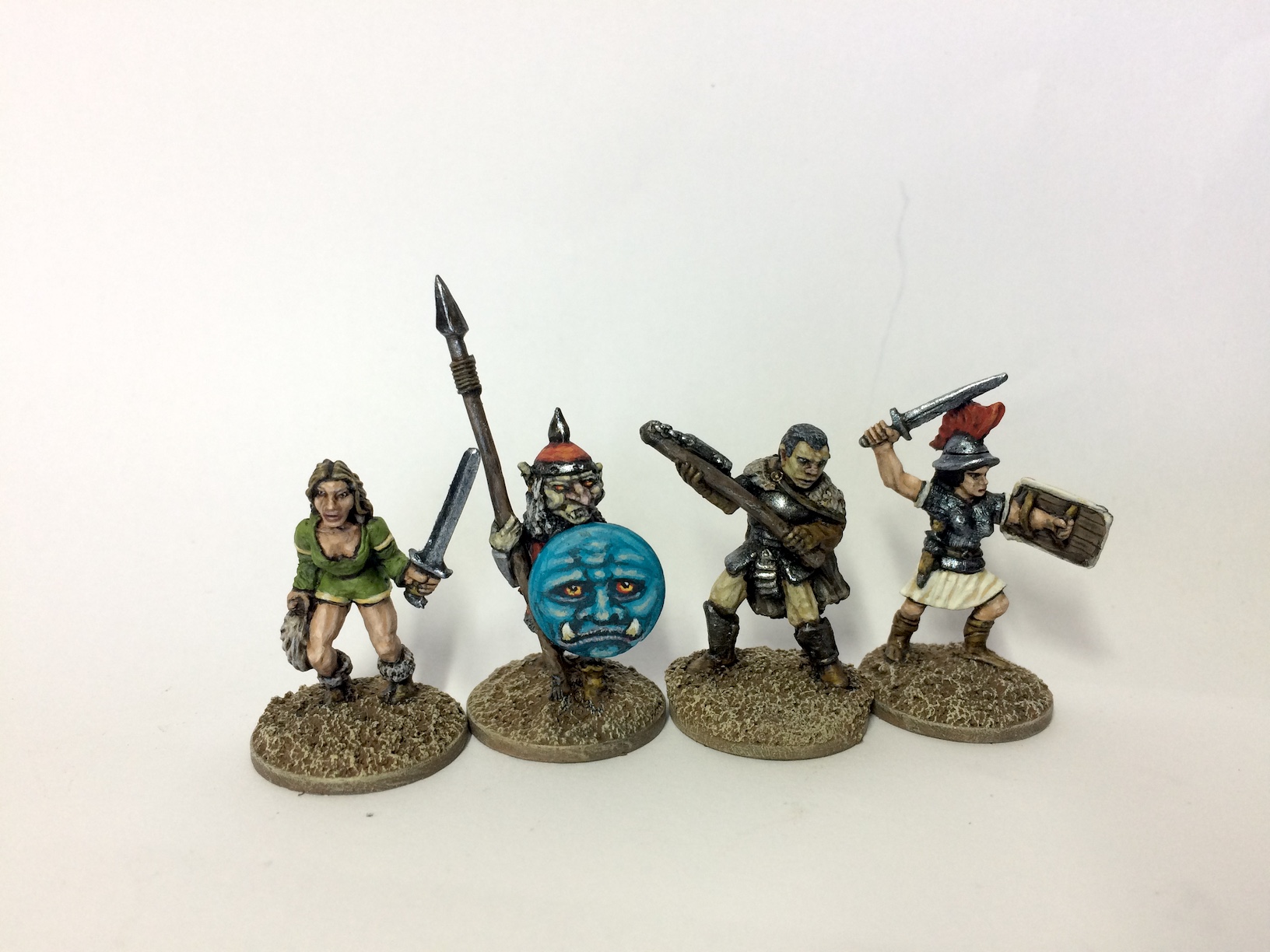
In our D&D games, these fellows will probably serve as hobgoblins, as they're fairly hefty next to the "true 25mm" figures that I'm painting up for RPGs. Below are a couple from Tin Soldier and a Julie Guthrie half-orc from Grenadier alongside the Hinchliffe goblin.


Thursday, 31 December 2020

The last lantern-bearer: a mechanism for megadungeon campaigns

He always gets away ...

One thing I want to do in 2021 is get an episodic megadungeon campaign going alongside our daily D&D game. That campaign is inching up into higher levels, with most of the PCs around level six. I envisage the megadungeon game as being dingier, dicier and deadlier - featuring low-level characters with a high chance of mortality. It'll serve as an occasional refresher, an option for when some players can't make it, and a default setting for games with my occasional adult group. Every expedition will be perilous - and players shouldn't expect every character to come back.

That threatens continuity, of course. But I think I've found a way to resolve it: the last lantern-bearer. No matter what happens, he or she gets away to tell the tale - and fall into the employ of the next party. 

A while ago, I mused on the failings of pretty much every RPG encumbrance system I've encountered. Our long Zoom campaign has borne this out. With most of the character sheets out of my sight, the party always seems to be carrying a remarkable amount of stuff. I offset this to some extent with environmental restrictions ("no one wears armour in town/on a ship/in the desert"), yet the sheer volume of items carried continues to thumb its nose at realism. 

The coin-based treasures in older modules makes this worse. Today, I walked a couple of miles into town to obtain £5 in pennies and tuppences: basing for the great many 1/72 miniatures that will feature in this megadungeon. The weight of a mere 400 copper coins was noticeable on the way back - and trudging through the snow with many thousands would have been a struggle, especially if other gear were involved.


All based up and ready for the party ...

That leads to a simple default for the megadungeon campaign. Players carry their own gear, whatever gems and jewellery they can pocket or wear, and about 100 gp (in various metals). Everything else - the looted idols, the stolen artworks, the exquisite temple carpets - goes on the mules. And who tends to those? Why, the lantern-bearers, of course.

Here's how it works. Every party is accompanied by a team of mules or camels, and those are tended by a team of lantern-bearers - probably five or six. They do not usually fight; they do often flee. And at least one of them always gets away.

That sounds arbitrary, and indeed it is. But the concept serves three useful functions. 

First, the lantern-bearers provide a pool of reserve characters. There's nothing new there, of course. But these aren't henchmen. The sole circumstances in which they fight are when PCs die and their gear becomes available (offering, in game terms, the opportunity for the lantern-bearers to become PCs). The assumption is that the lantern-bearers are impecunious local youths. "Well, I guess you'd better put his armour on, son. If you can hold that spear steady, you can earn a share of the loot."

Second, the lantern-bearers remove all the usual encumbrance and lighting concerns. Their main tasks are to steer the mules, which carry the loot, and provide plenty of light. Those concerns are thus lifted from the PCs, leaving them free to concentrate on exploration, larceny and murder: the stuff they really enjoy. Because lantern-bearers don't offer a threat, monsters are likely to deal with the PCs first - and that gives the lantern-bearers ample opportunity to hide or flee (grabbing some light loot, perhaps, placing their lantern on the floor and trusting to the auxiliary torches they generally carry).

Third, the lantern-bearers provide continuity between parties. The problem with really dangerous megadungeons is that the wiping out of a party makes a second foray a little artificial. The players have already been there even though the PCs have not. But a recurring lantern-bearer or two plugs this hole nicely. Now the new party can learn all about the woes of the last one from someone who was there - and lived to tell the tale. It's artificial, sure, this inevitable survival of at least one lantern-bearer (and his inevitable hiring by the next party), but it's much less artificial than having the party learn from their deceased forebears without any connection. And if sessions are intermittent, the meta-gaming conceit can lead to appropriate in-game reminders: "That door, sir! That's the door that swallowed Captain Juras last spring. Be careful, sir, I beg you ...". 

What this allows me to do is to use the mega-dungeon for a series of occasional one-offs that build on each other despite frequent total-party kills. And by making TPKs a very real danger, I'm hoping to keep the players keen for revisiting - and revenge!

Happy Hogmanay!

Saturday, 20 June 2020

Red orc, wizard and D&D


Our lockdown D&D campaign must be about 90 sessions long by now. We've been playing every day with only a handful of skipped sessions over the past three months. 

In that time, the players have ransacked the Caves of Chaos, explored Quasqueton, hunted demon-worshippers, saved the Keep on the Borderlands from a titanic and long-buried giant, played off merchant-prince factions against each other in the city of Kalbarad, explored the sewers of said city to break up an illegal orc-fighting ring, stolen a ship, sailed to the Fire Isles and the Far Isles, destroyed the threat of sea devils to shipping, rid the roads of Rothia of non-human bandits, fought off Red Hand assassins, killed the wizard Imrin Sark and - today - toppled his black tower. The wizard destroyed their ship with blue fire, however, thwarting their plan to get rich from trading Rothian wine. 

But soon a ship will sail from Rothia to a far, far land and a fabled city called ... Jakalla. One player has found a Tsolyani grammar, and others are intrigued by the prospect of powerful magical items said to be found in the underworld of this city - like the Eye of Advancing Through Portals, which they found on a foe's body. We'll see what they choose to do next ...

The late Imrin Sark

Anyway, one side-effect of the campaign's breakneck speed is that I'm now always dredging up half-painted miniatures to finish them off and get fresh foes on the table. I got two red orcs finished in time for yesterday's session and this wizard done in time for today's.

Thursday, 11 June 2020

Magic item: the Ring of Pandemonium


This is a magic item that I recently introduced to our lockdown D&D campaign. As with all the magic items I like to use, its rewards come with risks.

The Ring of Pandemonium is an iron ring that allows the wearer to summon demons to fight on his or her behalf. Knowledge of how to do this comes the moment the ring is put on - and so too does an awareness that summoning demons takes a serious toll.

One demon may be summoned per round by kissing the ring. Each is a 3HD creature with two attacks and immunity to non-magical weapons. It will vanish when combat ends, although it will happily engage several foes in succession. Alternatively, a demon may be summoned to perform a single task (retrieve a captive, fetch an item, etc.). The demon will attempt to do this fearlessly, but may be thwarted in the process.

Every time a demon is summoned, the summoner's player rolls 1d6 and deducts a point - permanently - from the appropriate attribute (STR, INT, WIS, DEX, CON, or CHA). Modifiers are adjusted appropriately. If a stat falls below three, the character is lost beyond all hope of resurrection.

That gives a Moorcockian feel to the ring's use. Like Corum with the creatures retrieved from death by his hand and eye, PCs will be able to slaughter legions of lesser foes with their ordinarily invulnerable summonings. But only at great personal detriment. And the bald explanation in game mechanics causes palpable fear.

So far, this has worked precisely as I hoped. After facing a spectral foe who used the ring to summon demons to fight them, the party were delighted to get hold of it. One negative INT modifier later, they were a whole lot less keen. So now they carry a great power with them that they are terrified to use. That's exactly how I think magic should work.


Wednesday, 8 April 2020

Strength, shields and spears - my house rules for Basic D&D

While in lockdown, I've been running D&D for my kids and some friends. We've got a seven-strong party with player ages ranging from nine to a fair few decades past that. And it's been great - not only as a way for the kids to see their friends every day but also as a gaming experience. I've been taking them through The Keep on the Borderlands, which I've never run or played before, and it's been a blast.

We're using Basic D&D (as contained in the Rules Cyclopedia). Although the red-box Basic set was probably the second RPG I ever read (after Runequest), I don't think I ever played it. I did play a bit of AD&D, but - as children - we disdained Basic as childish!

Clearly, that was absurd. The rules contained in the Cyclopedia are well constructed and sturdy, and they seem nicely modular. In choosing them over the superb Whitehack, I wanted three things: a proper 'rules as written' game of D&D with simple choices (against Whitehack's more freeform approach), an instantly available common reference for the players and a very well-defined system of character progression. After all, who knows how long lockdown will last?

Nevertheless, I had to tweak a few rules. We're now eight or so sessions in, and I'm quite pleased with the tweaks. So here they are.

1. STR as HP/STR and HP
I've blogged about this before, but I've never been able to get over the possibility that a first-level fighter might have STR 18 and HP 1. The Fantasy Trip's use of ST(R) as HP gets round this elegantly. And Into the Odd takes a similar approach by combining HP and STR as HP. When characters run out of HP, they take wounds off STR and have to save under their remaining STR to stay in the fight/conscious/alive. I love this system. As in The Fantasy Trip, I have characters take STR damage off a running total that leaves the 'true' STR stat unaffected for lifting portcullises, 'to hit' and damage bonuses, and so on.

It works really well because it preserves HP as the classic Robin Hood vs the Sheriff of Nottingham store of cunning parries, shaken-off light wounds and narrow dodging of death. And it means that characters who roll 1 for HP don't feel too aggrieved. Perhaps they're just green, clumsy or plain unlucky - all conditions that can be cured through advancement. And it means that the STR 18/HP1 fighter is still much hardier than the average fighter; even after taking a 6HP blow, he'll be much more likely to stay in the fight than the STR 6, HP 4 magician would. That's just as it should be, I think.

At the same time, the fragility of first-level characters (and others) is preserved. There's no need at all to fudge your initial HP roll (my son's thief has 1HP and only 10 STR, but has made both his STR saves so far!).  Low HP mean that you'll be taking STR saves sooner rather than later. But they don't mean that you'll always die or pass out on being struck by a goblin slingshot or hit with a kobold cudgel. Combat becomes less predictable, which can't be bad.

2. PC and NPC deaths
Now, the chances of a PC death with this system are reduced somewhat. I've generally ruled that if you fail your STR check, you're out of the fight (not necessarily unconscious, but groaning and unable to do anything useful), but if your comrades rescue you, you can be revived with proper care (say, a week of rest and the attendance of physicians or equivalents). If your friends get you back to base immediately, you'll probably be OK.

That helps with party continuity and plausibility, and also with forcing the PCs to adjust their plans. If someone breaks their leg in a fight, you can't take them with you. And if you leave them, they'll die. Decisions, decisions ...

Similarly, if you're forced to retreat from combat without rescuing your friend, he's dead. So far, such injuries have made our campaign more episodic, which is a good thing. Raids on the Caves of Chaos are all fun and games until someone gets hurt ...

And there's also a risk of immediate death in certain situations. Our sole death so far came when a PC tried to leap through the gnashing portcullis-mouth of a living tower (pinched from Return to the Keep on the Borderlands). I warned him that this was a DEX save with death as the consequence, and he still attempted - and failed - his roll. Splat!

I'd apply the same warning in a focused combat like a duel to the death with a master swordsman, but not to a sudden skirmish with orcs. It means that the battlefield is strewn with the dying as much with the dead; the orcs don't get the STR save, but their leader might. Important NPCs get STR saves, but faceless minions don't.

In proper wilderness adventures (the Caves of Chaos are too close to the keep to count!), a failed STR save probably entails death. So running out of HP is no laughing matter - but it's something that the strong can usually shrug off.

All in all, this system makes combat more interesting. Maimed companions demand decisions - and death always threatens but isn't always instant.

3. Target 20
I've shamelessly stolen this from Delta. It's great - no need for THAC0 and all that. It makes combat and other stuff much faster. Hooray!

4. Shields shall be splintered
And I've nicked this from Trollsmyth too. I have a more complex house rule for Whitehack, but it doesn't work in a roll-high system. The point is that shields should be valuable in combat - just as they were historically. And I just love the heraldry-driven complications that can arise from carrying the Broken Skull's tokens into the Bloody Tusk's territory ...

5. Spears go first - and polearms can be spears
I'm just about OK with Basic's individual-initiative system, in which two-handed weapons attack after others. I can rationalise certain things with reference to cramped dungeons and sudden ambushes. But it becomes laughable when a dagger-wielder takes on a halberdier in the open and goes first. So, the way I fix this is to allow spears to win individual initiative (whether wielded in one hand or two), which makes them the natural weapon of choice for soldiers. And of course they can be thrown too. So the archetypal spear-and-shield-wielding guardsman makes a lot of tactical sense.

On top of that, I allow polearms to be used as spears or as two-handed weapons in any given round. So, if you want to hold your foe at bay with the pointy bit of your halberd, you'll win initiative against a foe with a sword, axe or knife, but you'll only do d6 damage. If you want to swing it for the full d10, you lose initiative.

I'm well aware that this isn't strictly accurate - you can swing a polearm at a foe long before they get a chance to close with you. But there might be a glimmer of truth in it for a 'killing blow' - especially if we're assuming that most fights take place in fairly cramped conditions. And it makes for nicely balanced decisions.

I'm not quite sure what to do about poleaxes. It's fairly clear that the authors of Basic had little idea of what a poleaxe actually was (up to 15' long? And no spike? Cheaper than other polearms? Really?). As the poleaxe is the descendant of the Danish axe, they might both be covered by the battle-axe category - but then the poleaxe was the weapon of choice of the heavily armoured knight, so it should be the best thing on the battlefield! I suspect it's easiest for now just to group it with other polearms - although poleaxes are generally significantly shorter than halberds, so would be more wieldy in close and less good at the speary stuff. I probably have to accept that D&D just doesn't do that level of detail!

6. Magicians are rare
This is less of a rule than a tonal note. The only magician in our party is an elf. I'm keen to have sleep spells and magic missiles be awe-inducing interventions - not something that most bandits or guardsmen will have seen before. So magic-users are rare, distrusted and generally keen to conceal their powers.

Sunday, 5 April 2020

Elven swords as minor magic items

Decisions, decisions ...

Almost every GM must have at some point purloined the likes of Sting, Glamdring and Orcrist from The Hobbit. As a reminder, these are elven swords "made in Gondolin for the Goblin-wars. Their blades glow blue when orcs are near.

A neat magical item, then. But where's the catch? My view of magical items is that they're at their best when they bestow minuses as well as plusses. The best magic items in legends and literature are ambivalent: think of Stormbringer, Tyrfing or Andvaranaut.

Tolkien's elven swords don't have any obvious disadvantage in the books. Most GMs would probably include them as "+1 swords, glow when orcs are near" (or goblins - D&D's division of the species makes this tricky to translate!). Fair enough - but I think it's better to drop the bonus and make their magic more minor.

After all, a sword that acts as an early-warning system is a considerable advantage in its own right. So here's how I treat "elven swords" in our D&D games:

1. They glow when non-human and non-demi-human chaotic creatures are near. So they'll help detect a disguised demon but not an evil priest or chaotic bandit.
2. They give no mechanical advantages in combat; they are, however, elegant and well made.
3. They have to be fully drawn to glow (you can't just loosen one in its scabbard to check the edge).
4. As a result of 3 above, you have to have the sword readied as you advance with it. That means that you can't use a bow or crossbow, or a two-handed weapon, at the same time.
5. As elves are on the small side in D&D (unlike Tolkien), elven 'swords' are short swords or 'normal' (i.e. arming) swords. They do not come in bastard or two-handed varieties. Daggers are much rarer than swords.
6. You can carry a drawn sword in your shield hand, but you'll have to drop it to use the shield in combat; in our D&D games, shields are highly desirable thanks to Trollsmyth's tremendous 'shields shall be splintered' rule. So, if you have a better weapon for combat (a one-handed bastard sword, say), you'll need to weigh up whether the early warning trumps optimal combat readiness.
7. While you get an early warning, you also give an early warning: the blue light from an elven sword is fierce and bright.

There are still ways to optimise situations, of course. A shield-armed character might carry the drawn sword in his shield hand and a spear or axe ready to throw before switching to the sword. And an adventurer sneaking round the underworld with an elven sword might duck down empty corridors to inspect the blade safely. But characters still have to make decisions of minor difficulty. And that's just as it should be.

And it's always worth remembering that some people react to such swords very badly indeed:

The Great Goblin gave a truly awful howl of rage when he looked at it, and all his soldiers gnashed their teeth, clashed their shields and stamped. They knew the sword at once. It had killed hundreds of goblins in its time, when the fair elves of Gondolin hunted them in the hills or did battle before their walls. They had called it Orcrist, Goblin-cleaver, but the goblins called it simply Biter. They hated it and hated worse anyone who carried it.


Sunday, 1 December 2019

Into the Odd - the best RPG for kids?

An eclectic band of intrepid adventurers

We had friends staying last weekend. After introducing their kids to Song of Blades and Heroes last time they were up, I'd promised my kids that we'd do a bit of roleplaying with them this time. So, after a jaunt up the hill on Sunday, we settled down for a spot of dungeon-crawling.

I'd planned on using Whitehack or the Black Hack. Then I thought about one of the fantasy variants on Into the Odd. But then I decided just to use Into the Odd itself. And I'm very glad I did: it made for the perfect introduction to RPGs. 

Why? Well, the game's loose setting and brilliant character-generation system made for a very easy set-up. We rolled characters, and then the kids chose miniatures to represent them from the Cabinet of Shame. That gave us a space marine in corroded bronze armour, a 'space monkey' and an orc with an axe that fairly approximated the shovel in the player's 'starting package'. And that eclectic mix worked just fine as we laid out dungeon tiles and explored the underground complex I'd sketched out half an hour earlier.

The scenario was simple: the PCs were desperadoes, short of cash, and the authorities had put a price on the tentacled head of an evil sorcerer. So the PCs were raiding his underground fastness. No other background was needed.

And we had a blast. The new players grasped the concepts of ability saves on a D20 very quickly. And the no-messing combat (rolling damage, with no time wasted on fripperies such as rolling to hit) was equally clear - as were its risks. 

But best of all was the way that the players instinctively made use of their starting equipment (determined by cross-referencing a character's hit points and highest stat on a table of 'packages'). One character had a pistol, a smoke bomb and some wire. Another had a dog, a pistol and a shovel. The use of this limited gear led to all manner of interesting situations. Best of all was the final encounter with the octopus-headed wizard. The PCs filled the chamber with smoke, then dashed down the stairs to improvise a trip wire. They pulled off their rolls, swiftly dispatched the fiend and made off with this head. The dog, alas, did not make it out, but all of the PCs did, though only by dint of a couple of successful saves to avoid critical damage. 

I ran another session on Friday evening for my son and one of his schoolfriends (both RPG veterans). This time, we played through The Iron Coral, the introductory adventure that comes with the rules. With most of the 'dungeon' explored, both characters met a sticky - but undeniably fitting - end. This time, I was struck by the speed at which the game runs. We played it quite a bit last year, but I'd forgotten quite how quick and decisive combat encounters can be, and how much time that frees up for exploration and role-playing.

Of course, games in which combat is a game in itself can be tremendous too. We've played The Fantasy Trip a lot this year, and it's excellent - because every time there's a fight, you get an engrossing board/skirmish game to resolve it. And in TFT, every fight can be deadly for the PCs, which adds tension and suspense even if the party are just facing a few goblins.

For games in which all players are familiar with the rules, TFT is tremendous. And its rules are clear, logical and relatively simple, which helps. It's also perhaps the best RPF for very large parties, because the tactical aspects of fighting give everyone lots to consider as you go round the table.

But for smaller games in which the players are not familiar with all the combat options they can take and just need a sense that "fighting is dangerous", Into the Odd is very hard to beat.

And as an introductory game for kids, it's the best. Start with a pistol, a smokebomb and a length of wire - and watch as imagination does the rest.


Sunday, 3 November 2019

All RPG encumbrance systems are rubbish ...


... or at least that's my experience with them.

Why? Because even with the simplest, smartest or most intuitive rules, the system always - always - gets forgotten in the heat of the game. Perhaps I'm an outlier here, but I've never known any group of players to adhere to encumbrance rules - or even to remember them. I've certainly never managed it as a player.

But I don't think it really matters as long as the GM asks one question whenever a physical challenge presents itself. That challenge might be crawling, climbing or combat, but the question should always be this: what do you do with your stuff? 

A central failing in many encumbrance systems is that they're trying to do two different jobs at once. Many systems grossly underestimate how much a strong, fit character should be able to carry in the wild for days on end. At the same time, they often overestimate how much the same character would be able to carry while still being unhindered in hand-to-hand combat.

The two situations are very different, so it's unsurprising that it's hard to cover them with a single system. How much stuff can determined travellers carry through the wilderness? Lots. How much stuff can those travellers keep about their persons and still fight unaffected? Very little? Hence the question: what do you do with your stuff? 

The answer will tend to be variants of "We discard some of it" (for climbing, crawling and the like) or "We dump it" (for fighting). So it leads to resource depletion in the first case and an extra dimension to combat in the second. Each of these adds interest to the game.

If PCs discard some of their stuff, they're creating an obvious trail for anyone who might be following - unless they decide to conceal the abandoned gear. But if they do that, they're depleting both their resources and time. They might also be drawing predators to their trail if they abandon edible items (which might not be limited to food: remember the rust monster!).

And if they dump some of their stuff for a fight, they immediately create a more interesting tactical situation. The best RPG fights tend to resemble engrossing skirmish wargames, with much more to consider than merely rolling to hit. And, as any seasoned skirmish gamer knows, the best skirmish games tend to involve objectives beyond simply killing the enemy. A pile of hastily dropped supplies and loot immediately creates objectives for PCs and enemies alike. All of a sudden, manoeuvre, push-backs and retreats become much more important. And that's something that the GM should exploit to the full.

Monday, 21 October 2019

Monsters in 1/72


In an earlier post, I rambled on about the advantages of 1/72 miniatures in RPGs: in summary, huge numbers of different historical types, consistency of scale between ranges and the 'anonymity' provided by the less detailed and less exaggerated style of modelling.

Thanks to Caesar and Dark Alliance, a reasonable number of fantasy humans and humanoids are now available in the scale: goblins, elves, dwarfs, orcs, trolls, fire demons, lizardmen, ratmen, Amazons, Cimmerians and undead.

But there's a sizeable gap in these ranges: giants. Large humanoid monsters - ogres, regular trolls (the Dark Alliance ones are enormous), giants, ifrits, jinn, minotaurs and so on - are missing.

The obvious thing to do is to plug this gap with 28mm miniatures. But not all of those 'read' well with 1/72 figures. The Wizkids D&D range (Nolzur's Marvellous Miniatures) do, though.

These miniatures are realistically proportioned. Perversely, that makes them look a little odd next to 28mm figures in 'heroic scale', where hands and faces are enlarged like those of a haptic homunculus. It also makes them quite bland next to most other fantasy 28s. But for those reasons, they look just right with 1/72. They're bigger, but they're stylistically similar in a way that Games Workshop (for example) aren't.

The Wizkids miniatures also have the stubborn mouldlines that some 1/72 figures have. Again, that makes them less suitable for 28mm scale, as they look a bit rougher and readier than hard-plastic or metal figures that can be cleaned up properly. But that roughness is much less of a visual handicap at the smaller scale (visual expectations already being dampened).

The D&D line comes mainly in pairs. It's best when they're of different creatures, as with the wereboar and werebear above and below, or the yuan-ti malisons (a snake-bodied man and a snake-headed man). But there's nothing wrong with a pair of ogres (i.e. Whizkid orcs) or twin giants (the Cursed One, whoever he is).


I've scanned through the Wizkids range, and there seems to be at least a dozen packs that would provide good 1/72 monsters. They're available in my local branch of Blackwells, which makes them cheaper than most 28mm miniatures too.

Thursday, 17 October 2019

Robbers on the road


I don't recall coming across the term road agent before I read Cormac McCarthy's The Road. It means a highwayman or robber of stage coaches. And it's got a wonderfully sinister tone - amplified in McCarthy's tale by the fact that his road agents are murderers and cannibals too

Murderous robbers play a big part in the Greek myths. As I put together a campaign with an ancient-world flavour, I've been thinking a bit about these. The best examples are the eccentric murderers encountered by Theseus on the road to Athens: Sciron, Procrustes and the rest.

These robbers get up to all sorts of unsavoury tricks. They stretch people to fit beds - or lop off their limbs to do the same. They kick people from cliffs, or wrestle them to death, or beat them with cudgels, or tear them apart with trees.

They also provide a tremendous template for RPG encounters. The PCs need to get somewhere, but there's an obstacle in their road. They can go round it (creating an opportunity for wilderness or maritime adventures) or they can go through it.

That entails dangers. Here's Plutarch on the robbers on Theseus's road to Athens:

For verily that age produced men who, in work of hand and speed of foot and vigour of body, were extraordinary and indefatigable, but they applied their powers to nothing that was fitting or useful. Nay rather, they exulted in monstrous insolence, and reaped from their strength a harvest of cruelty and bitterness, mastering and forcing and destroying everything that came in their path. 

Some of these robbers are demigods or literal monsters, like the cyclopean club-wielder Periphetes. Some of them also guard entrances to the underworld and consort with monsters: a giant sea turtle or a savage giant boar.

While the brief ancient texts can imply that these robbers were solitary individuals, some have families with them, and it's easy to imagine them holding court among thronging followers: as bandit chiefs rather than solitary brigands. That adds further scope to an RPG encounter: approaching the haunts of an infamous bandit might involve ominous portents, surly guards and obsequious underlings. Think of Jabba the Hutt's palace - or Kurtz's lair in Heart of Darkness:

Now I had suddenly a nearer view, and its first result was to make me throw my head back as if before a blow. Then I went carefully from post to post with my glass, and I saw my mistake. These round knobs were not ornamental but symbolic; they were expressive and puzzling, striking and disturbing—food for thought and also for vultures if there had been any looking down from the sky; but at all events for such ants as were industrious enough to ascend the pole. They would have been even more impressive, those heads on the stakes, if their faces had not been turned to the house. Only one, the first I had made out, was facing my way. I was not so shocked as you may think. The start back I had given was really nothing but a movement of surprise. I had expected to see a knob of wood there, you know. I returned deliberately to the first I had seen—and there it was, black, dried, sunken, with closed eyelids—a head that seemed to sleep at the top of that pole, and, with the shrunken dry lips showing a narrow white line of the teeth, was smiling, too, smiling continuously at some endless and jocose dream of that eternal slumber. 

An encounter with a road-agent of the sort that Theseus faces might, in a gaming session, include interactions with all manner of ne'er-do-well, opportunities for audiences with the monstrous bandit-king himself, and the chance to witness a horrific execution - or become an involuntary participant in one ...

1/72 hoplites


These are the first 1/72 figures completed for my new RPG project. Nothing fancy - but quick to paint and, when seen on the tabletop, they'll "do".

They'll probably be player-characters, but could well end up as henchmen or villains too.

One thing about this scale is that you can do quite a lot of "conversion" with paintwork alone. I may well paint up some of the duplicates as ghosts or undead in corroded armour and with pallid flesh.

Saturday, 12 October 2019

Enter 1:72 - and a protocol for miniature use in RPGs

Converted lizardman from Caesar; hoplites from Zvezda

Miniatures are a bit of a double-edged sword in RPGs. On the one hand, they provide focus for the players and create lots of tactical options in combat situations. On the other, they can erode the 'theatre of the mind' that's such an attractive feature of the game.

Most of the miniatures I own are the standard 28mm sort. A couple of years ago, though, I ran a Whitehack campaign using 15mm miniatures based on pennies. The smaller scale has lots of advantages: the dinner table becomes a much bigger space, and there's less of a sense of identification about the miniatures. So you hear less of "We killed that goblin last time!", because your 15mm goblin tribe probably has various duplicates on the table at the same time.

But there were disadvantages too. Painting 15mm isn't that much faster than painting 28mm, and the miniatures aren't that much cheaper - especially as you have to buy in batches, often of the same figure. And the best stuff for fantasy RPGs - Khurasan and Splintered Light - isn't readily available in the UK.

On top of that, "15mm" miniatures vary radically in compatibility with each other. I'm not a huge stickler for scale consistency, but the difference in size between "small" and "big" 15mm stuff can be enormous. That can spoil one of the main attractions of the scale: using the huge range of historical figures with fantasy ones. Alas, dwarfs and goblins from some manufacturers tower above men-at-arms and knights from others.

Also, the smaller figures don't take up much room even on a penny - so that 'crowding' is no more achievable than with 28s based on the standard 25mm round base.

And because the figures are metal, they're heavy and fragile. With reasonable success, I constructed a travel set of 15mm miniatures in a box lined with magnetic card, so that the kids and I could play skirmish games on holiday. The only problem with it was that the magnetism wasn't sufficient to keep the miniatures from rattling around in a rucksack - so that they needed a fair bit of retouching afterwards.

I'll probably rebase the lizardmen on twopence pieces

The allure of an intermediate scale
Enter 1/72. I've dabbled in this scale before, but only in monsters that are somewhat scale-agnostic, such as the Caesar lizardmen, which I've used in both 28s and 15s. But I've started to see the attractions of RPG gaming in 1/72 scale entirely.

First, 1/72 figures tend to be a lot more compatible with each other than 15mm. Yes, there are scale discrepancies between manufacturers. But they're slight. One viking or hoplite won't be twice as tall as another. That opens up a huge range of historical soldiers and civilians (1/72 ranges offer a nice array of ancient and medieval civilians). Populating a crowded marketplace or court is far more achievable.

The second attraction is cost. For between six quid and a tenner, you can get 40 or more miniatures. Yes, there'll be some repetition, but there's also a lot of variety within boxes. I bought some Italieri crusaders yesterday; the box included nine mounted knights along with multiples of eight different foot-soldiers.

And those multiples offer a further attraction: anonymous 'extras' for town guards, the local baron's men-at-arms or whatever. Compared with the characterfulness of 28mm miniatures, the unassuming nature of 1/72 figures takes some of the emphasis off the miniatures on the gaming table and back into the players' minds.

At the same time, the compatibility of the figure and their anatomically correct scaling (as opposed to the 28mm emphasis on faces and hands) adds an extra dimension of realism. And the miniatures occupy a penny base just about perfectly - allowing for a reasonable amount of crowding while still providing stability and weight. And they'll travel unscathed in my magnetised box.

Swords, sorcery and soft plastic
But the biggest attraction, for me, is 1/72's suitability for sword and sorcery. I don't much like Robert E Howard's Conan stories, which I find poorly written and heavy on the sublimated wish-fulfilment. But I do like the Hyborian blueprint of a world including lots of thinly veiled proxies for historical cultures, all thrown together with anachronistic glee. Fritz Leiber does it rather better, and so too does Howard's contemporary and correspondent Clark Ashton Smith.

The best way of representing that sort of mish-mash - ripe for games involving travelling adventurers - is to have different cultures visually represented. And 1/72 opens up a whole wealth of intriguing possibilities. Imagine these as town guards in one northern city. Or these as invaders threatening a coastal civilisation far to the south. If you want a human-centric game - or one that's set in or nodding to Glorantha or Tekumel - this is the scale to do it.

Fantasy creatures, of course, are less well represented. But Dark Alliance/Red Box and Caesar do quite a few fantasy sets: orcs and goblins of various stripes, lizardmen, ratmen, trolls, hyena-riders, fantastical barbarians and undead. And, of course, 28mm monsters will generally work fine in 1/72: they'll just be bigger (and nastier).

It's also worth noting that some of the official D&D miniatures from Wizkids are a nice fit with 1/72 stuff, because they are similarly (i..e more naturally) proportioned. This snakeman is much bigger in 1/72, but the proportions of his human elements make him a better fit in 1/72 than in 28mm.


Also, some 15mm goblins work pretty well at this scale. I reckon the little chap below is perfect for a small Middle Earth orc or a D&D goblin:


The same's true of these (rather large) 15mm frog-men:


And I'll be stripping down these Ral Partha dwarfs (painted by a friend when we were teenagers) and repainting them. They're tiny by 28mm standards, but just right for short but strong mine-dwellers in 1/72:


These old Chronicle kobolds and orcs work too (as larger and fiercer monsters at this scale - gnolls and ogres, perhaps):


I can also see lots of potential for using these in Dragon Rampant. The reduction in unit 'footprint' makes a 3'-wide dinner table a better battlefield - and assembling and painting up cavalry is much quicker. And then there's Hordes of the Things. A box of 48 miniatures (like the Dark Alliance fantasy sets, with four identical sprues of 12 figures) could be used for a couple of different factions of individually based models for RPG and skirmish games and a few elements of multi-based troops for massed-battle wargames like HotT. 

Then there's painting. I found the Caesar lizardmen exceptionally easy and quick to paint. The softness of detail is actually an advantage when it comes to painting 1/72 for RPGs, as you can blast through them without worrying too much about precision.

A protocol for miniature use in RPGs

These considerations of scale and "anonymity" have got me thinking about how miniatures are best used in RPGs. Nicely painted 28s and precise floorplans are great for dungeon crawls and one-shots, but take a lot of time to prepare. And there's the problem I brought up at the start: the way in which the tabletop props can detract from the imagined scene. That doesn't much matter in the typical dungeon crawl, but it causes problems in more sophisticated games - not least because if everything's set out in detail and represented with miniatures, everything looks like a fight.

So here's how I'm planning a forthcoming session with some old friends. I'll almost certainly use The Fantasy Trip for the game, because of its simplicity and speed of character generation and its tremendous tactical combat. That entails a hex grid, so I'll get one of the Chessex dry-erase maps. The smaller scale of the 1/72 miniatures will compensate for a grid size that's smaller than the TFT standard. 

Now, what I want from an RPG session is plenty of roleplaying. But if there's to be fighting, I want that to be intense and tactical - essentially a mini-wargame for players and GM alike, with both sides aiming to win. Of course, I'll allow and encourage any convincing stratagem that interrupts the normal flow of combat. 

To balance that with role-playing and 'theatre of the mind', I won't use the dry-erase markers until swords are drawn. The players will know they're in a large audience chamber or a cramped tomb or whatever, but until they have a fight on their hands, I won't sketch it on the grid or place miniatures to represent NPCs. 

That should have two important effects. First, the players will process the monsters and NPCs as they're described before they see how they're represented on the table - if they see that at all. And second, rather than every encounter looking like a fight, as it does in a floor-plan-assisted dungeon crawl, every encounter will appear a role-playing opportunity. Only if that leads to fighting will I quickly sketch in the scene, place a few props and - finally - plonk the baddies down on the table.


Tuesday, 25 June 2019

A ten-year-old's take on At the Mountains of Madness


For the past four months, my son's been working on his first RPG scenario. He based it on Lovecraft's At the Mountains of Madness after reading first the graphic novel and then the story itself.


Using Fimo, tin foil, cocktail sticks and hot glue, he made all the monsters himself. He also painted up miniatures for the player-characters (in a single afternoon after school!) and made floorplans from cardboard, white glue and loo roll. He drew designs on index cards to show the carvings on the complex's walls.


This Sunday, he ran the game for four friends. It seems to have been a hit, and he's planning to repeat it with a couple of other groups of friends. The giant penguin - in lieu of the group of merely large sightless albino penguins in the story - was my sole contribution to the set-up. It's a Hobbycraft papier-mache shape with some added extras in Milliput.


I'm sure we'll find ways of recycling the monsters in other games. There are three Elder Things:


The Whistler in the Darkness (an original creation):


A captive Mi-go:


And - of course - Shoggoths:


My son also drew this to encapsulate the scenario:


All in all, it somewhat outstrips my efforts at a similar age; those were largely confined to graph paper.


Monday, 20 May 2019

The Fantasy Trip


Last year, I found my curiosity piqued by The Fantasy Trip and looked into a couple of the retroclones. I resolved to get hold of it when it was republished - in part, because I couldn't remember if I'd ever played the minigames on which it's based: Melee and Wizards. Steven Jackson Games were popular as lunchtime diversions when I was at primary school; we played Car Wars and OGRE quite a bit, but I'm not sure about Melee.

Having bought the Legacy Edition of The Fantasy Trip, I'm still not sure. The rules seem familiar, as do some of the counters. But it was a long time ago - and if we did play it back then, we played Car Wars and OGRE much more. I never owned any of them, and I do remember designing some grid-based combat games shortly after I moved schools - possibly to recapture the counter-and-grid thrills of those lunchtime sessions.

Anyway, the kids and I played four games of Melee over the weekend. It's terrific. I'm planning to use it for most RPG sessions with the kids and their friends from now on, simply because it'll make combat encounters so much more compelling than the various D&D clones we've tried. Whitehack will doubtless remain a go-to for small, focused groups, and I'm playing Tunnels & Trolls with some old friends next weekend, but for dungeon-crawling with the kids, The Fantasy Trip/Melee appears perfect.

So why is that? Well, the sheer amount of decisions to be made - formalised in the game as options - gives a tremendous range of outcomes. I can't think of any one-figure-per-player skirmish game that offers quite so many options in combat situations.

And yet the game is very simple. For Melee (the TFT combat system as a freestanding game), characters have three stats: strength (ST), dexterity (DX) and movement allowance (MA). You design your character(s) by deciding the balance of their ST and DX and then choose whatever weapons and armour you like.

And that's where the real genius of the game comes in. It combines a reasonable amount of realism with a tremendous amount of game balance. Strong characters can take and hand out more punishment: ST acts as your hit points, and allows you to use nastier weapons) But DX decides who attacks first - and the higher your DX, the higher your chance of landing a roll. Armour absorbs damage - but also reduces DX and MA.

So sufficient ST to wield a grisly weapon like a two-handed axe will impair your DX when you initially assign points between them - and heavy armour will impair it still further. But you will be appropriately tank-like and able to deal terrible damage on those rare occasions when you hit.

Alternatively, you could choose high DX to allow you to hit quickly and often. But against heavily armoured foes, you'll be relying on lucky shots to get through the armour.

You can see how this is perfect for gladiatorial combat: secutor v retiarius, or whatever.

And then you've got the hand-to-hand option - grappling, essentially, in which no weapon larger than a dagger is useful, but a dagger is very useful indeed. That creates a whole extra dimension. If you're determined to grapple with a foe, you'll probably want to drop your main weapons and draw a dagger - but there's a chance that they'll be able to do the same when you close, or even just clobber you with their main weapon and step back.

It's a fantastically elegant combat system. There are certainly lapses in realism; I suspect armour wasn't quite so constricting/slowing, at least initially, and of course many strong people are very dextrous too. YOu don't need to be terribly strong to use a two-handed sword or battleaxe; a two-handed sword isn't usually twice the weight of a regular sword. And the weapons list has some oddities (a pike axe?). But for a balanced game, it's just right.

Incidentally, while the RPG rules (In the Labyrinth) give a whole list of real-world weapons that might fit into the various categories, these make very little sense. The glaive and the naginata - essentially the same thing - are in different slots, for example. None of this matters, though - it's very easy to look at a miniature and decide that its big fantasy polearm is the very quintessence of pike axe.

After an initial one-on-one run through the rules, we played three lizardmen against three orcs, then a couple of games with two burly, armoured hobgoblins and a smallish giant against five orcs: two heavily armoured types and three skirmishers (two with javelins and one with a light crossbow). Both times, the orcs won, because they were able to surround the unsupported giant and pierce it with many weapons. There was something of the mammoth hunt about it, which seemed quite appropriate.

We're eager to play more, and to try the wizard rules. There are printable hex papers of appropriate size available online, so drawing out some floorplans on those will be no more onerous than drawing them out on traditional grid paper.

The labyrinth beckons ...

Sunday, 21 April 2019

Easter eggs and the joy of recontexualisation


What lies beneath?

Last night, I set up a quick Easter egg hunt for the kids. It was simple: a card on the kitchen table with a couple of mini-eggs and a slightly cryptic note about where the next treasures could be found. And so on. So they went scurrying from room to room, looking in bookshelves and behind masks, out to the garden and back in again. Despite the simplicity of the exercise, they really enjoyed it, with the younger proudly boasting about the clues she'd worked out.

One set of treasures was concealed beneath the "antelope statue", which my daughter immediately recognised as the scenic gaming item we made from one of my son's old toys (above). This was on the table about a foot away from the first note, and there was a weird satisfaction in the doubling back.

This got me thinking about dungeon design. One of the problems I have with classic  adventure modules is that they typically have hidden treasures and secrets that most parties will never find.

These features presumably stem from a time when inch-by-inch investigation was a norm, and where checking for traps and the application of ten-foot poles were standard.
But most players I run games for don't act like that. They'll happily ransack sleeping quarters, store-rooms and book-cases, but they won't go around twisting the left horns of statues or tugging on torch brackets.

That's probably as it should be: sessions would crawl along at a tedious pace if the PCs were looking for secret doors at every turn. And there's much more realism in players assuming that the world conveyed to them by floorplans or GM description is largely as it seems.

At the same time, treasures and hidden doors that give themselves away are a bit silly: what's the point of them if any passer-by can spot the cracks in the stonework?

But, as this morning's egg hunt demonstrated, hidden treasures are exciting if their discovery feels earned. And that's especially true if you're recontextualising something that you've already encountered. That huge bronze statue in the hexagonal room on the first level of the dungeon? Down here on the third level, you've just learned that twisting the left horn opens a secret cache in the torso. Back we go!

How might such information be discovered? Well, here are a few ideas.

1. "Let me live, and I'll tell you a secret ..."
A dungeon's denizens will doubtless know some of its secrets. And what better way for the last hobgoblin guard to secure his wretched life than by bargaining some of the information to which he is privy?

2. Carved in stone
Murals and reliefs deeper in the dungeon can contain revelations about areas the party has already passed through. Perhaps that brazen antelope was used for horrifying Moloch-style sacrifices. If so, a relief carving might show hideous beastmen opening it by tugging on its horns and imprisoning victims within. That tells the players that the statue opens, and it shows them how it's done. But it doesn't tell them what's inside it. Their curiosity should be piqued.

3. Book learning
Sorcerers' libraries are great resources, particularly if you have a random table to generate their contents. But for especially useful information, it might be better to have a single book (open on a desk, perhaps) that describes or illustrates areas with which the players are familiar. Or perhaps a map, showing the rooms they have passed through and some secret chambers they have missed: "That door must be behind the carvings with the griffins!"

4. Tavern gossip
If the dungeon has a market or tavern - and no self-respecting underworld should be without a Mos Eisley-style speakeasy - then the PCs may overhear all sorts of useful tibits: "That fancy warrior we roasted in the goat? He had all sorts of shiny weapons, but they burned us when we touched them, so we melted them down with him."

"They didn't melt, Gruznok. I looked yesterday. Still shining in the ash and bones."

5. Threats and menaces
A villain or NPC might threaten the players with imprisonment in some secret vault or oubliette. "I'll tell you where the last sneakthief ended up - under the Jade Giant's foot. There's no getting out from the pit under that - but there are things that can get in."

Once the villain's dispatched, the PCs are likely to revisit the Hall of the Jade Giant. Of course, if the villain is merely subdued, he might offer up some additional information, as in 1 above.

6. Unusual correspondence
Remember those huge statues of open-mouthed snakes coming through the floor on the first level? Well, down here on the third, there's a matching snake descending from the ceiling. And is that ... a ladder inside the mouth? But if this one joins up to the one in the hobgoblin shrine, where does the one in the armoury lead?

And so on.

All of these should give the PCs ideas about returning to places they've already visited. The lure of loot is strong, but discovery sings a siren song of its own. Who knows? They might even find an Easter egg ...

Monday, 8 April 2019

Neutral ground: the dungeon pub, Mos Eisley and Down in the Dungeon

Down in the Dungeon (from Monster Brains)


I'm currently constructing a Tunnels and Trolls dungeon. One thing is certain: it will contain a tavern. I've loved the idea ever since I chanced upon a copy of that 80s curiosity Down in the Dungeon. That book, by Rob Stern and Don Greer, is a sort of D&D cash-in that I once perused in print long, long ago. A primary-school friend's older brother's friend owned it, or something like that (as seems to be the way). 

The tavern is a hackneyed staple of traditional RPGs, of course. Superior examples of the trope are Gimpy's Tavern in Pavis and Apple Lane's Tin Inn. But rather than a starting point or brawling ground, a dungeon pub could be something much more interesting.

The first of the boozer illustrations in Down in the Dungeon is entitled Neutral Ground (see above). There's your starting point. This is a place where the normal rules don't apply. 

The idea of members of various dungeon factions and adventurers sharing a drink is just irresistible. Those orcs you fought at the Skull Gate? You might meet some of them in here. But they'll be off duty! They might just be prepared to let bygones be bygones. Or they might have a bone or two to pick. 

There are probably bouncers to keep the peace. Ogres, perhaps. Or automata of some kind. In any case, it's doubtless a fragile peace. But still, you might get a chance here to buy that scarred orc veteran a couple of pints and maybe loosen his tongue. You might even find out that the Skull Gate is unguarded on certain occasions.

The obvious template (and as the Grognardia blog suggests, probably the inspiration for Neutral Ground) is the Mos Eisley Cantina in Star Wars. For what is a dungeon but a hive of scum and villainy? And what do scum and villains like to do? Why, drink, of course. 

So what can we take from Mos Eisley and apply in our underground tavern?

1. All sorts of things
This is neutral ground. Dwarves drink beside orcs. Or perhaps with them. Lizardmen hang out with trolls. Skeletons make a mess on the floor as their wine splashes through them. No one so much as blinks. You might even spot a gelatinous cube in the corner, patiently absorbing spilled liquor from the floor. And of course there are also sorts of potent brews on offer. There may even be all sorts of potent broos ...

2. We don't serve their kind in here.
This isn't a nice place. Some beings just aren't welcome. Elves might be an obvious example. But it might be more amusing if (say) dwarven PCs are denied entrance even though there are lots of other dwarves quaffing away inside. Or half-orcs being barred despite both orcs and humans being served. What we want here is something arbitrary and irrational that leads to improvisation by the players (one dwarf on another's shoulders under a long cloak; a half-orc trying to pass as a whole one; an elf improvising some sort of disgusting disguise). The particular strand of barroom bigotry needn't be explained, though it could be. And the prejudice might shift from one visit to the next - to test the players' creativity or simply to torment them.

3. Most of the best freighter pilots can be found here.
That famous smuggler you need? You'll find him at the Underworld Inn when he's in town. This is the place to meet NPCs who need to lie low.

4. Watch your step. 
Bars full of monsters mean brawls full of monsters. This is where all the wandering monsters hang out when they're not wandering. PCs should expect hassle ... 

5. This place can get a little rough.
... and so should NPCs. The PCs might have the opportunity to help out an NPC, thus earning trust or gratitude.

6. Sorry about the mess.
Whatever happens, the patrons and management have seen it all before. Throw a few coins down on the bar, and no one will say anything.

Now, while the dungeon pub is certainly gonzo, it needn't be goofy. The obvious parallel is with a fairy or goblin market (see Christina Rossetti, Jack Vance's Lyonesse and Hellboy 2). The irrationality of the prejudices in 2. above could be played up nicely as a sort of fairy whimsy. 

But what else could we add? Well, if we take the fairy aspect (through a Vance or Susannah Clarke filter, perhaps), we could have a lot of fun with the drinks. So what's on tap?

1. Session ale. 
This is terribly, terribly moreish. After one pint, you'll want another - unless you can make a Luck save (T&T) or a Wisdom save (D&Dish systems). If you fail that, you'll have a penalty on the next save (a higher-level save in T&T), and so on. It costs you money (price to be determined by GM). And when you run out of money, you'll want to trade gear, weapons and armour. It also it temporarily reduces your CON by a point for each pint drunk. When that reaches 0, you pass out for d8 hours. If you make your save, you succumb to a fit of violent retching. The CON points return at a rate of two an hour thereafter as you sober up.

2. Veritas vino
This is delicious. The trouble is, it relaxes you with its rosy glow. You feel so good that you just have to tell anyone you meet what you're doing and why. "We're planning to come back on Seventh Night to go through the Skull Gate - because it isn't guarded then!". Drinkers of this wine tend to attract an audience.

3. Murder mead
It's very tasty, but it makes you violent. Very violent. It achieves this through a weird inversion of reality. If a  drinker fails a CON save (-1 for each pint), he or she will perceive a random stranger in the bar coming up to them and issuing a challenge ("I don't like you", etc.). In fact, though, the drinker will have done precisely that to the stranger. Mayhem often ensues.

4.  Braggart juice
This makes the drinker very convivial but also inclined to boast. I'd leave this one to the player's ingenuity - with XP or cool points for truly epic bragging.

5. Slumber wine
Think Bombur in Mirkwood. Slumber wine is a powerful restorative (recover 1 HP or CON point, depending on system, per goblet), but it isn't meant for mortals. Make successively more challenging saves with each glass or fall into a deep, deep sleep for 6 + d6 hours. While asleep, the  character will occasionally chuckle or smile contentedly.

6. Orc-draught
This is also a restoring drink, but it tastes awful: fiery, astringently herbal and cough-inducing. A CON check is needed to keep it down, but it restores 1 HP/CON point per flagon. Failure to "take your medicine" will attract raucous mirth from nearby orcs. Half-orcs may benefit from the drink without requiring the check. 

7. Legstealer
This is a pleasant-tasting ale. It appears light, and it's cheap. Each pint reduces the drinker's DEX by one point - but it only takes effect when they rise from the table. They will then be hit by the full penalty immediately. Points are recovered at the rate of one an hour thereafter.

8. Sealbreaker
This is refreshing. But make a CON test (with successive penalties) for each pint or feel an urgent need to urinate. Once this starts, it will recur every few minutes - and in all stressful situations - for D4+1 hours.

9. Ruby ale
This is a wholesome drink (recover D4 hit/CON points per session, regardless of how much is drunk), but it reddens the skin remarkably. The effect is cumulative; one flagon makes you look a bit flushed. By the time you've had six, you'll have gone full Hellboy. The effects are (d6): 1-2 measured in hours per pint; 3-4: days per pint; 5: weeks per pint; 6: permanent.

10. Elf-draught
This is erudition in a glass - at the expense of your physique. Each serving takes a point from your ST(R) and adds it to your INT. It's a truly delightful drink, though - you'll need to make an INT save to stop. This gets easier, though, the more you drink. It has no effect on those with elfin blood.

The names of these beverages change with baffling frequency, of course. And there are doubtless many more ...