Showing posts with label 1/72. Show all posts

Wednesday, 31 May 2023

Kitbashed unit with scale versatility


 I'm always keen to maximise the utility of miniatures in different games. This unit is ostensibly a troop of 'luggits' (goblin berserkers) for Kings of War. But as it's composed of a 60 x 40mm base and a 40 x 40 one, it also works as two different sorts of unit. The first is a horde element for 28mm (or 1/72) Hordes of the Things or DBA and many other games:


As base depth is variable in HotT, I'd probably field this as a horde in 28mm and a warband in 1/72 (a scale in which these small-by-28mm-standards goblins are quite hefty). 

Meanwhile, the 40 x 40 unit works as a beast or behemoth unit in 15mm HotT - ogre hunters or whatever. 


I've got already got a few 1/72 goblin units using this scheme (they'll mix freely with these, as the big 1/72 Caesar orcs are only slightly smaller than Oathmark and Wargames Atlantic goblins - I often give the Caesar orcs Oathmark or WA heads). I find that the 40/60 basing is very handy in a game, as by aligning the first rank 60/40 and the second 40/60, you get a nice, coherent unit that's easy to move on the table because the offset basing holds it together.

Here, I've gone with an obvious leader (the chap with the spiky helmet and long sword) at the edge of the 60mm base. When the unit forms up for a 100mm frontage, he marks the 'leader point' for pivoting in Kings of War. 

As I put together more of these, they'll also form 120mm units for Impetus: two 60s or three 40s. 

And, finally, the 15mm orc warbands on 40 x 20 bases that I'm working on will double up as 40 x 40 orcling bases for Kings of War - helping to achieve maximum flexibility!


Tuesday, 2 March 2021

Hooooo! A kitbashed 1/72 troll


Progress on my megadungeon project has stalled in recent weeks (thanks to that toad), but I've been beavering away on miniatures for the game. Some of these will be used in our regular D&D campaign, which will be switching to 1/72 scale when more epic encounters demand it.


This fellow is a troll of the Poul Anderson/D&D sort, quickly kitbashed from a Reaper Bones ghast and a spare Otherworld troll head. He'll be one of the bigger sorts; I have others underway kitbashed from Games Workshop ghouls. There are plenty of trolls around that work in 1/72 scale, but the D&D/Anderson sort should be armed only with their teeth and claws, which is more of a challenge.


Earlier, I made a couple of smaller ones out of GW ur-ghuls and gnoblar/goblin heads. These are less canonical in appearance, but I want plenty of variety among my trolls - not least so I can tell them apart on the tabletop when tracking hit points and regeneration.


The important thing is that they're unarmed. I'm planning to create reusable sheets with troll stats on them, assigning those with higher hit points to the bigger ones and noting special features (extra arms, heads, etc.) as I go. The idea is that I can print out the troll sheet whenever there's a troll encounter and have extra details (names, quirks of personality, possessions, etc.) and specific hit points ready to go. If the party kill a troll whose name they know, that stat block will be renamed on the sheet. It's a simple trick, but it'll make tracking combat easier and lend the encounters more character and precision from the get-go. 

I'll do the same for all the major monster types in the megadungeon - so that the two orcs you meet wandering down the corridor aren't just faceless 1HD drones but Sharguz and Bagtuth, two cowardly grifters on the fringers of the tribe with some information they think the PCs might be willing to pay for ...


Monday, 4 January 2021

Megadungeon mechanics part five: the joys of one hit die and the implications of what has gone before


I mentioned in the previous post in this series that my forthcoming megadungeon campaign will be more like a wargame than our main D&D campaign. That could be  misleading, though, as I mean it in only one very specific sense: that combats will mostly be of the one-hit variety. This is going to be - for most players - a low-level campaign. A character that gets to level two will be cherished. And one that gets to level three will be prized. 

In part, this limited advancement will come down to player decisions. As I've noted before, I'm using gold for XP - but only if that gold is spent on unspecified advancement-related stuff: training, study, sacrifices, etc. I'm also going to make equipment - notably armour - much more expensive than it is in the common iterations of D&D. I want a mail hauberk to be a significant treasure item in its own right. Full plate harness might cost as much as levelling up. And then there's the process of hiring mercenaries that I've set out: the common way to do this is to have them fight for an equal (or double or triple) share of the expedition's loot, which will cut down the amount of gold available to PC. When they can be hired for a day-rate, that day-rate will be high. All of this means that the players will be constantly choosing between advancement, equipment and assistance. 

It also means that most PCs will be on a solitary hit die for much of the time. I'm toying with the idea of having PCs roll their hit dice for each expedition, although that might prompt a mutiny. But as monsters will be doing fighter weapon damage (d8/d10) for the most part, even second-level fighters will be vulnerable to a lucky stroke from a hobgoblin poleaxe (d10).

So characters will be more like Balin (taken out by one orc-arrow) than Boromir (pin-cushioned by countless arrows and still fighting to the last). This has three main implications.

1. Big battles can be handled easily. If the players hire 20 mercenaries to raid a goblin lair, we might conceivably have 50 or more miniatures on the table. But if we know that most of the goblins will be killed in a single attack and that many of the mercenaries (and PCs) will be too, we can look forward to an initial frenzy of d20 rolls and then a rapid clearing of the battlefield. Mass combat won't involve much more book-keeping than a typical skirmish wargame, and the deadliness should keep it exciting. I expect a lot of traditional PC activity (sneaking, stealing, trickery) to take place during large-scale combats as well as as an alternative to them.

2. Shields shan't be splintered. Because I want highly dangerous encounters, I won't be using Trollsmyth's excellent "shields shall be splintered" rule. We use that in our regular D&D campaign, and it's great. But in the megadungeon game of fully equipped expeditions, it will just lead to mules being burdened with umpteen spare shields. What I'll probably do to compensate is have larger shields modify AC by 2 or 3 rather than 1, which will be reserved for bucklers. So a tower/kite/buckler hierarchy of 3/2/1 modifiers is probably the way to go - although I'll be thinking about this a bit more. 

3. Tactical retreats will be common. When running our main D&D group through the Caves of Chaos last year, I though that one of the most satisfying sessions was when a raid on the hobgoblin caves utterly failed. It ended with some PCs badly wounded and the hobgoblins hunting for them with hounds in the forest. And of course, the PCs swore revenge - which was all the more satisfying when it was eventually achieved. If your characters have only one hit die apiece, you're going to be very sensitive to the turning of the battle's tide. And that leads on to the next point.

4. Game sessions may involve multiple expeditions. I really like this concept: that three or four hours of play might not be confined to a single raid, but could feature two or three. In running our 250+-session lockdown campaign, I've observed that the joy of the game comes as much from the story that emerges between the sessions as from the sessions themselves. I want to reproduce that even in an episodic and occasional campaign, so that grudges can form, vengeance can be taken and best-laid plans can gang aft aglae. And the best way of doing that is to have more story in a single session. For that reason, downtime will be almost instant. Once the PCs are out of the dungeon, we move straight on to preparing the next expedition: "Two months pass, and your wounds are healed. Assemble your new party! What's the plan now?". As the megadungeon will have many entrances, there should always be a different approach worth trying - whether that's launching a diplomatic mission to attempt to recruit another faction to your current cause, attacking from a different direction or hiring a squadron of stone-masons to block up some of the entrances of the dungeon altogether.

With the lights out, it's more dangerous ...

I've also been considering some other implications of my previous posts. Most obviously, the continuity conceit of the last lantern-bearer won't work if many of the PCs have infravision. So perhaps all PCs should be humans. That frees up dwarfs and elves to be villains, which is just as it should be. 

Then there's the presence of pack animals. I want these to be essential for expeditions to the megadungeon, for realism (food, blankets, water), to simplify encumbrance considerations and to allow for the removal of large items of treasure. They do, of course, make the party more visible, noisy and exposed - but I think that can be turned to the party's - and the game's - advantage too. If you're pursued by angry dire wolves, you might think about hobbling your mules and abandoning them to their awful fate so that you can get away. That's one option that the last lantern-bearer often has - and it's one reason that he always gets away.

The danger to mules also means that it's not only monsters that move around the dungeon, but treasure too. That provides a great boost to emergent narrative, I think. If the dire wolves dragged down your mules outside the hobgoblin stronghold, what has happened to the golden idol you looted from the troglodytes? The hobgoblins probably have it - but what have they done with it? Could you somehow play the vengeful trogs off against them? Or have they returned it to the trogs and forged an alliance with them as a result? Does that mean that their lair will now be guarded by chameleon-like stink lizards that you won't see until they're upon you? Or has a drooling ogre rescued the statue from the dire wolves' leavings and dragged it to his cave where he's now attempting to woo it by piling severed heads in front of it each day? 

That's for the players to find out ...


Saturday, 2 January 2021

A third round of megadungeon mechanics: mercenaries


I've been thinking a bit more about how adventuring parties will be structured in my episodic megadungeon campaign (see here and here for previous thoughts). 

In some ways, this campaign is going to be much more of a wargame than most of the games I run, though there will be ample opportunities for roleplaying. But the game will take the form of successive armed raids on a (largely) subterranean stronghold of great size, and so tactics and organisation will play a large part. 

Each party will consist of the PCs plus an equal number of non-combatant lantern-bearers (torch-bearers, porters, etc.) and the same number of pack animals (mules, donkeys, camels, whatever). These are 'free' in that they're assumed to have been hired or bought before the game starts. So a party of three adventurers will be accompanied by three lantern-bearers and three pack animals. The fixed ratio makes it simple, and there's no 'on-screen' cost to the players. 

A party with just three combatants will represent easy pickings for monsters, however. So PCs would be advised to bolster their numbers with mercenaries. This decision is down to the party's leader - the PC with the highest CHA - but individual PCs can also choose to hire their own bodyguards.

So, how does hiring work? Well, it's simple: hired fighters get a share of the loot: an equal share (with certain exceptions - see below). 

That introduces a nice risk/reward consideration from the get-go. Do you hire 10 archers to rain arrows on the orcs on the first level? It might work well - but then your party of three will have to split any loot 13 ways, assuming that everyone survives. That assumption might not be safe, of course, but most parties will balk at getting such a small fraction of any takings.

Now, if the party's leader decides not to hire mercenaries, party members can still opt to split their shares with hired hands. So, a cautious dwarf might not like the idea of going in with just three fighting adventurers and might opt to split his share with three of his kin. Those dwarves will answer to him, of course.

There's also potential to play on the idea of the Doppelsöldner and allow the PCs to hire higher-level fighters for a higher share of the loot. Dungeons & Dragon's level system provides an obvious way to do this. But there will be scarcity limits on high-level fighters: no more than one third-level or two second-level hirelings per PC. So, if our three-strong first-level party hires three third-level fighters, the loot will be divided into 12 shares, with each of the hirelings taking three of those and the PCs getting only a quarter of the spoils between them.

Non-divisible treasures (magical swords, amulets, etc.) will be chosen by combatants in turn, starting with the highest-level character, whether PC or NPC, and then rolling dice for priority. So if our first-level party hires three third-level fighters and then finds the Drinker in the dungeon, one of those hirelings is likely to make off with it (which might be just as well).

Note that hirelings are not potential PCs in the way that lantern-bearers are. If your character gets killed, you can roll up a new character and embody him or her in one of the lantern-bearers, who, when offered the gear of the slain adventurer, has just acquired a taste for adventure. But hired fighters don't become PCs in the same way. They can, of course, be run temporarily by players who've lost their characters if the party is down to its last lantern-bearer.

This means that players can't leapfrog to higher-level characters after PC deaths. It also means that hiring high-level fighters is always costly unless they're slain on the job. Your party doesn't get to keep the Drinker because you took over Ulav the Fearless mid-game; instead, you roll up a new PC when the expedition ends.

That's the main system for hiring fighters. But there will be an alternative available once the party has amassed a bit of cash. They will be able to hire fighters for a day rate,  paid in advance. This rate will be much higher than that in the Rules Cyclopedia, so that it forces the players to make tough choices about how they spend their loot: hire help, progress in experience or buy better equipment. And fighters hired in this way will also be subject to the classic Rules Cyclopedia morale rules. They've already been paid, so if things go badly, they're more likely to break and run. After all, if you think that the orcs are about to finish off the party, you're not going to be too concerned about breaking your contract with a corpse. 

I also like the idea of unscrupulous PCs hiring equally unscrupulous orcs. As in Rules Cyclopedia, this will be significantly cheaper than hiring human fighters. But it will also be riskier. First, orcs will be morale 6 rather than the morale 8 for human mercenaries. Second, their loyalty will be vulnerable to reaction rolls in encounters with certain creatures (powerful ones that can speak orcish, such as ogres). And third, you always have to worry about situations in which your orcish hirelings outnumber you and are not afraid of you. I might, though, allow orcs to fight for half-shares under the share system, in which case they would still be subject to morale rolls (unlike human mercenaries fighting for a share)  but with morale 8 rather than 6 (i.e. the share incentive acts as the equivalent of a strong leader as described in the Rules Cyclopedia).

The net effect of all this is to make orcish hirelings a high-risk proposition that could be tempting in certain circumstances. If you're going to storm the hobgoblin stronghold, a few dozen orcish mercenaries could be a cheap way to achieve overwhelming numbers. But you don't want things to go too badly for them (prompting morale rolls) - or too well (so that there are lots of them inside and in control of the stronghold before the party establishes control). 


Friday, 1 January 2021

More megadungeon mechanisms

Happy New Year!

After yesterday's post on the last lantern-bearer (the one who always gets away), I've been thinking of a few more mechanisms for the episodic megadungeon campaign I plan to run this year. These are mostly fairly arbitrary-seeming rules that will - I hope - add tension, excitement and a bit of grit to the game.

I'll probably use some variant of the original D&D rules for this (possibly Whitehack). I want to strip things right back, so that hit points are low and deadliness is high. In our regular D&D campaign, I use STR in the Into the Odd style: with characters losing STR points after their hit points are gone and having to make a STR save each time they take STR losses. That works really well - but for this campaign, I might go for maximum deadliness, so that starting PCs may well just have 1 or 2 hit points each. That should amp up the risks nicely.

So here are some of these mechanisms.

1. Adventuring parties are always accompanied by an equal number of non-combatant porters/lantern-bearers and the same number of pack animals. There's no point going on a treasure-seeking expedition to the Underworld if you don't have the means of carrying off the loot. And - in meta-game terms - that gives us the pool of reserve PCs, the encumbrance and lighting solution, and the continuity mechanism that I outlined yesterday. The pack animals also carry plenty of food, water and fuel.

2. Party casualties are always replaced from the lantern-bearer pool, with a new character rolled up on the spot. Such replacements can be of any class (hitherto hidden talents) and are equipped from what can be salvaged from the dead or provided by the rest of the party. The pack animals are likely to carry a few spare spears and bow. I'll probably have hand-to-hand weapons do damage by class rather than type (fighters d8 or d10 for two-handed; clerics, elves, dwarves and thieves d6 or d8; magic-users d4 or d6), to avoid any class restrictions on weapons.

3. Expeditions always end when the session ends. This isn't an original idea, of course, but I think it'll provide a nice rhythm and aid continuity, especially as the players aren't likely to be exactly the same each time. I might provide some narrative cover for this ("You need to get out by nightfall - the place is crawling with monsters after dark"), or I might just leave it entirely arbitrary.

4. Escaping lantern-bearers don't bring party treasures or equipment with them. They are assumed to have fled as fast as their legs can carry them. But they do know where the loot was last seen - and are able to guide a new party back to that point. It's unlikely, of course, that the loot will still be lying around. But if Baldros the Bold and his men met their end at the hands of the Iron Hand hobgoblins, it's a fair bet that the hobgoblins now have the golden idol that Baldros stole from the troglodyte tribe.

5. Gold provides XP - but only when it's spent (on training, better equipment, magical research, etc.) Living costs are included in this it's assumed that the PCs pay for their upkeep during the course of their training or studies. I'll probably seriously revise whatever armour and weapon list I use so that better weapons (two-handed swords, etc.) and - especially - better armour is seriously expensive. That way, there should be a nice dilemma for expedition survivors: better gear or character advancement? And of course, this mechanism keeps the focus squarely on loot - which incentivises dungeon-crawling.

6. All parties have a nominal leader - the PC with the highest CHA. This is largely for "historical" atmosphere in the dungeon: "That's where they got Captain Juras and his lot. That's him there - turned to stone!" or "See the tarred head on the spike up there? That's Chardro. 'Prince of Thieves,' he called himself. But the orcs are no respecters of royalty". The leader also has total control of the lantern-bearers/porters and pack animals, however. They go where he tells them to (except when they flee, of course), which should help to keep the party together - especially in light of the following.

7. There is safety in numbers. In the dungeon, large groups are much safer than small ones. You might think that a couple of thieves could sneak off on their own, relying on stealth and guile to get in and out with choice items of loot. But the dungeon ecology is against you. Wandering monsters - dangerous vermin of all sorts, including kobolds (or equivalent) - are always ready to pick off the isolated. And these creatures can see in the dark and are ever watchful from the safety of their burrows. Stragglers or break-off groups incite regular wandering-monster checks - and those monsters are numerous and emboldened. This makes plenty of sense: small creatures like kobolds are unlikely to risk frontal attacks on large, well-equipped groups (the kobolds don't know that the lantern-bearers won't fight). But ambushing a couple of thieves in the darkness? It's a near certainty. 

The point of all of this is to create a game in which the dungeon, rather than the party, is the focus, and in which 'victories' over the dungeon are to be prized. A total-party kill should come as an exhilarating last stand - and a successful expedition should feel like a real achievement. So too should taking a character up to second or third level - gaining the chance of surviving a hit or two in combat.

I'll be running this with 1/72 miniatures, which offers more space for all those pack animals and lantern-bearers on the table - and especially over Zoom. That scale is also somewhat "depersonalised", with the miniatures being more generic and interchangeable - which I see as a good thing for RPGs. 

The key, though, will be creating a megadungeon with plenty of interesting features and perils beside its inhabitants. I started work on this last year, and I hope to make it a major focus in 2021.


Thursday, 31 December 2020

The last lantern-bearer: a mechanism for megadungeon campaigns

He always gets away ...

One thing I want to do in 2021 is get an episodic megadungeon campaign going alongside our daily D&D game. That campaign is inching up into higher levels, with most of the PCs around level six. I envisage the megadungeon game as being dingier, dicier and deadlier - featuring low-level characters with a high chance of mortality. It'll serve as an occasional refresher, an option for when some players can't make it, and a default setting for games with my occasional adult group. Every expedition will be perilous - and players shouldn't expect every character to come back.

That threatens continuity, of course. But I think I've found a way to resolve it: the last lantern-bearer. No matter what happens, he or she gets away to tell the tale - and fall into the employ of the next party. 

A while ago, I mused on the failings of pretty much every RPG encumbrance system I've encountered. Our long Zoom campaign has borne this out. With most of the character sheets out of my sight, the party always seems to be carrying a remarkable amount of stuff. I offset this to some extent with environmental restrictions ("no one wears armour in town/on a ship/in the desert"), yet the sheer volume of items carried continues to thumb its nose at realism. 

The coin-based treasures in older modules makes this worse. Today, I walked a couple of miles into town to obtain £5 in pennies and tuppences: basing for the great many 1/72 miniatures that will feature in this megadungeon. The weight of a mere 400 copper coins was noticeable on the way back - and trudging through the snow with many thousands would have been a struggle, especially if other gear were involved.


All based up and ready for the party ...

That leads to a simple default for the megadungeon campaign. Players carry their own gear, whatever gems and jewellery they can pocket or wear, and about 100 gp (in various metals). Everything else - the looted idols, the stolen artworks, the exquisite temple carpets - goes on the mules. And who tends to those? Why, the lantern-bearers, of course.

Here's how it works. Every party is accompanied by a team of mules or camels, and those are tended by a team of lantern-bearers - probably five or six. They do not usually fight; they do often flee. And at least one of them always gets away.

That sounds arbitrary, and indeed it is. But the concept serves three useful functions. 

First, the lantern-bearers provide a pool of reserve characters. There's nothing new there, of course. But these aren't henchmen. The sole circumstances in which they fight are when PCs die and their gear becomes available (offering, in game terms, the opportunity for the lantern-bearers to become PCs). The assumption is that the lantern-bearers are impecunious local youths. "Well, I guess you'd better put his armour on, son. If you can hold that spear steady, you can earn a share of the loot."

Second, the lantern-bearers remove all the usual encumbrance and lighting concerns. Their main tasks are to steer the mules, which carry the loot, and provide plenty of light. Those concerns are thus lifted from the PCs, leaving them free to concentrate on exploration, larceny and murder: the stuff they really enjoy. Because lantern-bearers don't offer a threat, monsters are likely to deal with the PCs first - and that gives the lantern-bearers ample opportunity to hide or flee (grabbing some light loot, perhaps, placing their lantern on the floor and trusting to the auxiliary torches they generally carry).

Third, the lantern-bearers provide continuity between parties. The problem with really dangerous megadungeons is that the wiping out of a party makes a second foray a little artificial. The players have already been there even though the PCs have not. But a recurring lantern-bearer or two plugs this hole nicely. Now the new party can learn all about the woes of the last one from someone who was there - and lived to tell the tale. It's artificial, sure, this inevitable survival of at least one lantern-bearer (and his inevitable hiring by the next party), but it's much less artificial than having the party learn from their deceased forebears without any connection. And if sessions are intermittent, the meta-gaming conceit can lead to appropriate in-game reminders: "That door, sir! That's the door that swallowed Captain Juras last spring. Be careful, sir, I beg you ...". 

What this allows me to do is to use the mega-dungeon for a series of occasional one-offs that build on each other despite frequent total-party kills. And by making TPKs a very real danger, I'm hoping to keep the players keen for revisiting - and revenge!

Happy Hogmanay!

Wednesday, 19 August 2020

Some 1/72 elements for HotT

These are the first instalments in a large Hordes of the Things project. It may eventually lead to the replacement of my 28mm HotT armies with 1/72 equivalents - and the individual rebasing of those 28mm miniatures.


Tuesday, 31 December 2019

This year's last ... (1/72 knights)


A dozen quick 1/72 knights to finish the year. They'll probably need a touch-up when the festivities subside ...

Happy Hogmanay to all!

Monday, 2 December 2019

Guards! Guards! (1/72)


Rushing to the rescue or providing impediments to PCs: any fantasy city needs its guards. These fellows will represent the authorities in the big game of Into the Odd I'm running in a couple of weeks. When I've got 12 painted, they'll also form a unit of Heavy Missiles with Venomous shooting in Dragon Rampant - or perhaps I'll plunder The Pikeman's Lament for proper musket rules. 

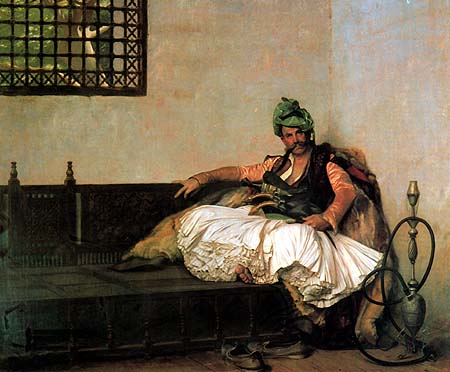
While the guards are Seven Years War Austrians from HaT, the next miniature is a Strelets bashi-bazouk. Although they've enjoyed a long afterlife as an insult hurled by Herge's Captain Haddock, the historical bashi-bazouks were irregular Ottoman soldiers paid only in plunder - a close analogue to RPG adventurers, in other words. Murderhobos especially: the bashi-bazouks were responsible for some heinous atrocities in various campaigns.

Bashi-bazouk chieftain (Jean-Léon Gérôme)

Bashi-bazouk (Stanislaw Chlebowski)

They also cut quite a dash, as the Orientalist paintings of Jean-Léon Gérôme and Stanislaw Chlebowski make plain. And they were always armed to the teeth. This fellow will work well as a PC or perhaps an NPC brigand. 


I also added to the dangers of the Underworld in this scale with a very quickly painted stone golem from Reaper Bones. A bit of a handful for either guards or adventurer, I suspect ...


Tuesday, 19 November 2019

A snake in the ... sand


Giant snakes make for good wandering (or more accurately, lurking) monsters. This one's a Reaper Bones 28mm beast. No doubt he'll see action in various scales, but for now he's earmarked for 1/72 gaming. 

This was a ridiculously quick paintjob using GW's contrast paints over drybrushing. Nothing fancy, then, but he looks suitably generic - something that's useful for RPGs where the same threats might be encountered more than once in a given area ("The ruins are infested with serpents of great size ...").


Monday, 18 November 2019

Up from the sewers - 1/72 ratmen


I painted these Caesar ratmen over the weekend. They're remarkably quick to paint, being scruffy and presumably dirty, and the Caesar soft plastic holds paint extremely well.

A few years ago, I painted another dozen or so. Initially, those were based on square Warhammer-style bases to serve as "lesser ratmen" alongside 28mm Skaven in Song of Blades and Heroes. I then  rebased them on pennies to serve as large (gnoll-ish) monsters in a 15mm RPG campaign. And more recently, I rebased them on Hordes of the Things element bases, reasoning that they could work with both 15mm and 28mm figures as either a warband of big creatures or one of small but vicious ones.

Now, though, I'm thinking about rebasing them again to join this batch. It wouldn't take long and would give me plenty of RPG baddies and two full Dragon Rampant units (six scouts and 12 light infantry or fierce foot).

Sunday, 17 November 2019

1/72 troll


A quick Dark Alliance troll to keep these little dirt-dwellers company.


Friday, 15 November 2019

1/72 orcs and hyena


Here's a Caesar orc and a Dark Alliance one, the latter mounted on some sort of hyenadon.

I'm having a go at painting up the Caesar orcs as some sort of subhuman Bronze Age marauders: Fomorians, perhaps, or Gloranthan Tusk Riders (dismounted).


The nice thing about 1/72 is that you get lots of duplicates in a pack. That creates scope for creating several warbands from the same box, each distinguished by a different paintjob. 

I wonder if the Caesar orcs might also work as Gloranthan dark trolls, if painted appropriately. They're roughly the right size (7' if they stood up straight). At this scale, the niceties of muzzle length are less of a problem than they would be in 28mm.


The hyena rider is the first of several. I painted him ages ago, but only got round to the base last night. 


A key advantage of 1/72 is the ability to get cavalry done relatively quickly: our 28mm forces boast only a handful of wolfriders and the odd dinosaur rider among hundreds of infantry. So I'm increasingly looking to 1/72 for Dragon Rampant and Of Gods and Mortals and similar games.


Friday, 25 October 2019

Dark Alliance goblins (1/72)


Here's the first batch of five goblins for my 1/72 RPG project. In The Fantasy Trip, where any combat encounter can pose a significant risk to the health of the party, this lot are a fairly serious threat - especially underground and in the dark!


Monday, 21 October 2019

More 1/72 monsters

The Ogre King
Another decent source of 1/72 monsters is the old Mithril range of Middle Earth miniatures. Many people love these; I'm not so keen. I always found them a little bland (and I was bemused by the fact that all the orcs were unshod).

Like the Wizkids D&D miniatures, they're more realistically proportioned than 'heroic' 28s, which makes them a nice fit as ogre-sized creatures in 1/72. I have perhaps a dozen of the orcs kicking around, including some children and the Great Goblin (above). Alas, I don't have the standing version, although I do have another similar uruk who will fit in.

Monsters in 1/72


In an earlier post, I rambled on about the advantages of 1/72 miniatures in RPGs: in summary, huge numbers of different historical types, consistency of scale between ranges and the 'anonymity' provided by the less detailed and less exaggerated style of modelling.

Thanks to Caesar and Dark Alliance, a reasonable number of fantasy humans and humanoids are now available in the scale: goblins, elves, dwarfs, orcs, trolls, fire demons, lizardmen, ratmen, Amazons, Cimmerians and undead.

But there's a sizeable gap in these ranges: giants. Large humanoid monsters - ogres, regular trolls (the Dark Alliance ones are enormous), giants, ifrits, jinn, minotaurs and so on - are missing.

The obvious thing to do is to plug this gap with 28mm miniatures. But not all of those 'read' well with 1/72 figures. The Wizkids D&D range (Nolzur's Marvellous Miniatures) do, though.

These miniatures are realistically proportioned. Perversely, that makes them look a little odd next to 28mm figures in 'heroic scale', where hands and faces are enlarged like those of a haptic homunculus. It also makes them quite bland next to most other fantasy 28s. But for those reasons, they look just right with 1/72. They're bigger, but they're stylistically similar in a way that Games Workshop (for example) aren't.

The Wizkids miniatures also have the stubborn mouldlines that some 1/72 figures have. Again, that makes them less suitable for 28mm scale, as they look a bit rougher and readier than hard-plastic or metal figures that can be cleaned up properly. But that roughness is much less of a visual handicap at the smaller scale (visual expectations already being dampened).

The D&D line comes mainly in pairs. It's best when they're of different creatures, as with the wereboar and werebear above and below, or the yuan-ti malisons (a snake-bodied man and a snake-headed man). But there's nothing wrong with a pair of ogres (i.e. Whizkid orcs) or twin giants (the Cursed One, whoever he is).


I've scanned through the Wizkids range, and there seems to be at least a dozen packs that would provide good 1/72 monsters. They're available in my local branch of Blackwells, which makes them cheaper than most 28mm miniatures too.

Thursday, 17 October 2019

Robbers on the road


I don't recall coming across the term road agent before I read Cormac McCarthy's The Road. It means a highwayman or robber of stage coaches. And it's got a wonderfully sinister tone - amplified in McCarthy's tale by the fact that his road agents are murderers and cannibals too

Murderous robbers play a big part in the Greek myths. As I put together a campaign with an ancient-world flavour, I've been thinking a bit about these. The best examples are the eccentric murderers encountered by Theseus on the road to Athens: Sciron, Procrustes and the rest.

These robbers get up to all sorts of unsavoury tricks. They stretch people to fit beds - or lop off their limbs to do the same. They kick people from cliffs, or wrestle them to death, or beat them with cudgels, or tear them apart with trees.

They also provide a tremendous template for RPG encounters. The PCs need to get somewhere, but there's an obstacle in their road. They can go round it (creating an opportunity for wilderness or maritime adventures) or they can go through it.

That entails dangers. Here's Plutarch on the robbers on Theseus's road to Athens:

For verily that age produced men who, in work of hand and speed of foot and vigour of body, were extraordinary and indefatigable, but they applied their powers to nothing that was fitting or useful. Nay rather, they exulted in monstrous insolence, and reaped from their strength a harvest of cruelty and bitterness, mastering and forcing and destroying everything that came in their path. 

Some of these robbers are demigods or literal monsters, like the cyclopean club-wielder Periphetes. Some of them also guard entrances to the underworld and consort with monsters: a giant sea turtle or a savage giant boar.

While the brief ancient texts can imply that these robbers were solitary individuals, some have families with them, and it's easy to imagine them holding court among thronging followers: as bandit chiefs rather than solitary brigands. That adds further scope to an RPG encounter: approaching the haunts of an infamous bandit might involve ominous portents, surly guards and obsequious underlings. Think of Jabba the Hutt's palace - or Kurtz's lair in Heart of Darkness:

Now I had suddenly a nearer view, and its first result was to make me throw my head back as if before a blow. Then I went carefully from post to post with my glass, and I saw my mistake. These round knobs were not ornamental but symbolic; they were expressive and puzzling, striking and disturbing—food for thought and also for vultures if there had been any looking down from the sky; but at all events for such ants as were industrious enough to ascend the pole. They would have been even more impressive, those heads on the stakes, if their faces had not been turned to the house. Only one, the first I had made out, was facing my way. I was not so shocked as you may think. The start back I had given was really nothing but a movement of surprise. I had expected to see a knob of wood there, you know. I returned deliberately to the first I had seen—and there it was, black, dried, sunken, with closed eyelids—a head that seemed to sleep at the top of that pole, and, with the shrunken dry lips showing a narrow white line of the teeth, was smiling, too, smiling continuously at some endless and jocose dream of that eternal slumber. 

An encounter with a road-agent of the sort that Theseus faces might, in a gaming session, include interactions with all manner of ne'er-do-well, opportunities for audiences with the monstrous bandit-king himself, and the chance to witness a horrific execution - or become an involuntary participant in one ...

1/72 hoplites


These are the first 1/72 figures completed for my new RPG project. Nothing fancy - but quick to paint and, when seen on the tabletop, they'll "do".

They'll probably be player-characters, but could well end up as henchmen or villains too.

One thing about this scale is that you can do quite a lot of "conversion" with paintwork alone. I may well paint up some of the duplicates as ghosts or undead in corroded armour and with pallid flesh.

Saturday, 12 October 2019

Enter 1:72 - and a protocol for miniature use in RPGs

Converted lizardman from Caesar; hoplites from Zvezda

Miniatures are a bit of a double-edged sword in RPGs. On the one hand, they provide focus for the players and create lots of tactical options in combat situations. On the other, they can erode the 'theatre of the mind' that's such an attractive feature of the game.

Most of the miniatures I own are the standard 28mm sort. A couple of years ago, though, I ran a Whitehack campaign using 15mm miniatures based on pennies. The smaller scale has lots of advantages: the dinner table becomes a much bigger space, and there's less of a sense of identification about the miniatures. So you hear less of "We killed that goblin last time!", because your 15mm goblin tribe probably has various duplicates on the table at the same time.

But there were disadvantages too. Painting 15mm isn't that much faster than painting 28mm, and the miniatures aren't that much cheaper - especially as you have to buy in batches, often of the same figure. And the best stuff for fantasy RPGs - Khurasan and Splintered Light - isn't readily available in the UK.

On top of that, "15mm" miniatures vary radically in compatibility with each other. I'm not a huge stickler for scale consistency, but the difference in size between "small" and "big" 15mm stuff can be enormous. That can spoil one of the main attractions of the scale: using the huge range of historical figures with fantasy ones. Alas, dwarfs and goblins from some manufacturers tower above men-at-arms and knights from others.

Also, the smaller figures don't take up much room even on a penny - so that 'crowding' is no more achievable than with 28s based on the standard 25mm round base.

And because the figures are metal, they're heavy and fragile. With reasonable success, I constructed a travel set of 15mm miniatures in a box lined with magnetic card, so that the kids and I could play skirmish games on holiday. The only problem with it was that the magnetism wasn't sufficient to keep the miniatures from rattling around in a rucksack - so that they needed a fair bit of retouching afterwards.

I'll probably rebase the lizardmen on twopence pieces

The allure of an intermediate scale
Enter 1/72. I've dabbled in this scale before, but only in monsters that are somewhat scale-agnostic, such as the Caesar lizardmen, which I've used in both 28s and 15s. But I've started to see the attractions of RPG gaming in 1/72 scale entirely.

First, 1/72 figures tend to be a lot more compatible with each other than 15mm. Yes, there are scale discrepancies between manufacturers. But they're slight. One viking or hoplite won't be twice as tall as another. That opens up a huge range of historical soldiers and civilians (1/72 ranges offer a nice array of ancient and medieval civilians). Populating a crowded marketplace or court is far more achievable.

The second attraction is cost. For between six quid and a tenner, you can get 40 or more miniatures. Yes, there'll be some repetition, but there's also a lot of variety within boxes. I bought some Italieri crusaders yesterday; the box included nine mounted knights along with multiples of eight different foot-soldiers.

And those multiples offer a further attraction: anonymous 'extras' for town guards, the local baron's men-at-arms or whatever. Compared with the characterfulness of 28mm miniatures, the unassuming nature of 1/72 figures takes some of the emphasis off the miniatures on the gaming table and back into the players' minds.

At the same time, the compatibility of the figure and their anatomically correct scaling (as opposed to the 28mm emphasis on faces and hands) adds an extra dimension of realism. And the miniatures occupy a penny base just about perfectly - allowing for a reasonable amount of crowding while still providing stability and weight. And they'll travel unscathed in my magnetised box.

Swords, sorcery and soft plastic
But the biggest attraction, for me, is 1/72's suitability for sword and sorcery. I don't much like Robert E Howard's Conan stories, which I find poorly written and heavy on the sublimated wish-fulfilment. But I do like the Hyborian blueprint of a world including lots of thinly veiled proxies for historical cultures, all thrown together with anachronistic glee. Fritz Leiber does it rather better, and so too does Howard's contemporary and correspondent Clark Ashton Smith.

The best way of representing that sort of mish-mash - ripe for games involving travelling adventurers - is to have different cultures visually represented. And 1/72 opens up a whole wealth of intriguing possibilities. Imagine these as town guards in one northern city. Or these as invaders threatening a coastal civilisation far to the south. If you want a human-centric game - or one that's set in or nodding to Glorantha or Tekumel - this is the scale to do it.

Fantasy creatures, of course, are less well represented. But Dark Alliance/Red Box and Caesar do quite a few fantasy sets: orcs and goblins of various stripes, lizardmen, ratmen, trolls, hyena-riders, fantastical barbarians and undead. And, of course, 28mm monsters will generally work fine in 1/72: they'll just be bigger (and nastier).

It's also worth noting that some of the official D&D miniatures from Wizkids are a nice fit with 1/72 stuff, because they are similarly (i..e more naturally) proportioned. This snakeman is much bigger in 1/72, but the proportions of his human elements make him a better fit in 1/72 than in 28mm.


Also, some 15mm goblins work pretty well at this scale. I reckon the little chap below is perfect for a small Middle Earth orc or a D&D goblin:


The same's true of these (rather large) 15mm frog-men:


And I'll be stripping down these Ral Partha dwarfs (painted by a friend when we were teenagers) and repainting them. They're tiny by 28mm standards, but just right for short but strong mine-dwellers in 1/72:


These old Chronicle kobolds and orcs work too (as larger and fiercer monsters at this scale - gnolls and ogres, perhaps):


I can also see lots of potential for using these in Dragon Rampant. The reduction in unit 'footprint' makes a 3'-wide dinner table a better battlefield - and assembling and painting up cavalry is much quicker. And then there's Hordes of the Things. A box of 48 miniatures (like the Dark Alliance fantasy sets, with four identical sprues of 12 figures) could be used for a couple of different factions of individually based models for RPG and skirmish games and a few elements of multi-based troops for massed-battle wargames like HotT. 

Then there's painting. I found the Caesar lizardmen exceptionally easy and quick to paint. The softness of detail is actually an advantage when it comes to painting 1/72 for RPGs, as you can blast through them without worrying too much about precision.

A protocol for miniature use in RPGs

These considerations of scale and "anonymity" have got me thinking about how miniatures are best used in RPGs. Nicely painted 28s and precise floorplans are great for dungeon crawls and one-shots, but take a lot of time to prepare. And there's the problem I brought up at the start: the way in which the tabletop props can detract from the imagined scene. That doesn't much matter in the typical dungeon crawl, but it causes problems in more sophisticated games - not least because if everything's set out in detail and represented with miniatures, everything looks like a fight.

So here's how I'm planning a forthcoming session with some old friends. I'll almost certainly use The Fantasy Trip for the game, because of its simplicity and speed of character generation and its tremendous tactical combat. That entails a hex grid, so I'll get one of the Chessex dry-erase maps. The smaller scale of the 1/72 miniatures will compensate for a grid size that's smaller than the TFT standard. 

Now, what I want from an RPG session is plenty of roleplaying. But if there's to be fighting, I want that to be intense and tactical - essentially a mini-wargame for players and GM alike, with both sides aiming to win. Of course, I'll allow and encourage any convincing stratagem that interrupts the normal flow of combat. 

To balance that with role-playing and 'theatre of the mind', I won't use the dry-erase markers until swords are drawn. The players will know they're in a large audience chamber or a cramped tomb or whatever, but until they have a fight on their hands, I won't sketch it on the grid or place miniatures to represent NPCs. 

That should have two important effects. First, the players will process the monsters and NPCs as they're described before they see how they're represented on the table - if they see that at all. And second, rather than every encounter looking like a fight, as it does in a floor-plan-assisted dungeon crawl, every encounter will appear a role-playing opportunity. Only if that leads to fighting will I quickly sketch in the scene, place a few props and - finally - plonk the baddies down on the table.