Monday, 2 March 2026

Ghosts and goblins


 Here's the latest member of my growing troupe of night goblins. With these creatures, I'm aiming for a folkloric approach: eerie creatures of the Otherworld rather than mundane subterranean soldiers. 


In light with that approach, I kitbashed a leader for the goblins from a Games Workshop ghost and some night-goblin parts. In folklore, the distinction between ghosts and goblins isn't necessarily clear, so I thought a sinister fairy might benefit from appearing rather ethereal. 

I've got a few other conversions and kitbashes awaiting paint; some of these have tails or animal heads. I'm also planning a few larger bases of two or three figures for use in "large skirmish" games. 

Thursday, 26 February 2026

A Chronicle hobgoblin


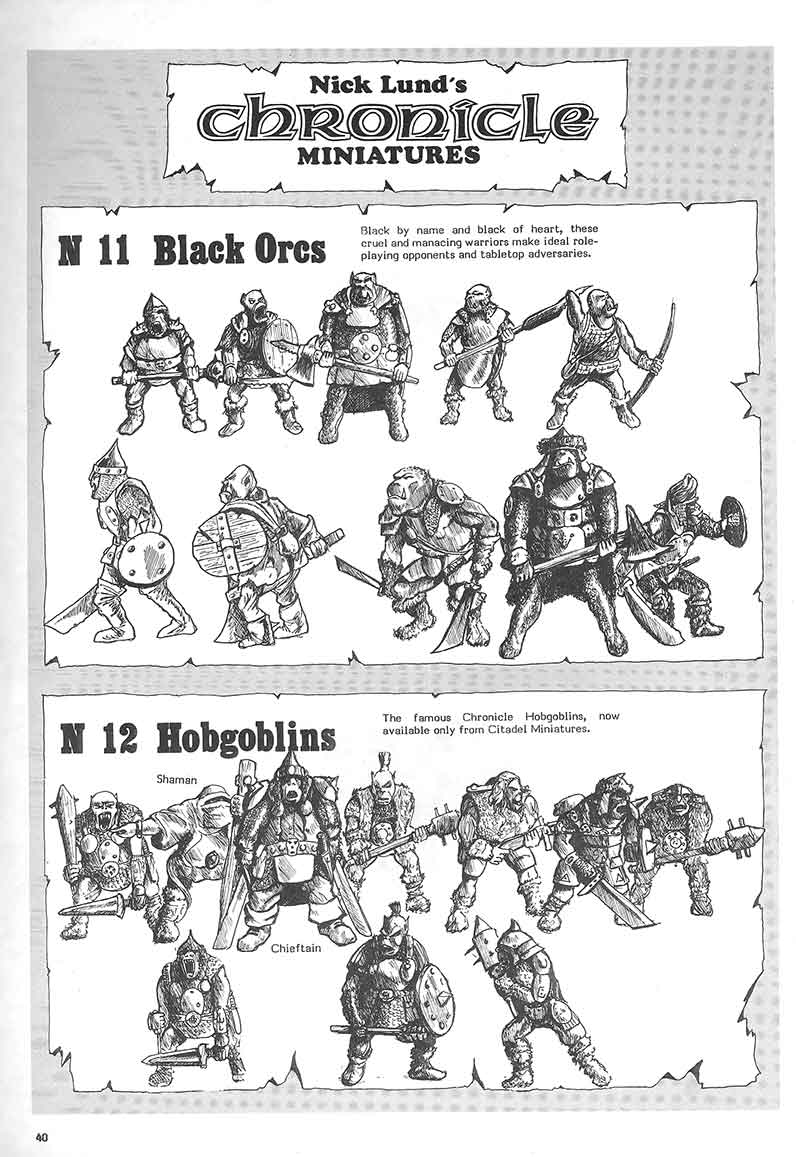
 Here's a blast from the past: one of Nick Lund's Chronicle hobgoblins, which were produced by Citadel in the early 80s. 


When I was a child, these were some of the most sought-after miniatures for their sheer heft and menace. They were also a staple of the Joe Dever/Gary Chalk armies that featured in White Dwarf and the like at that time.


 The later, slottabased Chronicle range were finer sculpts with plenty of attractions of their own, but they lack the bulk and brutality of the earlier range:


Tuesday, 24 February 2026

First game of Elf, Knyghte, Pyke, Sworde


 Last night, my son and I played an introductory game of Nordic Weasel Games' Elf, Knyghte, Pyke and Sworde (EKPS). I've been impressed by various other Nordic Weasel systems (Shoot People in Space, Squad Hammer, etc.) and liked the sound of a game that catered to a slightly smaller warband size than Dragon Rampant. I always struggle with getting enough cavalry painted, so the idea of having units of as few as three horsemen was appealing. 


We played a fairly simple straight-fight scenario, with four dwarfs, three musket-toting ladies, three zebra riders and a couple of individuals facing off against six orc archers, six orc light infantry, three hobgoblin wolf riders and another brace of characters. 


The game played out pretty fast. We got a few things wrong - chiefly with the morale rules, where we initially failed to realise that a passed bravery test exempts you from further tests that turn. But we know now. 


One thing I'd wondered was whether the move rates (5" for most infantry, 4" for orcs and dwarfs) would be a bit sluggish in 28mm. But the game proceeded at a fair crack, and running helped (extending those moves to 7.5" and 6", respectively, at the price of fatigue for most troop types). We played on 3' x 3', but I think those move rates would work find on a 6' x 4' table: there'd probably be a lot of running and exhaustion initially, before troops rest and slow down before engagement. 

I really liked the way in which the game uses groups: they aren't bound to keep together but are at greater morale risk if they don't. The targeting rules for shooting worked very nicely too - individual figures matter more than in Saga or the Rampant series, so that units aren't just 'blobs'. 

The Power Source system was a lot of fun (we just had Might, Luck and Leadership and only used the first of these), with lots of potential for heroic feats without unbalancing things: the ticking clock as Might points were exhausted by heroes surrounded by foes was exciting. 

The different troop types were nicely differentiated too. In EKPS, you have set profiles (like HOTT or Frostgrave: Polearm, Missile, Great Weapon, Skirmisher, Shield, Fantastic, etc), but these combine with profiles for various creatures, which are in turn divided into sub-types (Ranker, Veteran, Armoured and so on). So you can build lots of different profiles through the combinations. 

As an example, there are no profiles for lizardmen. But you could easily start with an armoured orc, hobgoblin or beastman and work from there to get a suitably tough and scaly set of stats. 

We'll certainly play again soon. The PDF is packed with all kinds of delights (scenario generators, RPG elements, a "combat RPG" approach with a games master and plenty more), so we've only skimmed the surface so far.

For me, the game's a great incentive to paint up all kinds of interesting old miniatures of which I have too many for a SOBH warband but not enough for a Dragon Rampant retinue (without fiddly dependence on reduced-model counts) or Saga army. I'm thinking of Citadel preslotta dark elves, dwarfs, lizardmen and troglodytes, hobgoblins and Slann - and as mounted troops can have their mounts shot from under them, there's plenty of potential to use all those Citadel foot-and-mounted personalities from the golden age ...


Monday, 23 February 2026

The People of the Toadstools - the and some very old dwarfs


I'm planning a goblin warband in a wild variety of colours: like Arthur Rackham's goblins, in all their variety, but with much brighter hues. I always liked this line from CS Lewis's White Witch: 

"Call the Cruels, the Hags, the Spectres, and the People of the Toadstools."

These nasty little sprites could be Cruels or the People of the Toadstools/

I also recently finished some very old Citadel dwarfs: Fantasy Tribes figures from the early 80s:


Sunday, 22 February 2026

The Alzabo from The Book of the New Sun


This is my son's take on the Alzabo, a monster from Gene Wolfe's tremendous The Book of the New Sun. 

Monday, 9 February 2026

Some weekend Dragon Rampant (second edition)


 A friend was up at the weekend, so we played a couple of games of Dragon Rampant, using the second edition for the first time. This is the Yellow Watcher scenario; we used my son's King in Yellow as a suitably disturbing Watcher. 

We then played the Grisly Bloodfeud on the Plains of Death scenario. Both games were losses for me, but both were plenty of fun. The new scenarios worked pretty well; the Grisly Bloodfeud has just enough of a twist on the standard straight fight to make things interesting.


We tried out some of the new rules, including larger units and the hewing champion. They worked nicely, adding a bit of extra variety to unit performance. 


All in all, there was plenty to encourage me to get on with basing up some units in a 3, 2, 1 format for faster movement, something I've had on the back burner for a while. 


Friday, 6 February 2026

An expanded Cult of the Possessed


 A while back, I painted up a 'minimalist' Cult of the Possessed for Mordheim. The minimalism took the form of a black undercoat with a couple of drybrushes with heads painted in a few layers of red (with yellow ink highlights) and weapons and some other accoutrements painted in green (with white ink highlights). 

Last year, I added a few more figures to the warband, including an old Citadel chaos sorcerer, a Citadel orc, a Ral Partha hillman, some GW film-tie-in Hobbit goblins and some Shieldwolf forest goblins. I also finished off a tyranid kitbash to serve as a medium-sized demon. So here they are, with the originals.


Tuesday, 20 January 2026

Giant goblins old and even older

These two miniatures were designed within a year or so of each other, both by Tom Meier. Both are "giant goblins" (i.e. Uruk-hai), the elder from the Wizards, Warriors and Warlocks range, and the latter from 1979's Fantasy Collector Series. 

The right-hand figure is obviously much more advanced sculpturally and is part of a classic range. But I rather like the cruder but charming earlier figure. For roleplaying games especially, I think simpler, older miniatures are often better than their modern equivalents: they leave more room for the imagination.


.


Monday, 19 January 2026

A Ral Partha giant goblin


 Tom Meier's Ral Partha giant goblins are one of the all-time great fantasy miniature ranges. They're essentially Tolkien's Uruk-hai (and sport both White Hands and Red Eyes on their banners), which are introduced in The Lord of the Rings as "goblin-soldiers of greater stature".

Ral Partha's earlier Wizards, Warriors and Warlocks range also contained giant goblins, more crudely sculpted, which bore the White Hand; the progress in Meier's sculpting style in a year or two was astonishing. 

Citadel later sold the giant goblins as "half-orcs", and Ral Partha relabelled them as "orcs" at some point. 


They're a terrific set of figures that are still up there with the best around today. They're still available from Ral Partha Legacy (and regularly on eBay), so they must be among the earliest fantasy miniatures still in production, along with Minifigs. 

Saturday, 17 January 2026

The Battle of the Five Armies for Hordes of the Things


 A little project I'm working on at the moment consists of opposing forces to fight the Battle of the Five Armies with the Hordes of the Things rules, for a friend.

These are the first few elements: a warband element for Bolg and his bodyguard, and a couple of goblin horde elements (many more to come ...). 

I'm using a mix of miniatures for the goblins: EM4, Wargames Factory, Oathmark, BattleMasters, Citadel, Warlord Games and Wargames Atlantic, at least. I'm kitbashing a lot of the EM4 figures to vary the three poses as much as I can. 


Other elements are close to completion too: Beorn (a god in HOTT terms), two bases of wolf riders and one of wargs, Dain's dwarves and Thorin and company. The other elements have been procured, so it's jut a question of working through them all now ...


A Minifigs knight


 This is a Minifigs knight that I've painted up for use in RPGs: an old-school D&D fighter, I fancy. 

I find Minifigs miniatures interesting to paint. They were sculpted with solder, I believe, so they're quite unlike modern miniatures, and there's plenty of room for freehand and imagination. I think they also work particularly well for RPGs for the same reason: there's no oversupply of detail, so there's plenty of scope to imagine what the character looks like aside from the miniature representation. 


I'm experimenting with a very basic form of non-metallic metal on these figures; I hope to improve as I go. As they're based on 20mm squares, they'll also form up nicely in threes as Hordes of the Things elements with 60mm frontage. I plan to base cavalry on 20 x 40mm for that reason and to make them more manoeuvrable in RPGs (big bases are quite limiting in that regard).


I've got quite a lot of Minifigs knights to work on (eBay acquisitions over the years). I'm also going to be using other old-school figures in the same project: Lamming, Heritage and very early Ral Partha (the cruder Wizards, Warriors and Warlocks range from before Tom Meier really hit his stride).

Thursday, 1 January 2026

Fangor Gripe and friends


 These are three retouched orcs finished today. I originally painted Fangor Gripe, the cyclops-orc, seven years ago: you can see him here. The early photos flatter the old paintjob; he looks a lot better now in the 'flesh' and considerably less washed out. My previous post shows the female orc on his left; the orc chieftain on his right was first painted around 1991 and is also shown in that post in his decades-old state. 


Fangor is a classic from the first Citadel range of slottabased orcs. These are among my favourite miniatures. 

The chieftain with sword and flail is an earlier Fantasy Tribe orc. His sword was broken when I acquired the figure in the late 80s or early 90s, and I replaced it with one that might have been cut down from a bit of scrap or something. The Fantasy Tribe orcs followed the AD&D Monster Manual in the weapons they =carried. 


Improving a decades-old paintjob to start 2026


This is an old Citadel armoured orc from the early 80s. It appears to be a female orc - a real rarity from Citadel - judging by the ample bosom beneath the hauberk (and perhaps the unusually long hair), although the head and most of the body were used for male orcs elsewhere in the range.

I painted this figure when I was a teenager, to form part of my first Hordes of the Things army. You can see her (?) below here:


Fairly recently, I rebased these orcs individually. I've decided to touch up their teenage paintwork a little bit. On the evidence of this morning, it doesn't take long - and I'm pleased with the results:


All I did was wash the flesh with Army Painter Strong Skin Shade, highlight the flesh a couple of times with magenta washes over the nose and lip beforehand, redo the eyes (I prefer glowing red eyes on my orcs as the one unifying factor in their otherwise disparate appearance) and add a few other highlights here and there.


I think there's an undeniable improvement from the paintwork of almost 35 years ago:


Next up is the fellow on the right!